
EXPERIMENTAL ANALYSIS OF A VORTEXING CFB FOR PROCESS INTENSIFICATION VIA HIGH-G FLOWS
Michael Bobek1,2, Jingsi Yang1,2, Justin Weber1, Frank Shaffer1, Ronald W. Breault1
1Nattional Energy Technology Laboratory, Morgantown, WV, USA 26507
2Oak Ridge Institute for Science and Education, Morgantown, WV, USA, 26507
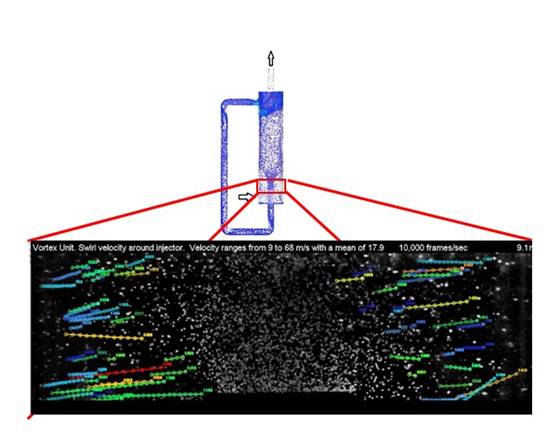
Fluidized beds are used in many industries for their favorable characteristics of good solids mixing, high rates of heat and mass transfer, and large throughputs. In the never-ending challenge of increasing efficiencies one avenue is through process intensification, specifically this work focuses on high-g flows, flows with the centripetal force typically on the order of 10 times the force of gravity. This operating regime provides intensified gas-solids contact through higher mass transfer, heat transfer, and gas throughput. This work focuses on an experimental analysis of a cold flow vortexing circulating fluidized bed. Through mapping the pressure distribution in the riser and utilizing high speed cameras to track particle behavior the insights into the behavior of the system were made and compared to barracuda CFPD modeling of the system. The figure below shows the high-speed video particle tracking, with results from the video analysis calculating particle velocities in the vortex of around 19 m/s and particle velocities of 1 to 2 m/s as they leave the recirculation section.
See more of this Group/Topical: Particle Technology Forum