
CFD Analysis of Pilot-Scale Multitube Pd Membrane Module for Hydrogen Purification from Coal-Derived Syngas
Rui Ma1, Bernardo Castro-Dominguez2, Ivan P. Mardilovich1, Nikolaos K. Kazantzis1, Anthony G. Dixon1, Yi Hua Ma1
1.Center for Inorganic Membrane Studies, Department of Chemical Engineering, Worcester Polytechnic Institute, 100 Institute Road, Worcester, MA 01609, USA.
2. University of Limerick, Sreelane, Castletroy, Co. Limerick, Ireland
Syngas production and hydrogen separation technologies are very mature, and also extremely important for the energy and chemical industries. Enhancing or intensifying these mature technologies is extremely challenging, but on the other hand would have tremendous impact on performance and economics of many processes. At this moment, most research on Pd membrane technology has been conducted at lab scale, and membrane module scale up and commercial unit design are still challenges that need to be addressed in order to commercialize this promising technology. Compared with the one shell, one membrane tube module, many questions need to be answered for a pilot scale, multitube membrane module, such as the study of tube to tube variation in hydrogen permeation due to the position in the module, the exploration of the optimal shell side operating conditions and the evaluation of mass transfer limitations such as concentration polarization. For this purpose, a three dimensional CFD simulation model was developed and used to study the aforementioned aspects of a pilot scale membrane module.
The geometry of a seven-tube module with a total permeable area of 1050 cm2 is shown in Figure 1a; coal-derived syngas was introduced to the shell side (retentate side) and pure hydrogen was collected from the tube side (permeate side). The asymmetrical fluid flow (Fig 2a) resulting from the outlet location leads to an uneven hydrogen permeation rate in each membrane tube (Fig 3). By adding a manifold for the membrane tubes in between the membrane tubes and the outlet (Fig1b), fluid flow tends to be more symmetrical (Fig 2b.), hydrogen permeance flux of each outer tube appears to be more even (Fig 3), thus the membranes are used more efficiently. In addition, due to the competition effect of the center tube with the six tubes around it, the center tube has the lowest hydrogen permeance flux. This phenomenon was addressed more in detail by the study of a further scaled-up module with 19 membrane tubes and a total permeable area of 2850 cm2 (Fig 4). Concentration polarization was also observed from the model and indicated by the second Damkohler Number. Furthermore, hydrogen recovery appears to be favored by high pressure and low temperature while membrane usage benefits from moderate pressure and high temperature, the trade-off between these two most important parameters of membrane modules is investigated and a thorough process optimization study was carried out using Box-Behnken method.
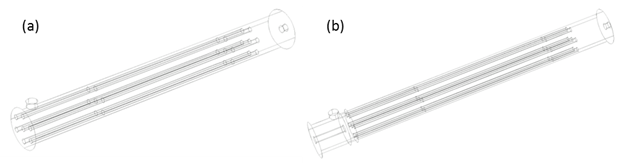
Figure1. Geometry of the 7 membrane tube module: (a) without manifold (b) with manifold
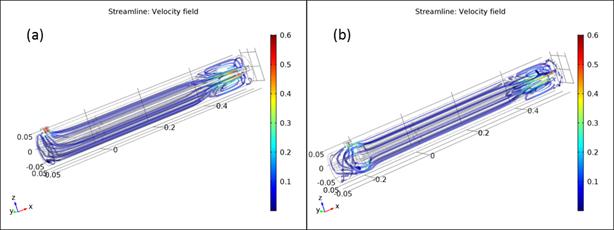
Figure2. Velocity field of the 7 membrane tubes module: (a) without manifold (b) with manifold
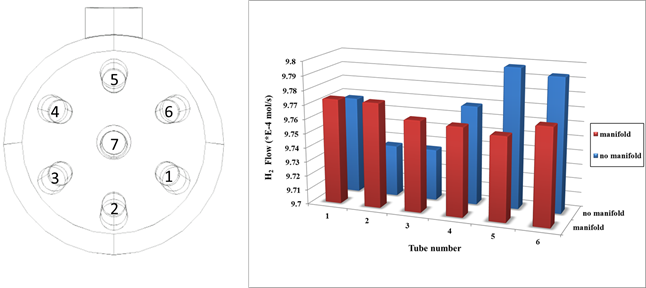
Figure 3. Hydrogen permeance flux of the outer tubes with different geometry
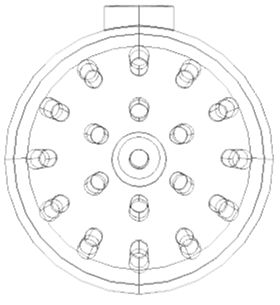
Figure 4. Cross sectional view of the 19 membrane tubes module
See more of this Group/Topical: Topical Conference: Advances in Fossil Energy R&D