
Redox-directed self-assembly of 2D semiconductor nanoantenna heterostructures with enhanced damping and nonlinear activity
D. Keith Ropera,b*, Greg T. Forcherioc, Jeremy R. Dunklind, Mourad Benamarae, Luigi Bonacinaf
a Microelectronics and Photonics Graduate Program, University of Arkansas, Fayetteville, AR 72701
b Department of Chemical Engineering, University of Arkansas, Fayetteville, AR 72701
cArmy Research Laboratory, Adelphi, MD 20783
dNational Renewable Energy Laboratory, Golden, CO 80401
eInstitute for Nanoscience and Engineering, University of Arkansas, Fayetteville, AR 72701
f GAP-Biophotonics, Université de Genève, Genève, CH 1211
Two-dimensional (2D) semiconductor heterostructures offer compelling new functionalities, e.g., gate tunability of p-n junction, valleytronics and anti-ambipolarity as well as unique optical, electronic and transport properties attributable to distinct atom-scale heterointerfaces. These features could enable atomically-thin flexible integrated circuits, field effect transistors and closed-loop resonators. However, directed self-assembly of 2D semiconductor nanoantenna heterostructures is limited by lack of computational descriptions of fundamental optoelectronic properties integrated with novel self-assembly processes and microscopic and spectroscopic analysis to confirm enhanced functionality.
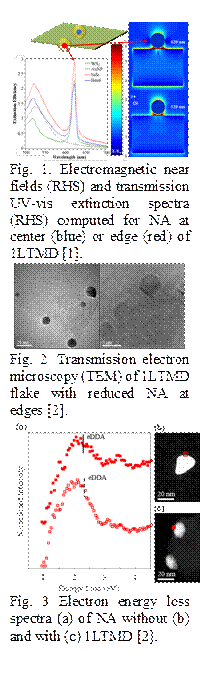
This work examined a new redox approach to direct self-assembly of nanoantenna (NA) at active heterointerfaces of monolayer (1L) transition metal dichalcogenides (TMD) to modulate electron transfer and nonlinear activity. Discrete dipole approximation (DDA) was used to analyze local electromagnetic near fields and transmission ultraviolet-visible (TUV-vis) extinction spectra (Fig 3) of NA and 1LTMD to identify optimal heterostructure architecture. The electrochemistry of solution-based metal electroless plating was adapted to self-assemble heterostructures of 1LTMD and NA by reducing metal salt directly onto exposed edges of solution exfoliated TMD (Fig 2). Nanometer- and femtosecond-resolved electron energy loss spectroscopy (EELS) was used to simulate and measure low-energy NA plasmon modes, damping and electric near fields at the heterointerfaces (Fig 3).
DDA (Fig 1) of local electromagnetic fields and field extinction spectra of 1LTMD-NA heterostructures predicted higher optoelectronic activity and tunability for NA assembled at 1LTMD edges. Transmission electron microscopy (TEM; Fig 2) and x-ray photoelectron spectroscopy (XPS) confirmed atomic structure and chemical bonding, respectively, of NA reduced directly onto 1LTMD flake edges for the first time. EELS (Fig 3) showed enhanced plasmon damping resulted from metal-chalcogenide covalent bonds at the 1LTMD-NA heterointerface. Comparing plasmon damping with computed inelastic population decay due to radiative and intraband mechanisms indicated local electron injection through a Landau mechanism. Quantum efficiency of injection was up to eleven percent. Mid-bandgap edge states increased likelihood of nonlinear activity in exfoliated 1LTMD. A tunable femtosecond laser system for Hyper Rayleigh Scattering (HRS) was used to measure second order nonlinear coefficient of 1LTMD and NA-1LTMD heterostructure. Nonlinear susceptibilities for 1LTMD exceeding those of conventional materials by >102 pm/V with concomitant increases in second harmonic generation (SHG) intensity and two-photon absorption probability were characterized [3].
Overall, DDA, TEM, XPS, EELS and HRS were coordinated to guide and characterize a novel method for redox-directed self-assembly of 1LTMD-NA heterostructures. Results confirmed features of the new heterostructure architectures including enhanced optoelectronic activity. Coordinated use of these tools offers a new integrated approach to tune damping, electric near-field and intrinsic nonlinear activity at nanoscale heterointerfaces.
[1] J.R. Dunklin, D.K. Roper et al., in preparation. [2] G. T. Forcherio, J.R. Dunklin, D.K. Roper et al., in submission. [3] G. T. Forcherio, D.K. Roper et al., in preparation.
See more of this Group/Topical: Nanoscale Science and Engineering Forum