
The oxidative dehydrogenation of propane (ODHP) as a method of “on-purpose” propylene production has the potential to be a game-changing technology in the chemical industry.[1] However, even after decades of research establishing supported vanadium oxide (V/SiO2) as the state-of-the-art catalyst for ODHP,[2,3] selectivity to the olefin product remains too low to be commercially attractive because of overoxidation of propylene into CO and CO2 (COx).
Here, we report that hexagonal boron nitride (h-BN) and boron nitride nanotubes (BNNTs) are highly selective catalysts for the ODHP reaction.[4,5] Despite structurally similar materials (graphene and carbon nanotubes) showing catalytic activity for partial oxidations in recent years, BN materials have yet to be explored for their own catalytic activity. Both h-BN and BNNT are among the most-selective catalysts reported for ODHP (Figure 1A). Aside from only propylene, it is equally interesting to compare the complete product distribution between BN and V/SiO2 catalysts (Figure 1B). While the main byproducts of V/SiO2 are overoxidized products COx, the main byproduct of h-BN and BNNT is ethylene, another important small olefin. For reasons that are still under investigation, BN materials are able to largely avoid the overoxidation reaction pathway.
We have kinetic evidence for an Eley-Rideal reaction mechanism when using h-BN, showing the rate of propane consumption dependent on the adsorption of oxygen and second order with respect to PC3H8. Our spectroscopic investigations tell us the surface of h-BN and BNNT is functionalized by oxygen only when exposed to ODHP reaction. Considering these insights, as well as previous DFT studies investigating stable O-terminated BN armchair edges, we calculated reaction intermediates suggesting the reaction active site may be a peroxo-like >B-O-O-N< armchair edge.
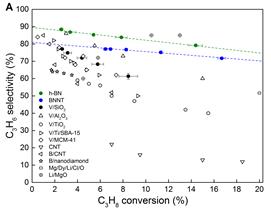
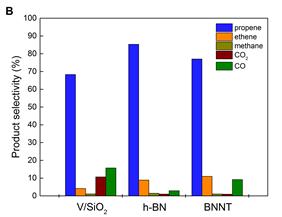
Figure 1. (A) Selectivity to propylene plotted against propane conversion for ODHP, comparing h-BN (green), BNNT (blue) and V/SiO2 (black) to previously reported catalysts (open shapes); (B) Comparisons of product selectivity between V/SiO2 (XC3H8=5.8%), h-BN (XC3H8)=5.4%) and BNNTs (XC3H8=6.5%). Product selectivities are represented by colored bars.
References
1. T. Degnan, Focus on Catalysts, 2 (2016) 1
2. C. Carrero, R. Schlogl, I. Wachs, R. Schomaecker, ACS Catal., 4 (2014) 3357
3. J. Grant, C. Carrero, A. Love, R. Verel, I. Hermans, ACS Catal., 5 (2015) 5787
4. J. Grant, C. Carrero, F. Goeltl, J. Venegas, P. Mueller, S. Burt, S. Specht, W. McDermott, A. Chieregato, I. Hermans, Science, 354 (2016) 1570
5. J. Grant, C. Carrero, J. Venegas, A. Chieregato, I. Hermans, US Patent Application 15/260,649; Filed September 9, 2016.
See more of this Group/Topical: Catalysis and Reaction Engineering Division