
Economic and Energetic Analysis of Biofuel Supply Chains
Rex T. L. Ng1,2 and Christos T. Maravelias1,2
1Department of Chemical and Biological Engineering and 2DOE Great Lakes Bioenergy Research Center, University of Wisconsin-Madison, Madison, WI
The efficient and effective transportation of lignocellulosic biomass is one of the critical challenges in biofuel production, due to its low bulk density and durability properties. Generally, in a biofuel supply chain (SC), baled biomass is either transported to a biorefinery directly, or sent to a depot for densification prior to transporting densified biomass to a biorefinery [1]. Many studies show the installation of depots in biofuel SCs offer better economic performance in large scale biorefineries [2–4]. However, from an energy point of view, depots may be infeasible if the total primary energy input (e.g., biomass harvesting and collection, depot operation, and baled and densified biomass transportation) is higher than the energy content of biofuel.
To better understand what supply chain configurations are preferable under different scenarios, we develop systematic methods to compare the cost and energy efficiency of biofuel SC under different configurations. We define a configuration as a combination of depot selection (with and without depots) and transportation modes (truck and rail). The analysis aims to provide some insights into the following questions: When should we ship biomass directly to the biorefinery? When depot is economically and energetically feasible? Which transportation mode yields low cost and high energy efficiency? What is the trade-off between the improvement of densification technology and cost or energy efficiency?
In this analysis, we consider corn stover which is collected from 12 Midwest states in the US. We assume that corn stover productivity is on an annual basis. A high moisture pelleting process [5] is employed at the depot, while dilute acid pretreatment, separate hydrolysis and fermentation are employed at the biochemical biorefinery [6]. Note that the analysis can be repeated using the proposed method for any feedstock, technology, and type of productivity (annual, seasonal or monthly basis). We estimate the minimum ethanol selling price (MESP) and total energy input based assuming the feedstock collection area to be circular with the biorefinery or the depot located at its center. When a combination of two or more configurations leads to better economic or energy benefits (referred to in this work as ‘hybrid configuration’), the average distance from depots in the annular area to the biorefinery at the center is estimated.
The results show what reductions in cost and energy input can be achieved through a hybrid configuration (Fig. 1A). From an economic point of view, direct shipment of baled corn stover (orange region) is preferred if the distance between biorefinery and harvesting site is lower than 155 km. Depots installation and truck transportation of densified corn stover (blue region) are favorable if the distance ranges between 155 to 260 km; while rail transportation of densified corn stover (red region) will only lead to better economic benefits at larger distance (≥260 km). From an energy point of view, rail transportation of densified biomass is always better than truck transportation. The depot installations with rail transportation have lower total energy input values than those with truck shipment of baled biomass if the distance is greater than 170 km. We further discuss key cost and energy efficiency drivers: corn stover productivity, biorefinery size, and densification efficiency. The MESP decreases with the increase of productivity and biorefinery size (Fig. 1B). We will show how the improvements in densification technologies can reduce transportation cost and energy consumption.
Finally, we will briefly discuss how the finding of this study can be used to formulate tractable mixed-integer programming (MIP) models for biofuel SCs operational planning, which account for non-uniform biomass availability and other practical considerations. We will show results from two case studies in southern Wisconsin.
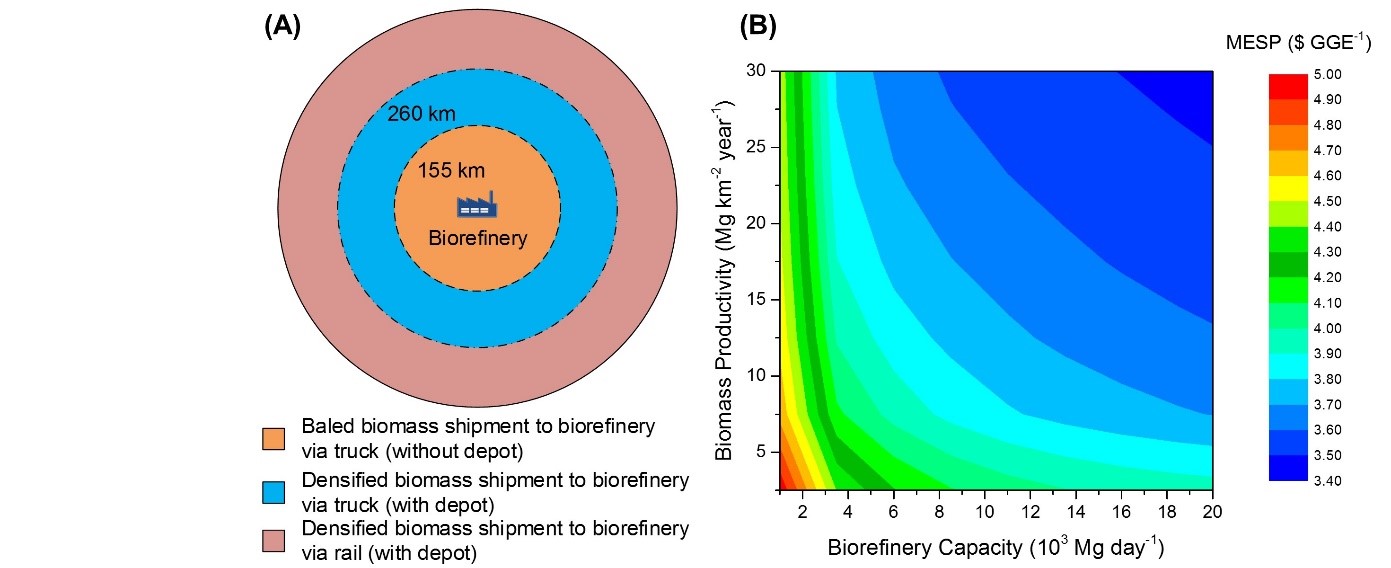
Figure 1: (A) Hybrid configuration, and (B) MESP as a function of biomass productivity and biorefinery capacity.
References:
[1] R.T.L. Ng, C.T. Maravelias, Design of biofuel supply chains with variable regional depot and biorefinery locations, Renew. Energy. 100 (2017) 90–102.
[2] D.J. Muth, M.H. Langholtz, E.C.D. Tan, J.J. Jacobson, A. Schwab, M.M. Wu, et al., Investigation of thermochemical biorefinery sizing and environmental sustainability impacts for conventional supply system and distributed pre-processing supply system designs, Biofuels, Bioprod. Biorefining. 8 (2014) 545–567.
[3] S. Kim, B.E. Dale, Comparing alternative cellulosic biomass biorefining systems: Centralized versus distributed processing systems, Biomass and Bioenergy. 74 (2015) 135–147.
[4] P. Lamers, E.C.D. Tan, E.M. Searcy, C.J. Scarlata, K.G. Cafferty, J.J. Jacobson, Strategic supply system design – a holistic evaluation of operational and production cost for a biorefinery supply chain, Biofuels, Bioprod. Biorefining. 9 (2015) 648–660.
[5] J.S. Tumuluru, K.G. Cafferty, K.L. Kenney, Techno-economic analysis of conventional, high moisture pelletization and briquetting process, in: Am. Soc. Agric. Biol. Eng. Annu. Int. Meet. 2014, ASABE 2014, 2014: pp. 4177–4189.
[6] D. Humbird, R. Davis, L. Tao,
C. Kinchin, D. Hsu, A. Aden, et al., Process Design and Economics for
Biochemical Conversion of Lignocellulosic Biomass to Ethanol: Dilute-Acid
Pretreatment and Enzymatic Hydrolysis of Corn Stover, Natl. Renew. Energy Lab.
(NREL), Golden, CO. (2011).
See more of this Group/Topical: Sustainable Engineering Forum