
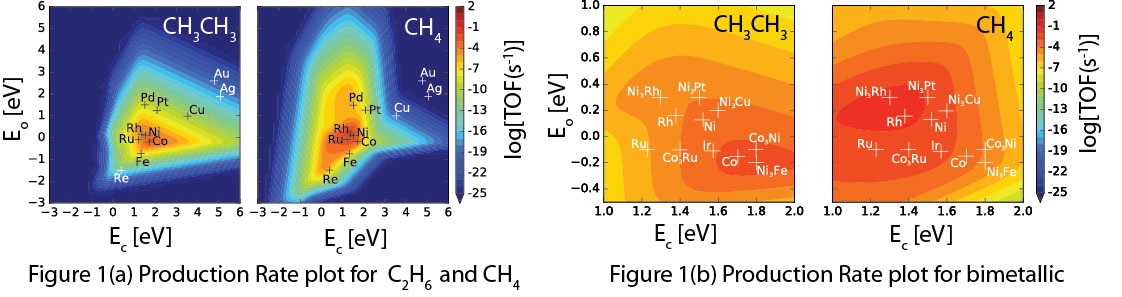
Hydrodeoxygenation (HDO) reactions constitute an essential class of biomass processing reactions employed for the catalytic deoxygenation of platform molecules. The C-C versus C-O bond cleavage plays an important role in these reactions. To gain insights into the HDO of biomass derived molecules, ethanol has been used as a model molecule. Density Functional Theory and microkinetic modelling using CatMAP1 have been utilized to determine the catalytic activity and selectivity trends of HDO reaction over stepped sites of transition state metals. For ethanol hydrogenation, various routes for decomposition have been studied: α-H abstraction, β-H abstraction, C-C, C-O, and O-H bond scission. Methane, carbon monoxide and ethane have been found to be the major products. Methane and carbon monoxide are formed upon the C-C scission and ethane upon the C-O scission in the ethanol HDO reaction. The activity trend for ethanol HDO has been observed to be: Rh > Ru > Ni > Ir > Co > Pd > Re > Pt > Fe > Cu > Ag > Au for methane production and Co > Ir > Ni > Rh > Ru > Fe > Pt > Pd > Cu > Ag > Re > Au for ethane production (Figure 1(a)). Lee et al. have experimentally determined the trend for HDO product of guaiacol to be Rh > Pt ~ Ru > Pd which is similar to the activity trend observed for ethane formation2. Rh and Ru cleave both C-C as well as C-O bonds, however, the C-C scission products have a higher turnover than the ones produced upon C-O bond breaking. At the reaction conditions, Co, Ir, Pt and noble metals are the metals selective for ethane formation. To better understand the HDO reactions, the change in catalytic activity has been studied as a function of temperature across the length of the reactor. The activity trend for the metal catalysts was observed to be the same throughout the reactor; however, at inlet conditions (373K), the activity is much smaller than that of the reaction conditions (523K). At 373K, most of the transition metal catalysts viz. Pd, Pt, Rh, Ir, Ru, Fe, Ni, Co have been found selective towards ethane production. In order to explore alloys that give a high turnover and selectivity towards desired products, a number of bimetallic have been studied (Figure 1(b)). Co3Ni and Ni3Fe have been found be the metals with the highest turnover of ethane (10-3s-1) and selectivity greater than 0.98 towards ethane. Ni3Rh has shown the highest production rate of methane, followed by Ni3Pt, Ni3Cu, and Co3Ru. The selectivity for methane on these alloys is greater than 0.9.
1. Medford, A. J., Shi, C., Hoffmann, M. J., Lausche, A. Fitzgibbon, S., Bligaard, T., Nørskov, J. K. Catalysis Letters, 145(3), 2015, 794-807
2. Lee, C., Sun, J., Suh, Y., Choi, J. & Ha, J. Catalysis Communication,17 (2012), 54-58
See more of this Group/Topical: Topical Conference: Innovations of Green Process Engineering for Sustainable Energy and Environment