
Majority of cancer deaths are attributed to metastasis, the translocation of primary tumor cells to secondary sites. Circulating tumor cells (CTCs), cancer cells found in the blood stream, are believed to be a major contributor to metastasis. Hence, enumeration of CTCs holds promise as a means of monitoring disease progression. Unfortunately, the extreme rarity of CTCs in blood samples (typically ~1 CTC per 106 blood cells) makes accurate enumeration challenging. The use of microfluidic devices functionalized with antibodies to capture and enumerate CTCs has been an active area of research for over a decade. In these devices one or more surfaces are typically coated with an antibody against the epithelial cell adhesion molecule (EpCAM), which is believed to be a biomarker for CTCs. Such microfluidic devices can reliably count the number of CTCs in blood samples at low flow rates, but the desire to increase throughput from current values of 2-3 mL/hr leads to loss of specificity towards CTCs. Furthermore, many non-CTC cells are captured in these devices, resulting in poor capture purity. Here we explore the possibility of enhancing the capture efficiency and specificity of microfluidic CTC capture and enumeration systems through the use of magnetic nanoparticles in the presence of a magnetic field gradient to improve cross-stream migration of cells towards the antibody (ab) functionalized surface of the microfluidic channels. Initial studies have focused on demonstrating this principle using cells that have uptaken nanoparticles through non-specific interactions.
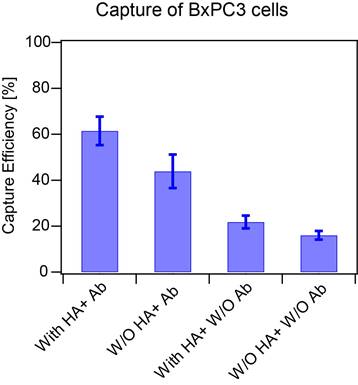
First we studied the uptake of dextran coated magnetic nanoparticles by EpCAM-expressing BxPC-3 pancreatic cells. Then capture efficiency for these cells using a microfluidic device with herringbone structure was quantified at 2 uL/s for the cases of bare and antibody-functionalized devices with and without magnetic fields. In the case of microfluidic devices coated with anti-EpCAM, in the presence of an external magnetic field created using a Halbach Array (HA), 62 % capture efficiency was found as opposed to 43 % when the device was not subjected to external magnetic field. We have currently obtained magnetic nanoparticles that can be employed to enhance the capture of CTCs at a throughput of 7.2 mL/hr.
Ongoing studies aim to develop magnetic nanoparticles conjugated with a peptide specific to EpCAM expressing BxPC3 cells. We expect such specific targeting will lead to an even greater improvement in capture efficiency and selectivity, especially in complex whole blood samples.
See more of this Group/Topical: Sustainable Engineering Forum