
DFT Studies of Intermetallic Gamma-Brass Crystal Structures for Selective Hydrogenation
Haoran He, Anish Dasgupta, Gaurav Kumar, Robert M. Rioux, and Michael J. Janik
Department of Chemical Engineering, The Pennsylvania State University, University Park, PA 16802, USA
*mjanik@ psu.edu; (814) 863-9366
Bimetallic compounds can offer tunable site electronics and ensemble structure for selective hydrogenation catalysis. In this study, we consider the γ-brass phase (Cu5Zn8 prototype), in order to expose surfaces with controlled Mx nuclearity to control the selectivity for hydrogenation. The γ-brass structure has a 52 atoms unit cell with 4 distinct symmetry sites —outer tetrahedral (OT), inner tetrahedral (IT) octahedral (OH) cuboctahedral (CO) as shown in Figure 1. In particular, the Pd-Zn γ-brass atomic arrangement as well as the substitution pattern of Zn by Pd in the Pd-Zn γ-brass phase (15.4-24%) has been extensively studied by Edstrom and Westman through x-ray diffraction analysis[1]. Surface energy calculations indicated that the most stable Pd8Zn44 facet is (1 -1 0), which exposes only monomers for Pd8, but includes Pd trimers for Pd9-11. We vary the number of Pd atoms per isolated active site and investigate its effect on H2 dissociation and acetylene hydrogenation mechanisms. DFT calculations agreed with experimental results that H2 activation is faster on trimer sites, substantiating the formation of Pd3 trimer sites on Pd9Zn43 catalyst surfaces. The activation barrier for H2 dissociation is nearly identical experimentally on Pd9, Pd10 and Pd11, further substantiating the isolation of the Pd trimer sites. DFT calculations indicate that acetylene binds strongly on both monomer bridge and trimer sites, whereas ethylene binds strongly on monomer atop and trimer side atop sites. At the same time, H2 dissociation and binding adjacent to ethylene is only possible on the trimer sites. DFT calculations showed the apparent barrier of ethylene hydrogenation is higher than the ethylene desorption barrier, which indicates Pd8Zn44 is superior catalyst in selectively hydrogenating acetylene to ethylene. Pd9-11 on the other hand, contains trimers on the surface, which can lower the ethylene hydrogenation barrier, compared with Pd8Zn44. The full path of acetylene hydrogenation on these isolated sites, as well as a microkinetic model for acetylene hydrogenation on these intermetallics, will be presented. The gamma-brass intermetallic structures offer isolated active sites with controlled nuclearity, allowing both the design of active and selective catalysts as well as the elucidation of site requirements.
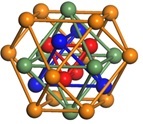
Figure 1. Illustration of the sites in the γ-brass structure: inner tetrahedral (IT, red); outer tetrahedral (OT, blue); octahedral (OH, green); and cuboctahedral (CO, orange).
References
1. Edstrom, V.A and S. Westman, X-ray Determination of Structure of Cubic Gamma Pd, Zn Phase. Acta Chemica Scandinavica, 1969. 23 (1): p.279-&. ADDIN EN.REFLIST
See more of this Group/Topical: Catalysis and Reaction Engineering Division