
Enhanced optoelectronic functionality of photovoltaic 2D crystal-nanoantenna hybrids
D. Keith Ropera,b*, Gregory T. Forcherioc, Jeremy R. Dunklind, Mourad Benamarae, Luigi Bonacinaf, Yana Vaynzofg, Claudia Backesh
a Microelectronics and Photonics Graduate Program, University of Arkansas, Fayetteville, AR 72701
b Department of Chemical Engineering, University of Arkansas, Fayetteville, AR 72701
cArmy Research Laboratory, Adelphi, MD 20783
dNational Renewable Energy Laboratory, Golden, CO 80401
eInstitute for Nanoscience and Engineering, University of Arkansas, Fayetteville, AR 72701
f GAP-Biophotonics, Université de Genève, Genève, CH 1211
g Kirchhoff-Institute for Physics and Centre for Advanced Materials, Ruprecht-Karls University Heidelberg, 69120 Heidelberg, Germany
 h Chair
of Applied Physical Chemistry, Ruprecht-Karls University Heidelberg, 69120 Heidelberg,
Germany
Two-dimensional (2D) nanocrystals (NC) offer a direct bandgap spanning the solar spectrum as well as enhanced electron mobility and gate tunability. Decoration of 2DNC by nanoantenna (NA) has enhanced measured photocurrent. But challenges in simulating, characterizing and fabricating 2DNC-NA hybrid structures has constrained their implementation in functional photovoltaic devices.
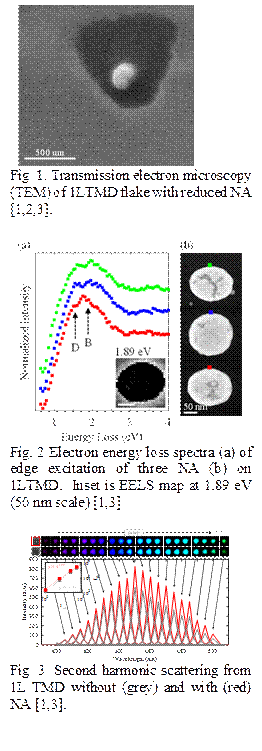
This work examined optical modulation of photocurrent, carrier injection and second harmonic generation (SHG) in 2DNC, i.e., graphene and transition metal dichalcogenide (TMD), via optically active NA. Monolayer 2DNC used were chemical vapor deposited (graphene) or liquid exfoliated from bulk (TMD). 2DNC were decorated by gold (Au) and silver (Ag) NA through three methods (i) evaporation, (ii) drop-casting and (iii) direct reduction (Fig 1; [2]). Electron energy loss spectroscopy (EELS) was used to predict and induce plasmon bright, dark, and hybrid modes. EELS enabled quantitative femtosecond-scale measurement of spectroscopic plasmon dephasing and nanometer-resolved mapping of electric fields on the 2DNC-NA hybrids (Fig 2). Coupled and discrete dipole simulations were used to characterize radiative and intraband dephasing in order to distinguish contributions to photocurrent from field enhanced electron hole pair generation and carrier injection [3]. X-ray photoemission spectroscopy was used to contrast physicochemical 2DNC-NA bonds vs. polyvinylpyrrolidone coatings representing alternate pathways for carrier injection. A tunable laser scanning confocal microscope (LSCM) was used to measure second harmonic generation of 2DNC-NA hybrids (Fig 3). A computational scaffold supporting analysis spanning atom to nanometer scales was used to develop compact structure-function relations in order to rationalize measured values.
Coordination of EELS, XPS, and LSCM offers a comprehensive approach to characterize increased photocurrent from field enhanced electron hole pair generation and from carrier injection in 2DNC-NA hybrids at high spatiotemporal resolution.
[1] G.T. Forcherio et al., in preparation. [2] J.R. Dunklin et al., in preparation. [3] D.K. Roper et al., in preparation.
See more of this Group/Topical: Topical Conference: Nanomaterials for Applications in Energy and Biology