
An experimental and triple-mode sorption modeling of sorption and diffusion in polymers
Hom N. Sharma, Stephen J. Harley, Yunwei Sun, and Elizabeth A. Glascoe
Lawrence Livermore National Laboratory
L288, 7000 East Ave., Livermore, CA 94550
925-423-5368
sharma@llnl.gov
Sorption and diffusion in polymeric materials is of great interest in wide range of applications (e.g. electronic components to microfluidics).(1-3) To many application, moisture sorption and diffusion can be catastrophic due to the change in chemical and mechanical properties of materials over time. The uptake and outgassing of moisture is also associated with aging and compatibility issues in a system, which can directly alter the lifetimes and viability of system assemblies and screening new materials for future designs. The process is dynamic and consists of different sorption modes and varies dramatically in different materials. Therefore, a detailed understating of the moisture uptake and diffusion is crucial.
In this study, we investigate the moisture sorption and diffusion phenomena using a combined experimental and modeling approach. Polymeric materials (for example: KaptonH and Kapton HN) are investigated over a wide range of temperatures and relative humidities (RH) to quantify the moisture transport mechanism as shown in the figure 1 below. Gravimetric type dynamic vapor sorption (DVS) experiments were employed to measure the moisture uptake and used for the modeling. A reactive transport model is used which includes a triple-mode sorption model(3) that includes absorption, adsorption, and pooling of species, molecular diffusion, and chemical reaction kinetics. Our sorption experiments and modeling results quantify the differences between the two example materials and demonstrate a substantially larger adsorption capacity and moisture affinity for Kapton HN compared with Kapton H. A distinct pooling mode can be seen above 70% RH in both materials, however the pooling mode is larger in Kapton HN. We also show a simultaneous simulation of the transport and chemical reactions of moisture through those example materials. Density functional theory calculations are performed to investigate the impacts on moisture uptake due to CaHPO4 filler, which is present only in Kapton HN.
This work performed under the auspices of the U.S. Department of Energy by Lawrence Livermore National Laboratory under Contract DE-AC52-07NA27344.
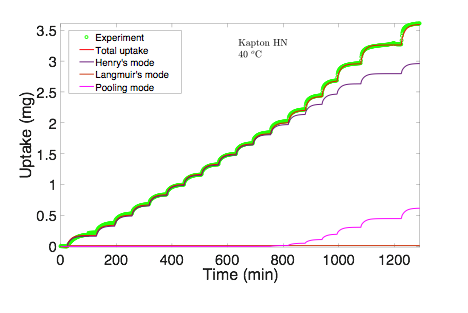
Fig 1:
Experiments and modeling results of dynamic moisture uptake by Kapton HN at a
range of relative humidities at 40 .
References:
1. Harley SJ, Glascoe EA, Lewicki JP, Maxwell RS. Advances in Modeling Sorption and Diffusion of Moisture in Porous Reactive Materials. Chemphyschem. 2014;15(9):1809-20.
2. Harley SJ, Glascoe EA, Maxwell RS. Thermodynamic Study on Dynamic Water Vapor Sorption in Sylgard-184. J Phys Chem B. 2012;116(48):14183-90.
3. Sun YW, Harley SJ, Glascoe EA. Modeling and Uncertainty Quantification of Vapor Sorption and Diffusion in Heterogeneous Polymers. Chemphyschem. 2015;16(14):3072-83.
See more of this Group/Topical: Materials Engineering and Sciences Division