
Advances in hydraulic fracturing technology has generated huge industrial attention towards catalytic conversion of low cost natural gas to valuable hydrocarbons. Developing molecular level understanding of catalyst active sites and its deactivation mechanism will help in the process of developing an effective commercial non-oxidative methane dehydroaromatization (MDA) catalyst. MoxCy/H-ZSM-5 is one of the suitable catalyst for the MDA process. Mo/HZSM-5 contains both metal site (Mo species) and acid site (H-ZSM-5) hence act as a bi-functional catalyst to efficiently activate methane on Mo species to produce C2H4 which than oligomerize and aromatize to benzene and its derivatives on acidic sites of shape selective zeolite1-2 . Nature of the active site for methane is suggested to be carbide or oxy-carbide but active phase structure is strongly debated. Lezcano-Gonzàlez and co-workers3 have carried our operando X-ray method and asserted MoC3 as possible active Mo speciation responsible for methane activation and formation of aromatics. Density functional theory calculations have been employed to study the effect of charge on catalytically active molybdenum carbide nano-cluster and its stability which will help in designing better MDA catalyst with suitable promoter species. In the study we have presented a detail investigation of effect of residual charge, Figure 1(a) showing a linear correlation between charges on MoC3 cluster on methane activation underlying the effect of reducibility of MoxCy cluster. Further, reaction mechanism insights have been studied for the methane activation and formation of ethylene, through formation of C2H6 and further C-H activation. Potential energy diagram for methane following scheme, Figure 1(b) shows ethylene will be formed easily on the catalyst surface, which eventually lead to formation for benzene with an intrinsic methane activation barrier of ~1.23 eV. The two resultant CH3 groups attached to the Mo2C6 cluster undergo C-C coupling reaction with relatively lower barrier of +0.35eV. Following these theoretical insights, H-ZSM-5 impregnated with Mo were tested experimentally for MDA under non-oxidative conditions. In order to minimize coke deposition two different approach a) carbon dioxide (CO2) as co-feed with methane4 and b) in-situ topotactic transformation of MoC form hexagonally close packing to face centered cubic5 by pre-treating catalyst with inflow of H2 at 2400ml/hr-gm GHSV for 6 hours at 350°C and then increasing the temperature to desired reaction condition with constant inflow of 30ml/min during carburization period carried out on a fixed bed reactor. Addition of CO2 to methane feed reduces not only inert coke but also reactive coke as elucidated by TGA analysis, Figure 1(c). In the current study, the effect of variation in CO2 concentration was studied. Results depict that addition of CO2 enhances benzene percentage upto 35% on mole basis, Figure 1(d) in product stream as higher oxygen donor ability of CO2 eliminate surface carbon by forming CO. Phase transformation of MoC hinders the migration of external surface Mo species to BAS present in zeolite channels resulting in retardation of inert coke deposition at pore entrance which results in enormous catalyst active with high selectivity towards aromatics, Figure 1(e) and less coke deposition resulting in high catalyst stability which is validated through coke gasification kinetics using Kissinger plot.
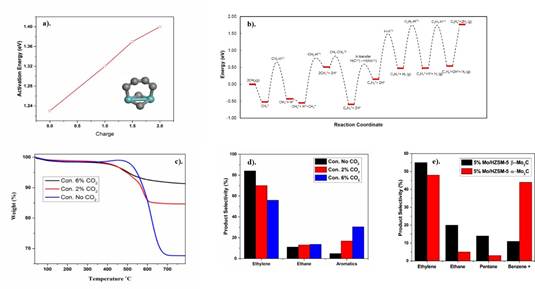
Figure 1. (a) Effect of residual charges on methane C-H bond activation, (b)Reaction diagram for methane activation and formation of ethylene on Mo2C6 nanocluster, (c) TGA analysis for Mo/HZSM-5, (d)-(e) Product selectivity during MDA process for Mo/HZSM-5.
Acknowledgement
Financial support provided by Gas Authority of India limited (GAIL) for carrying out this research work is gratefully acknowledge.
References
1. Majhi, S., Mohanty, P., Wang, H. & Pant, K. K. Direct conversion of natural gas to higher hydrocarbons: A review. J. Energy Chem. 22, 543–554 (2013).
2. Gao, J. et al. Identification of molybdenum oxide nanostructures on zeolites for natural gas conversion. 2534, (2015).
3. Lezcano-González, I. et al. Molybdenum Speciation and its Impact on Catalytic Activity during Methane Dehydroaromatization in Zeolite ZSM-5 as Revealed by Operando X-Ray Methods. Angew. Chemie - Int. Ed. 55, 5215–5219 (2016).
4. Ohnishi, R. Catalytic Dehydrocondensation of Methane with CO and CO2toward Benzene and Naphthalene on Mo/HZSM-5 and Fe/Co-Modified Mo/HZSM-5. J. Catal. 182, 92–103 (1999).
5. Liu, H., Bao, X. & Xu, Y. Methane dehydroaromatization under nonoxidative conditions over Mo/HZSM-5 catalysts: Identification and preparation of the Mo active species. J. Catal. 239, 441–450 (2006).
See more of this Group/Topical: Catalysis and Reaction Engineering Division