
Fe(III)-induced Rapid Deposition and Polymerization of Dopamine on Microfiltration (MF) membranes
Xuehua Ruan, Xuhang Liao, Yan Dai, Xiaobin Jiang, Gaohong He*
School of Petroleum and Chemical Engineering, State Key Laboratory of Fine Chemicals, Dalian University of Technology, Panjin, Liaoning, P.R. China, 124221
Corresponding Author Email: hgaohong@dlut.edu.cn
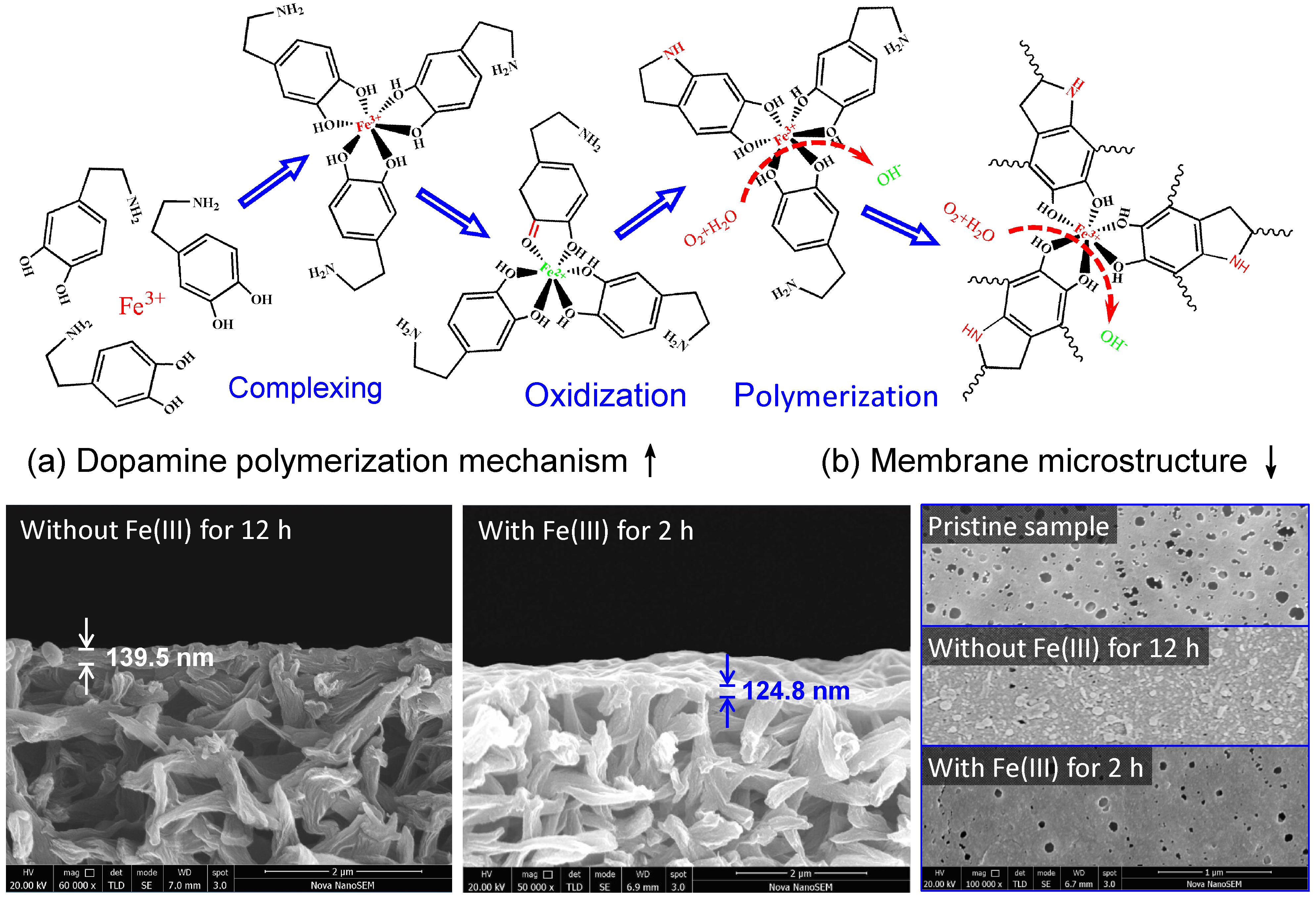
Polydopamine deposition, a promising strategy for material surface modification, is widely attempted to manufacture high-flux hydrophilic MF membranes. Nevertheless, the prospect is subjected to the time-consuming and uneven deposition arisen in the general coating routes. In this work, Fe(III) was employed to accelerate deposition and avoid agglomeration. According to the coordination theory, one Fe(III) ion and three dopamine molecules can be complexing together in the solution, which accelerates the deposition effectually. Besides, the multivalent Fe(III)-Fe(II) redox system, helpful to catalyze dopamine oxidization under dissolved oxygen, could promote the polymerization. The mechanism is illustrated in Figure 1a. In this instance, polydopamine coating layer can be yielded homogeneously and rapidly on the MF membrane surface. As a result, the growth rate of PDA with Fe(III) is accelerated by about 5 times, from 11.5 to 62.0 nm/h. The microstructure comparison between modified PVDF MF membranes without Fe(III) for 12 h and with Fe(III) for 2 h is shown in Figure 1b. PDA thickness coated on the former is about 139.5 nm, and that on the latter is comparable to be 124.8 nm. Much more, the samples modified in the PDA-Fe(III) solution possess the surface pore distribution similar to the pristine membranes. In comparison with the membranes modified by a general coating route, the PDA-Fe(III)-coated membranes behave excellently with the water flux three times higher. On the whole, the Fe(III)-induced PDA surface modification is a potential way to manufacture high-flux hydrophilic MF membranes facilely and efficiently.
|
Figure 1 Fe(III)-induced dopamine reaction mechanism and membrane microstructure.
|
Acknowledgement:
The authors are grateful to the financial support from National Natural Science Foundation of China (No. 21606035, U1663223, 21527812), Education Department of the Liaoning Province of China (LT2015007), and Changjiang Scholars Program (T2012049).
See more of this Group/Topical: Food, Pharmaceutical & Bioengineering Division