
Zhiyu Zhou, Michael P. Harold*, Dan Luss**
Department of Chemical and Biomolecular Engineering, University of Houston, Houston, TX 77204
* mharold@uh.edu, ** dluss@central.uh.edu
The abatement of NOx (NO+NO2) remains a challenge under the continuously more stringent emission standards. Commercialized deNOx systems, NOx storage and reduction (NSR) and selective catalytic reduction (SCR), function well from ~250 oC to ~400 oC, but have unsatisfactory performance outside that temperature range. Toyota researchers recently invented a new deNOx system, Di-Air (diesel NOx aftertreatment by adsorbed intermediate reductants), which involves fast injection of fuel into the exhaust feed to the NSR converter [1]. Previous studies show that ceria increases the deNOx performance of the Di-Air system in both low [2] and high [3] temperature regions. Data suggest that NOx conversion occurs via the reaction of an intermediate produced through the reaction with O2 and NO [1, 2]. However, a recent study [3] suggests that catalysts containing ceria may involve an alternative pathway of NOx abatement via NO decomposition at high temperatures. We studied in a bench-scale flow reactor system the NO decomposition and reduction on ceria under different frequencies with CO as sole reductant.
In our study, a lean to rich feed time ratio 6 to 1 of was controlled to keep the same fuel penalty (fuel to oxidant ratio). The lean/rich cycling conditions included lean/rich times (in seconds) of 90/15, 60/10, 30/5 and 6/1. Different reaction conditions were applied to study NO conversion behavior under favorable and adverse conditions. 500 ppm NO was added to both rich phase and lean phase. 2.5% CO was only added to rich phase and O2 with varied concentration was only added to lean phase. In some cases, CO2 and H2O were introduced continuously along with NO, O2 and CO to simulate lean exhaust.
When CO is used as the sole reductant and no H2O is introduced in the feed, NO is mainly converted to N2 with only trace amounts of N2O and NO2 detected. Figure 1 shows the cycle-averaged NO conversion with four cycle times from 450 oC to 625 oC in two feed conditions. In the first case, when 1400 ppm O2 is introduced in lean feed, Figure 1(a) shows that increase of lean/rich switching frequency enhances NO conversion. The optimized lean/rich switching frequency is always 6/1 above 500 oC. In the second case, when 2100ppm O2 is introduced in the lean feed, Figure 1(b) shows that a different optimal lean/rich switching frequency exists for different temperatures. The optimal lean/rich switching frequency is 30/5 at intermediate temperatures (500 oC and 550 oC) and 6/1 at high temperatures (600 oC and 625 oC) respectively. Figure 1 shows that the optimal lean/rich switching frequency changes with reaction conditions (e.g., temperature and feed condition).
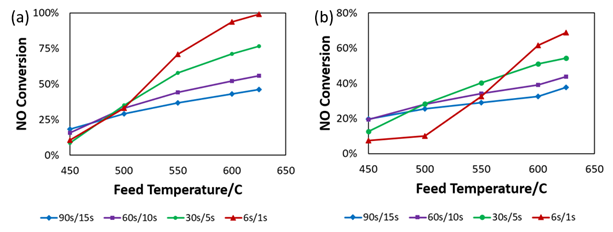
Figure 1. (a) NO conversion with different lean/rich switching frequency; (a) rich: 2.5%CO, 500ppm NO; lean: 500ppm NO, 1400ppm NO; (b) rich: 2.5%CO, 500ppm NO, lean: 500ppm NO, 2100ppm O2
Figure 2 shows the cycle-averaged NO conversion with the same four cycle times at 600 oC with fixed ratio of lean and rich feeds. The short cycle limit represents NO conversion obtained with total mixed lean and rich feeds. The long cycle limit represents weight averaged NO conversion in lean phase and rich phase. The optimal lean/rich switching frequency of 30/5 exceeds those of both short and long cycle time limit. This shows that the lean/rich cycling operation is beneficial to NO conversion.
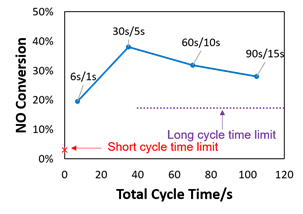
Figure 2. NO conversion at 600C, with a fixed switching frequency as 90s lean/15s rich; rich: 2.5%CO, 500ppm NO, lean: 500ppm NO, 3600ppm O2
Figure 3 shows that NO conversion changes when CO2 and H2O are fed. By comparing the blue line (reference) with either red line (with H2O only) or purple line (with CO2 only), it is obvious that both H2O and CO2 inhibit NO decomposition on ceria but H2O has a smaller detrimental effect than CO2. The green line (with both CO2 and H2O) lies between the red line (with H2O only) and the purple line (with CO2 only), which indicates that H2O can mitigate the detrimental effect of CO2.
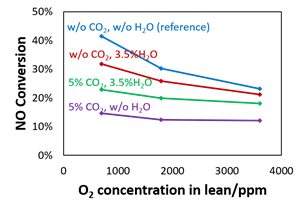
Figure 3. NO conversion at 550C, with a fixed switching frequency as 90s lean/15s rich; (rich: 2.5%CO, 500ppm NO, lean: 500ppm NO, varied O2 concentration, CO2 and H2O in both lean and rich if introduced)
This study on NO decomposition on ceria during lean and rich cycling helps explain the beneficial function of ceria on NOx reduction at high temperatures, which also provide guidance for optimization of catalyst formulation and operation strategies.
Reference
1. Y. Bisaiji et al., SAE Int. J. Fuels Lubr. 5 (2012) 380-388
2. Y. Zheng et al., Catal. Today, 276 (2016), 192-201.
3. Y. Wang et al., Top. Catal., 59 (2016), 854-860
See more of this Group/Topical: Catalysis and Reaction Engineering Division