
Butadiene is an industrially relevant precursor in the production of polymers, where it is typically polymerized with itself or other monomers to produce synthetic rubber. Polymerizing butadiene with styrene and acrylonitrile produces the plastic acrylonitrile butadiene styrene (ABS), while polymers of butadiene and styrene are also used in the production of automobile tires.
Here we present a renewable pathway to produce butadiene from biomass based tetrahydrofuran (THF), proceeding via a dehydrative ring opening of THF (Dehydra-Decyclization). A screening of various solid acid catalysts reveals that an all silica phosphorous containing zeolite (Phosphrous-self pillared pentasil, P-SPP) provides the highgest selectivity to butadiene of ~ 95%.1 The most significant undesired reaction pathway is the conversion of THF to propene and formaldehyde, which proceeds via a retro-prins condensation reaction. Increased methyl substitution at the 2 and 5 carbon positions of THF leads to significant increase in the rate, without change in selectivity to dienes, while substitution at the 3 carbon position leads to no change in rate. This suggests that a carbenium ion formed at the 2 and 5 carbon positions, is a kinetically relevant surface intermediate. A combination of in-situ titrations of pyridine and a sterically hindered base, 2,6-ditertbutyl pyridine, suggest that the surface chemistry is pre-dominantly Brønsted acid catalyzed.
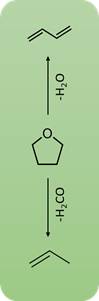
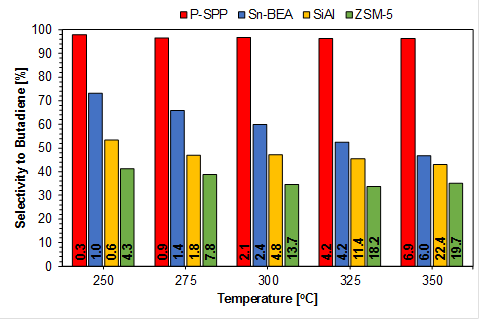
Figure 1. Dehydra-decyclization in a catalytic packed-bed flow reactor. Reaction of tetrahydrofuran to butadiene at 250−350 °C, WHSV = 1.0 h−1 and 5 Torr with catalysts: P-SPP (red), Sn-BEA (blue), amorphous silica−alumina (SiAl, yellow), and ZSM-5 (Si:Al = 140, green). Conversion for each experiment noted numerically within each bar.
[1] Abdelrahman, O. A.; Park, D. S.; Vinter, K. P.; Spanjers, C. S.; Ren, L.; Cho, H. J.; Vlachos, D. G.; Fan, W.; Tsapatsis, M.; Dauenhauer, P. J. ACS Sustainable Chem. Eng. 2017, In Press.
See more of this Group/Topical: Catalysis and Reaction Engineering Division