
10A. Design, Analysis, and Optimization of Sustainable Energy Systems and Supply Chains
A Superstructure-Based Assessment Framework for Downstream Bio-Separation
Wenzhao Wu, Kirti Yenkie, Christos T. Maravelias*
Dept. of Chemical and Biological Engineering, University of Wisconsin-Madison, Madison, WI 53706
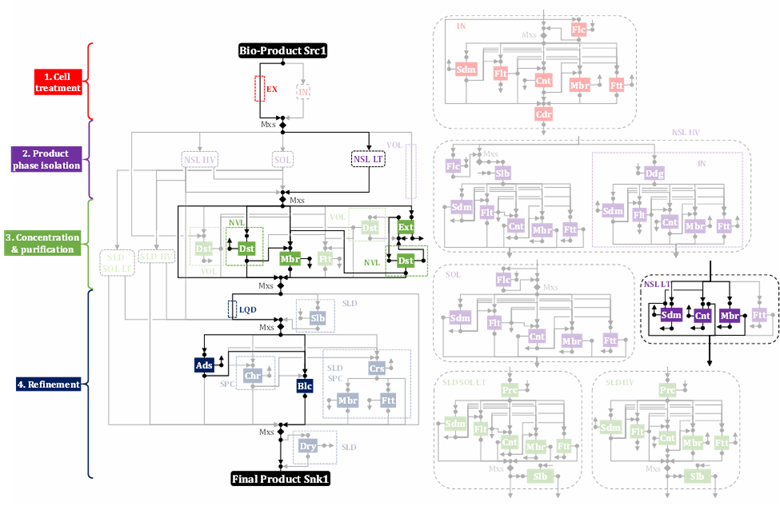
Figure 1. The general bio-separation superstructure (including the “dimmed” parts), and the reduced superstructure (excluding the dimmed parts) for the EX NSL LT NVL LQD CMD case. Attributes include EX/IN: extracellular/intracellular; SOL/NSL: soluble/insoluble in water; LT/HV: density lower/higher than water; VOL/NVL: more/less volatile than water; LQD/SLD: liquid/solid state; CMD/SPC: commodity/fine or specialty. Technologies include Ads: adsorption; Blc: bleaching; Cnt: centrifugation; Chr: chromatography; Cdr: cell disruption; Crs: crystallization; Dst: distillation; Dry: drying; Ddg: differential digestion; Ext: extraction; Flc: flocculation; Flt: flotation; Ftt: filtration; Mbr: membrane; Prc: precipitation; Sdm: sedimentation; Slb: solubilization.
Recent advances in synthetic biology and metabolic engineering have enabled the production of a range of fuels and chemicals using engineered microorganisms1,2. Despite the intriguing potential, the sustainable biological production of chemicals is challenging because the product is likely to have a low titer, and the purity specifications for high-value chemicals, as opposed to fuels, are rather strict, which means that separation costs are likely to represent a large fraction of the total production cost (often more than 60% of total cost3). Thus, the efficient synthesis of bio-separation processes becomes a critical task. Although this synthesis problem has been studied for various chemicals in the past, these studies were mostly performed on a case-by-case basis. There has been limited research towards the development of systematic methods for bio-separations, applicable to different classes of chemical targets. Therefore, we develop a general bio-separation superstructure optimization framework involving four separation stages4,5: (1) cell treatment, (2) product phase isolation, (3) concentration and purification, and (4) final refinement.
Specifically, we generate a general superstructure (Figure 1) that accounts for different types of bio-based chemical products by implementing a set of connectivity rules4,6. We further develop a superstructure reduction method to solve product-specific instances, based on product type, unit availability and suitability, case-specific considerations, and final product specifications. The reduced superstructure for an example case (for an EX NSL LT NVL LQD CMD product) is shown in Figure 1. Next, a MINLP optimization model, including short-cut unit models (e.g., Fenske-Underwood equations for distillation unit models) for the units included in the reduced superstructure, is formulated and solved to determine the optimal separation network and the key cost contributors. We can also determine alternate (next best) configurations using the integer-cut method to decide which technologies are essential and which can be changed in the optimal design with little compromise in the process cost. Finally, we vary a combination of parameters for the key cost contributing technologies (i.e. solve multiple optimization problems with varying parameter values) to determine the critical values when there is a shift in technology selection and the corresponding cost changes (represented in “heat maps”).
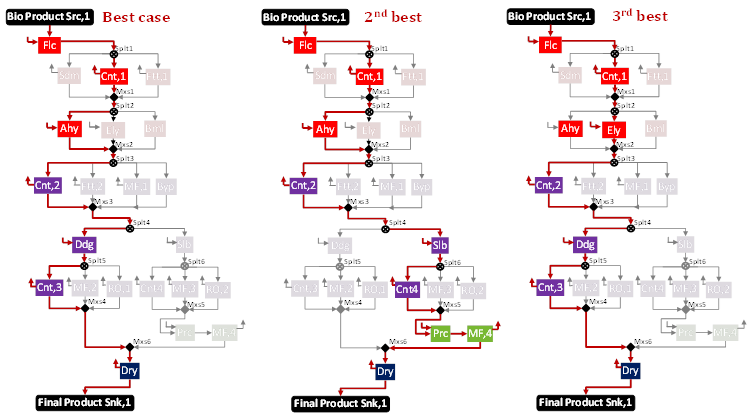
Figure 2. Best, 2nd best and 3rd best solutions (the un-dimmed parts) for the IN NSL HV SLD CMD case. The dimmed and the un-dimmed parts together constitute the reduced superstructure.
The proposed framework is applied to multiple case studies. In studying an IN NSL HV SLD CMD case7, we assume nominal values for parameters like plant capacity, product titer, desired purity, technology parameters, cost of raw materials, chemicals and separating agents from literature, and process simulation packages (SuperPro Designer) for economic assessment. The objective is to minimize the overall cost. After solving the model, we identify the optimal process and also apply integer-cuts to identify the 2nd best and 3rd best solutions (Figure 2). The stage-wise cost distribution for the best solution (Figure 3A) shows that stage 1 (cell treatment) is the key cost driver, followed by stage 2 (product phase isolation) and stage 4 (refinement) while stage 3 (concentration and purification) is absent. Finally, we generate a heat map that shows how the overall process cost changes with the variation in the key design parameters in Stage I (see Figure 3B). We observe that the total cost can vary from 4.7 to 11.44 $/kg by changing the centrifuge efficiency and filtration retention factor. Thus, the maximum improvement that can be achieved by selecting a suitable biomass harvesting operation is ~50% compared to the base case (shown by the black point in Figure 4B). We further discuss the extension of the results to generate useful insights for the class of IN NSL bio-based chemicals.
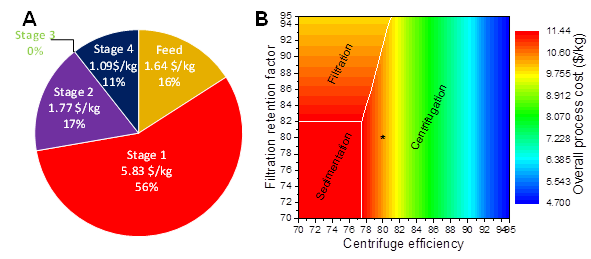
Figure 3. (A) Stage-wise cost distribution for the best solution; (B) Overall process cost with variation in the performance of cell harvesting technologies. Threshold values when there is a shift in technology selection is denoted by the white lines.
References
[1] Gavrilescu, M. & Chisti, Y., 2005. Biotechnology- a sustainable alternative for chemical industry. Biotechnology advances, Volume 23, pp. 471-499.
[2] Bornscheuer, U. T. & Nielsen, A. T., 2015. Editorial overview: chemical biotechnology: interdisciplinary concepts for modern biotechnological production of biochemicals and biofuels. Current Opinion in Biotechnology, Volume 35, pp. 133-134.
[3] Kiss, A. A., Grievink, J. & Rito-Palomares, M., 2015. A systems engineering perspective on process integration in industrial biotechnology. J Chem Technol Biotechnol, Volume 90, pp. 349-355.
[4] Wu, W., Yenkie, K.M. & Maravelias, C.T., 2017. A superstructure-based framework for bio-separation network synthesis. Computers & Chemical Engineering, Volume 96, pp. 1-17.
[5] Yenkie, K. M., Wu, W., Clark, R. L., Pfleger, B. F., Root, T. W., & Maravelias, C. T., 2017. A roadmap for the synthesis of separation networks for the recovery of bio-based chemicals: Matching biological and process feasibility. Biotechnology Advances, Volume 34(8), pp. 1362-1383.
[6] Wu, W., Henao, C. & Maravelias, C.T., 2016. A Superstructure Representation, Generation and Modeling Framework for Chemical Process Synthesis. AIChE J, Volume 62, pp. 3199-3214.
[7] Yenkie, K. M., Wu, W., Maravelias, C.T., 2017. Synthesis and analysis of separation networks for the recovery of intracellular chemicals generated from microbial-based conversions. Biotechnology for Biofuels
See more of this Group/Topical: Computing and Systems Technology Division