
One of the more common methods for characterizing solid acid catalysts is the temperature programmed desorption (TPD) of alkylamines, which selectively decompose to an alkene and ammonia over Brønsted acid sites. TPD is traditionally carried out either in a flow reactor or microbalance, coupled with a mass spectrometer for identification and/or quantitative purposes. Reactive gas chromatography is a new technique to measure Brønsted acid site densities of solid acid catalysts, which condenses the typical experimental setup required for a TPD into a single, fully automated gas chromatograph (GC). Reactions are carried out in a microcatalytic reactor, housed within a temperature controlled GC inlet liner, products are then separated in a GC column and quantified by a flame ionization detector (Figure 1a). This eliminates the need for more complex instrumentation such as on-line mass spectrometers or a flow reactor apparatus.
An investigation of the RGC method was carried out by characterizing ZSM-5, BEA and SPP zeolites of varying Si/Al ratios, utilizing alkylamine decomposition to selectively count Brønsted acid sites. A comparison between RGC measurements and conventional TPD methods show excellent agreement (Figure 1b), confirmed by comparison with pyridine in-situ titrations under Brønsted catalyzed reaction conditions. Reactive gas chromatography measurements performed using n-propylamine, isopropylamine and tert-butylamine were found to yield identical Brønsted acid site densities. Given the relatively low detection limits of a flame ionization detector, the method of reactive gas chromatography is found to be highly sensitive. Siliceous materials with Brønsted acid site densities of ~1 μmol gcat-1 could be reliably measured.
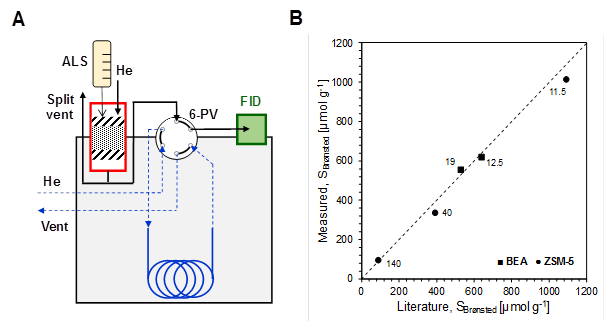
Figure 1. Method of Reactive Gas Chromatography for Solid Acid Titration. A. Solid acid samples loaded into the inlet liner (red rectangle) of a gas chromatograph are titrated with amines, introduced via an automatic liquid sampler (ALS) syringe, adsorbed and reacted on solid acid sites to produce propylene and ammonia. Resultant products are quantified by a flame ionization detection (FID). B. Comparison of zeolite measured Brønsted acid site density between reactive gas chromatography and literature values. Catalysts include ZSM-5 (Si/Al 11.5, 40, 140: ●) and BEA (Si/Al 12.5, 19: ■).
See more of this Group/Topical: Catalysis and Reaction Engineering Division