
10A. Process Design: Innovation for Sustainability
Screening for Economically Promising Bio-Based Chemicals
Wenzhao Wu, Matthew Long, Jennifer Reed, Christos T. Maravelias*
Dept. of Chemical and Biological Engineering, University of Wisconsin-Madison, Madison, WI 53706
The last decade has seen tremendous progress in metabolic engineering and synthetic biology1,2. These advances enable the use of engineered microorganisms such as Escherichia coli and yeast for the production of chemicals that are currently derived mainly from fossil fuel feedstocks3,4. However, it is still unclear which chemicals have the highest economic potential, which is key in developing a sustainable chemical production system. To this end, we develop a framework for the identification of economically promising chemicals that can be produced biologically using microorganisms (“bio-based chemicals”).
We first examine the US high-production-volume (HPV) chemicals5, which are manufactured in or imported into the United States in amounts equal to or greater than 454 metric tons (MT) per year. HPV chemicals include all commodity chemicals and a portion of fine chemicals. We establish an HPV chemical database (3574 chemicals) by compiling several HPV lists published by the EPA over the past two decades. Then we intersect the HPV chemical database with the KEGG database, which includes most chemicals produced by characterized reactions in biological systems, and thus 613 overlapping chemicals are found. These chemicals are then imported into a genome-scale metabolic model we develop, and 170 chemicals are identified to be producible by microorganisms, often with the addition of heterologous reactions. These 170 chemicals are the complete pool of candidate targets for bio-based production. In addition, market volume and price data is collected for them.
We first use the following two screening criteria to quantify economic potential.
Criterion 1: market volume. The market volume (MT/year) should be greater than an expected production capacity.
Criterion 2: market value. The market value ($/year) should be large enough to attract investment and recover capital cost within an expected time horizon.
The difference between the price and the production cost also plays a key role in determining the economic potential of a product. The larger the difference between a chemical’s selling price and its total production cost, the larger its economic potential. However, directly implementing a third criterion based on such a difference is challenging because the downstream separation cost is highly product-dependent and difficult to estimate. To this end, we use the “separation cost margin” as Criterion 3, which is the difference between the price and the upstream cost (including raw material supply cost and bio-conversion cost). We calculate the upstream cost using base cost data from the literature as well as the theoretical yield and productivity calculated using our metabolic model. For a specific product, if the margin is negative, then the product fails Criterion 3; if the margin is positive, then we compare it with the expected separation cost. In general, the separation cost depends on (1) the product properties, e.g., separation of extracellular insoluble products tends to be easier than that of extracellular soluble ones, especially when the product concentration is low; and (2) case-specific information, e.g., whether a known solvent exists for a particular product, and special product requirement such as colorlessness and dryness.
To account for these major separation cost drivers, we introduce a general downstream bio-separation superstructure optimization framework to provide guidance in the preliminary design of separation networks6,7. We then apply this framework and formulate superstructure models for different classes of bio-based chemicals8 based on their properties such as localization (intracellular/extracellular), solubility (soluble/insoluble) and density with respect to water (light/heavy). Further, we identify the optimal separation processes for base cases and the key cost drivers (such as titer and technology performances). Finally, we generate sensitivity curves (e.g. Figure 1A) and “heat maps” (e.g. Figure 1B) to show how the overall cost changes with the variation in the key cost drivers, which can help us roughly estimate the cost of separation for different classes of products.
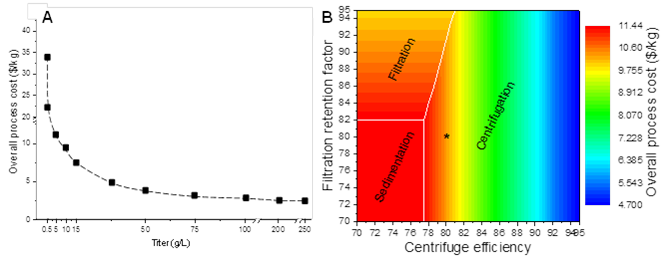
Figure 1. Cost estimates for intracellular insoluble products under varying parameters. (A) Sensitivity curve showing cost changes with the variation in titer; (B) “Heap map” showing the change of cost and the optimal cell harvesting technology with the variation in technology performances (centrifuge efficiency and filtration retention factor). The white lines show the threshold values where the optimal technology switches. The asterisk represents the base case.
As a preliminary result, we identify three chemicals as the most promising ones: glutaric acid, acrylamide and propanal, by setting a uniform separation cost margin threshold for all chemicals to be greater than 1.8 $/kg (an estimated margin for a case product - polyhydroxyalkanoate), a volume greater than 31751 MT/year (an estimated production capacity), and a market size greater than 200 million $/year (to recover capital cost in ~5 years supposing a 50% market share). More accurate results can be obtained by using the aforementioned bio-separation framework with a different separation cost margin.
References
[1] Gavrilescu, M. & Chisti, Y., 2005. Biotechnology- a sustainable alternative for chemical industry. Biotechnology advances, Volume 23, pp. 471-499.
[2] Bornscheuer, U. T. & Nielsen, A. T., 2015. Editorial overview: chemical biotechnology: interdisciplinary concepts for modern biotechnological production of biochemicals and biofuels. Current Opinion in Biotechnology, Volume 35, pp. 133-134.
[3] Wilson, S. A. & Roberts, S. C., 2014. Metabolic engineering approaches for production of biochemicals in food and medicinal plants. Current Opinion in Biotechnology, Volume 26, pp. 174-182.
[4] Zhang, X., Tervo, C. J. & Reed, J. L., 2016. Metabolic Assessment of E. coli as a Biofactory for Commercial Products. Metabolic Engineering, Volume 35, pp. 64-74.
[5] US EPA, 2004. High-production-volume (HPV) chemicals status and future directions of the HPV Challenge Program. Office of Pollution Prevention and Toxics, Washington DC.
[6] Wu, W., Yenkie, K.M. & Maravelias, C.T., 2017. A superstructure-based framework for bio-separation network synthesis. Computers & Chemical Engineering, Volume 96, pp. 1-17.
[7] Yenkie, K. M., Wu, W., Clark, R. L., Pfleger, B. F., Root, T. W., & Maravelias, C. T., 2017. A roadmap for the synthesis of separation networks for the recovery of bio-based chemicals: Matching biological and process feasibility. Biotechnology Advances, Volume 34(8), pp. 1362-1383.
[8] Yenkie, K. M., Wu, W., Maravelias, C.T., 2017. Synthesis and analysis of separation networks for the recovery of intracellular chemicals generated from microbial-based conversions. Biotechnology for Biofuels
See more of this Group/Topical: Sustainable Engineering Forum