
Syntheses of Pd doped CaCoxZr1-xO3-d novel perovskite-type redox materials for automotive emissions control
Qinghe Zheng and Marty Lail*
Energy Technology Division, RTI International, Durham, NC 27709, United States
Introduction
In recent years the family of rare earths, including cerium, experienced a rapid increase in price and decrease in availability, upsetting the markets and initiating a search for methods to reduce their concentrations in the oxygen storage materials (OSMs). Meanwhile, with the rapid increase of vehicle population and more stringent automotive emissions regulation, which requires as high as 96% conversion of all pollutants, improvements of three-way catalyst (TWC) performance by broadening operation window of the stoichiometric air-to-fuel ratios are of high interest. Furthermore, TWC, including the active metal (PGM metals) and the support materials (with CexOy-ZrO2-type OSM incorporated), may experience deactivation under fuel cut-off, an engine mode for enhanced fuel economy but exposes catalyst to high temperature (c.a. > 1000 oC) lean oxidative condition.
Perovskite-type materials, with general chemical composition of ABO3-d, where A and B are cations that may have multiple valence states, can exhibit significant swings in oxygen non-stoichiometry d through the reaction with gas phase oxygen. Perovskites possess not only excellent redox property but also high chemical/structural stability. Preliminary development of perovskite-type OSMs by selecting transition metals with low cost, large abundance and availability, remarkable redox properties, and good thermal stability would be a reasonable research strategy. Further research effort would require the development of advanced TWCs by incorporation of PGM group metals into the novel perovskite structures with outstanding OSC capacity. Enhanced catalyst activity and stability were previously reported by incorporating noble metals into the perovskite structures, which stabilize the metal against sintering, reaction with the support, and volatilization.
The present study focuses on a systematic screening of advanced perovskites as potential substitutes for commercial CZO in TWC. Novel perovskite-type materials CaCoxZr1-xO3-d were synthesized for the first time and reported here to show outstanding redox property and oxygen mobility than the current state-of the-art perovskite materials and the commercial CZO. Pd-doped CaCoxZr1-xO3-d showed profound catalytic activity towards NMHC and CO oxidation. The study aims at providing a comprehensive comparison of the oxygen storage/release capacities of the current state-of-the-art perovskite materials, and preliminary results for the development of the performing perovskite materials in automotive applications.
Experimental
CaCoxZr1-xO3-d and other perovskites were synthesized using Pechini method. CO- and H2- temperature programmed reduction (CO- and H2-TPR) measurements, and dynamic CO-air redox cyclic tests were performed to examine the CO and oxygen storage capacities of the as-synthesized materials, in comparison with the commercial CZO and CeO2. X-ray fluorescence (XRF), X-ray diffraction (XRD), and BET surface area measurements were used to characterize the studied materials. The kinetic data of the oxygen intake of the best performed perovskite materials is included. The HC and CO catalytic oxidation activities of perovskites with different amount of Pd doping were evaluated under simulated automotive exhaust conditions.
Results and Discussion
H2-TPR profiles of the as-synthesized perovskites and commercial ceria-based oxygen storage material (OSM) samples are presented by Figure 1(a). The novel CaCoxZr1-xO3-d perovskites exhibit higher reducibility than commercial Ce-based OSMs, as represented by higher H2 consumption (4.1~13.4 times higher) at lower reduction temperatures (50~250 oC lower). Specifically, the H2 consumption of CoxZr1-xO3-d increases with Co content. Doping of Pd into the perovskite structure further enhances the reducibility by lowering the reduction temperature. Catalytic oxidation activities of Pd doped perovskite OSMs are shown in Figure 1(b) and 1(c). Pd doped CoxZr1-xO3-d exhibit excellent activity for CO and HC (C3H6) oxidation. Complete combustion of CO and HC was observed. The T50 for C3H6 oxidation was as low as 240 °C. The HC oxidation activities of all the Pd doped CaCoxZr1-xO3-d TWCs are comparable to, if not higher than, state-of-the-art TWCs. These promising data clearly confirm the excellent potential for the proposed perovskite TWCs.
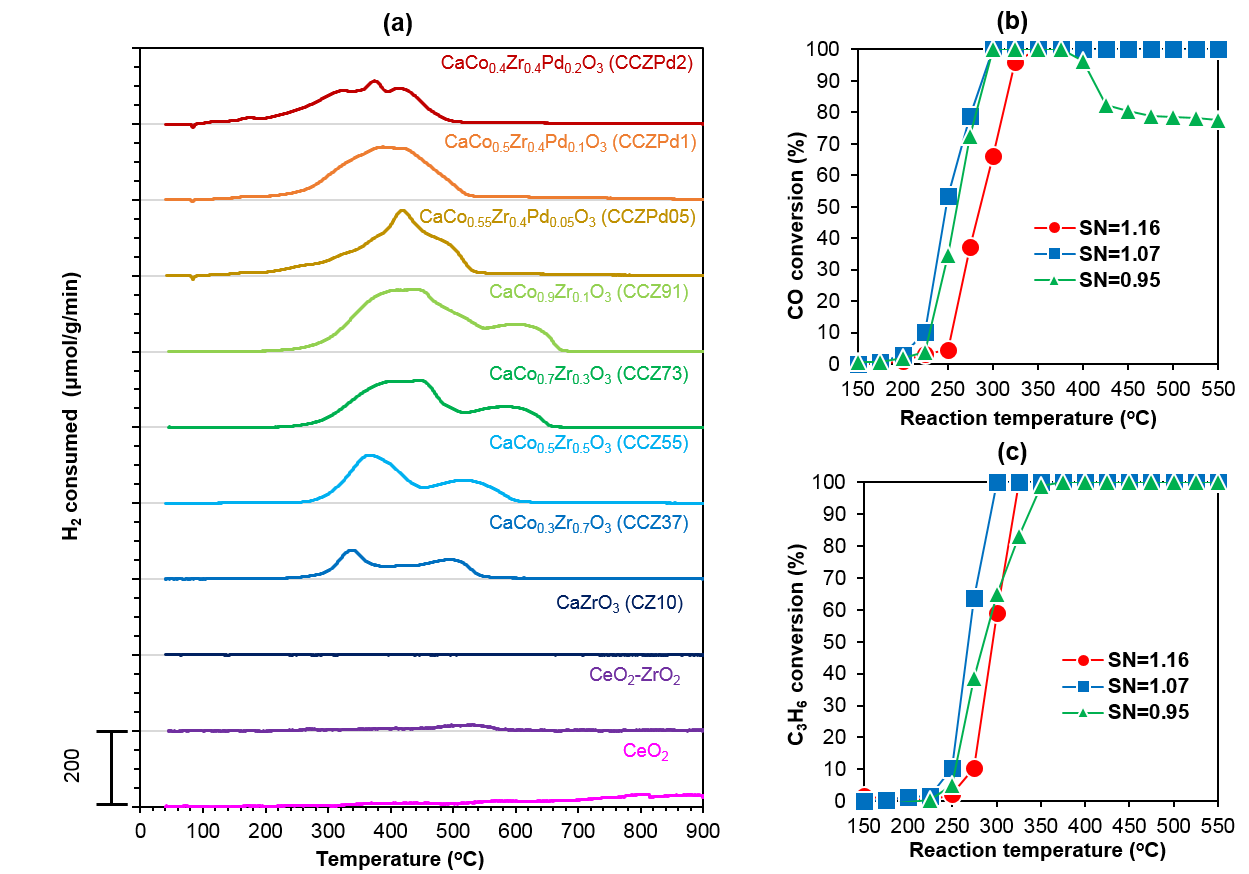
Figure 1. (a) H2 consumption as a function of reduction temperature during H2-TPR for CaCoxZr1-xO3-d –type perovskites with or without Pd doping, in comparison with commercial CeO2 and CeO2-ZrO2 OSMs. Catalytic oxidation activity of (b) CO and (c) C3H6 using simulated exhaust feed over CaCo0.55Zr0.4Pd0.05O3-d perovskite-type TWC. The simulated exhaust feed contains 600-660 ppmv C3H6, 0.75-0.825 vol-% CO, 0.675-0.75 vol-% O2, 19.5 vol-% CO2, balanced N2, at WHSV=16.69 h-1. The catalytic oxidation activity was measured under different stoichiometric numbers (SN) calculated as SN=2 [O2] / ([CO] + 9 [C3H6]).
Selected References
[1] Guilhaume, N.; Primet, M. J. Catal. 1997, 165 (2), 197-204.
[2] Tanaka, H.; Taniguchi, M.; Uenishi, M. et al. Angew. Chem. Int. Ed. 2006, 45 (36), 5998–6002.
[3] You, R.; Zhang, Y.; Liu, D. et al. J. Phys. Chem. C 2014, 118 (44), 25403–25420.
See more of this Group/Topical: Catalysis and Reaction Engineering Division