
Pulmonary delivery of antibiotics that are effective against Pseudomonas aeruginosa in patients with cystic fibrosis is limited due to the presence of a thick layer of pulmonary mucus, through which antibiotic diffusion is severely hindered. Mucus-penetrating nanoparticles (NPs) offer a promising delivery vehicle for such antibiotics, as the NPs’ diffusivity in mucosal layers is significantly faster than that of the antibiotics. However, the majority of nanofabrication processes are batch processes, which present issues in scalability. We have previously shown that polyethylene glycol (PEG)-surface-coated nanoparticles (NPs) made via Flash NanoPrecipitation (FNP), a block-copolymer directed self-assembly technique, can penetrate pulmonary mucus. Significantly, FNP is a continuous nanofabrication technique, which offers advantages in scalability over traditional batch processes. In order to encapsulate a hydrophilic antibiotic within NPs via FNP, we employ hydrophobic ion-pairing to increase the drug’s hydrophobicity temporarily and make it more suitable for the precipitation process. Sixteen ion-pairing reagents (IPs) were screened and used to successfully encapsulate a variety of hydrophilic compounds and proteins, such as gentamicin, polymyxin, and lysozyme, into mucus-penetrating PEG-coated NPs. In addition, IP compositions were varied to tune both drug encapsulation efficiencies (> 95%) and drug release rates (up to 7 days). Thus, the mucus-penetrating nanodelivery system developed herein offers new options for managing Pseudomonas aeruginosa pulmonary infections in patients with cystic fibrosis.
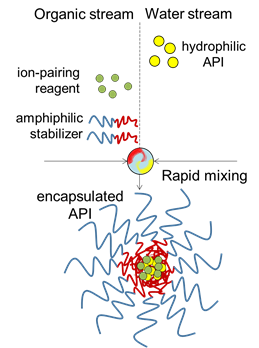
Schematic of Flash NanoPrecipitation used to simultaneously ion-pair a hydrophilic active pharmaceutical ingredient and encapsulate it into a nanoparticle.
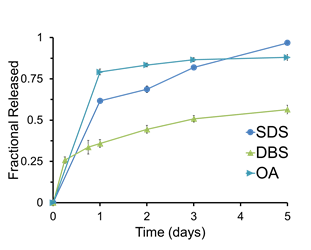
Release rates of polymyxin NPs. Fraction of polymyxin B released over time when using 1:1 API to IP charge ratio for various IPs.
See more of this Group/Topical: Nanoscale Science and Engineering Forum