
Interactions of Water and Chiral Properties of a Single Site Pt “29” CuxO/Cu(111) Catalyst
Kyle Groden, Alyssa Hensley, Alex C. Schilling, Andrew Therrien, Renqin Zhang, E. Charles H. Sykes, Jean-Sabin McEwen
Figure 1. Illustration of the excellent agreement between the simulated STM image of the “29” structural oxide model and the experimental STM image. The experimental and the simulated STM image were taken at -0.5 V. The images are 3.5× 3.5 nm2. The simulated image was done using the Tersoff-Hamann approach. |
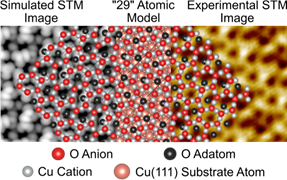
Single-site catalysts provide a promising means of using precious catalytic metals to a high degree of efficiency. Their design greatly reduces the metal loading and allows the atomically dispersed metal to actively participate in the underlying reaction of interest. Although the catalytic activity of single atoms has been under scrutiny1, recent studies unambiguously show that individual Pt atoms on a “29” copper oxide are able to oxidize CO at low temperatures2. The model system for the “29” copper oxide is shown in Figure 1, which was obtained through an extensive collaboration between experiment and theory3,4. To further investigate the activity of this system, its interactions with water were examined from first principles. This is in response to the experimental work, which demonstrates that there is interchange of isotopically labelled surface oxygen and that of gas phase water. To explain the experimental results, a reaction mechanism was proposed and a corresponding microkinetic model was constructed to model the desorption kinetics.
We also examined the chiral properties of the “29” copper oxide support used for the previously mentioned work. Imaging has determined 6 different chiral configurations of the surface Cu2O rings, each of which may behave in a chemically unique manner. This behavior may restrict the interactions of enantiomeric reactants to specific surface configurations, potentially leading to heterogeneous selectivity. As most reactions requiring any degree of enantioselectivity are typically performed homogeneously, this possible heterogeneous selectivity due to the surface orientation would be a powerful characteristic of this catalytic system. Our investigation is performed again using density function theory with propylene oxide as the enantiomeric probe molecule.
References:
1. Ding, K.; Gulec, A; Johnson, A. M.; Schweitzer, N. M.; Stucky, G. D.; Marks, L. D. Stair, P. C. Science 2015, 350, 189–192.
2. Therrien, A. J.; Hensley, A. J. R; Marcinkowski, M. D.; Lucci, F. R.; Coughlin, B.; Schilling, A.; McEwen, J.-S.; Sykes, E. C. H. (in preparation).
3. Hensley, A. J. R.; Therrien, A. J.; Zhang, R.; Marcinkowski, M. D.; Lucci, F. R.; Sykes, E. C. H.; McEwen, J.-S. The Journal of Physical Chemistry C 2016, 120 (44), 25387–25394.
4. Therrien, A. J.; Zhang, R.; Lucci, F. R.; Marcinkowski, M. D.; Hensley, A.; McEwen, J.-S.; Sykes, E. C. H. The Journal of Physical Chemistry C 2016, 120 (20), 10879–10886.
See more of this Group/Topical: Catalysis and Reaction Engineering Division