
Influence of Thermophysical Properties of Cryogenic Fluids on Growth and Collapse of Cavitating Bubbles
A distinctive feature of the dynamics of liquids is the possibility of the coexistence of a vapor phase with the liquid phase. Such formation and disappearance of a vapor phase in liquid are known as cavitating flow [Rayleigh, 1917]. Cavitating flow has been significantly governed by the physical-chemical properties of the liquid. The investigation needs to be performed to study the influence of thermo-physical properties of cryogenic fluid on the cavitating flows.
In Cavitating flow, plenty of nuclei available for the inception of cavitation. The fluid is in a precarious imbalance due to repetitive growth and collapse of cavitating bubbles until an equilibrium condition is achieved. Thus, the primary focus is on an exhaustive investigation of bubble growth and collapse. This event rate is dominated by two mechanisms: a momentum for the impulsion/expulsion of ambient liquid, and a heat transfer to initiate phase change at the interface. These mechanisms are known as the inertia (momentum) control and the heat transfer control, respectively. As the cavitating bubble grows, latent heat is extracted from the surrounding liquid to the interface, creating a thermal boundary layer. The consequence is a small local decrease of the liquid temperature, which results in a slight drop in the vapor pressure. This pressure depression suppresses the further development of the bubble because a greater pressure drop is needed to maintain the process. This phenomenon is known as ‘thermal suppression of cavitation,' as it plays a moderating role in the development of cavitation. The influence of thermodynamic effects can usually be neglected in fluids for which the critical-point temperature is much higher than the working temperature. But these effects become significant when the critical-point temperature is close to the temperature of the fluid, as in the case of cryogenic fluids [Ruggeri & Moore, 1968].
Cryogenic fluids are characterized by steep density variation and a small latent heat of vaporization as compared to room temperature fluids. The vapor pressure of cryogenic liquid is highly sensitive to temperature change as shown in figure 1(b). As a consequence, the liquid surrounding the vapor cavity undergoes substantial evaporative cooling. [Balje, 1981].
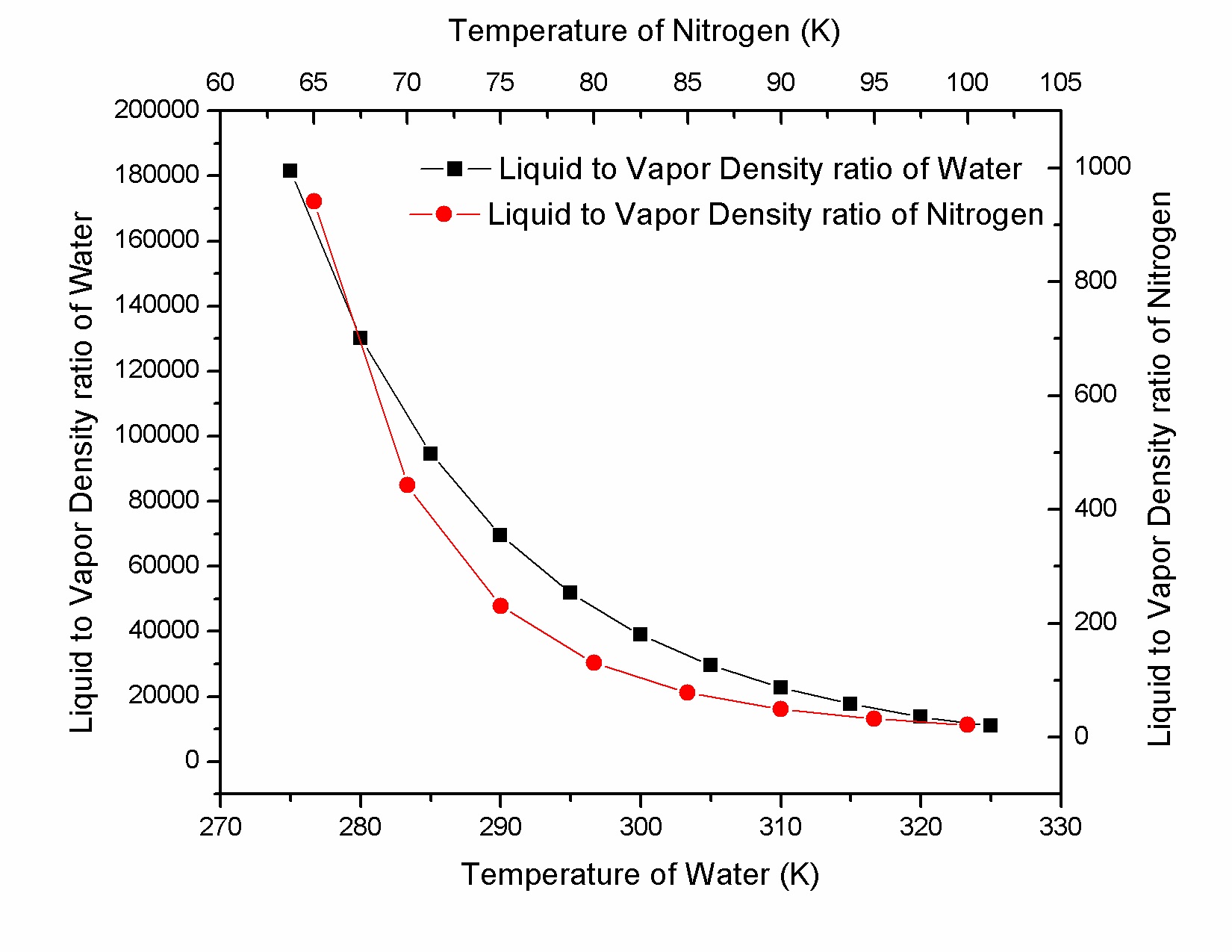
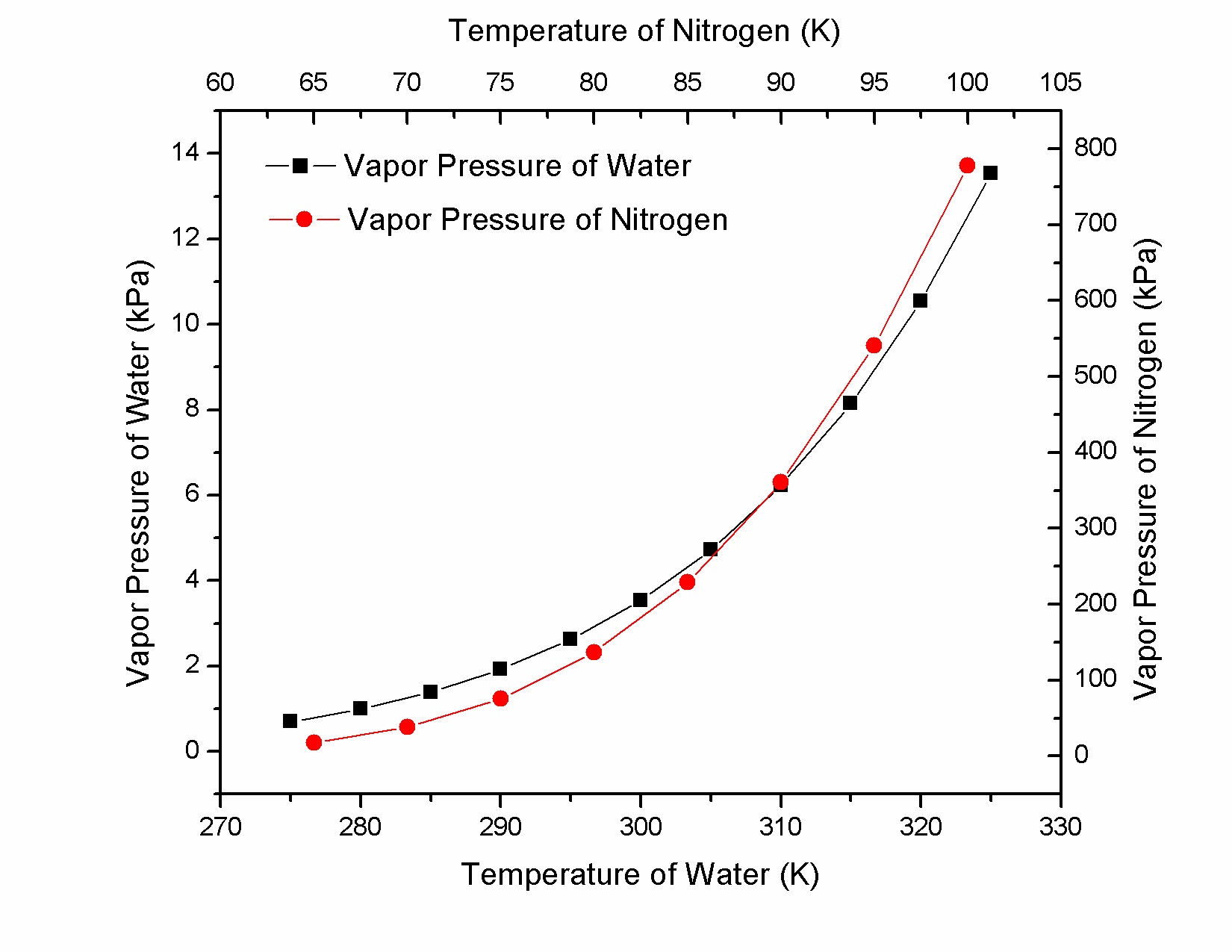
Figure 1 Variation in thermophysical properties for Liquid Nitrogen (NIST: REFPROP)
(a) Liquid to vapor density ration vs Temperature and (b) Vapor pressure vs. Temperature
Previous studies have concentrated on the consequences of the thermodynamic effect rather than on the investigation of the mechanism itself. However, on the local scale, each bubble undergoes a considerable rise of temperature during the collapse while significant local cooling of the liquid is also expected within the cavitation areas. The behavior of bubble breakdown process is governed by different thermophysical properties of fluids viz. vapor pressure, viscosity, and surface tension. The thermodynamic effects associated with the dynamically changing interfacial structures occurs due to coalescence and break-up of bubbles, significant discontinuities of the fluid properties and complicated flow field near the interface results in due to the prevailing phase change process. The repeating transient collapses of cavitating bubbles in high-pressure regions influences the shape and stability of the bubbles, which can respond with the formation of a micro-jet. These re-entrant jets penetrate the bubble induce the process of cavitation erosion.
Therefore, for modeling inertial and heat transfer controlled bubble growth in cryogenic fluids due to multiphase malevolent cavitation process and to investigate the effect of thermo-physical properties of cryogenic fluids, demands a computational approach which can simultaneously capture different elementary physical phenomenon (i.e., nucleation, evaporation/condensation, coalescence/fission, bubble-turbulence interaction, and so on). In this paper, a multiphase formulation which solves energy equation in conjunction with the mass and momentum conservation that accounts for variable thermodynamic properties of the cryogenic fluid and nucleation transport equation has been used to investigate the fundamental dynamics of growing or collapsing spherical and non-spherical bubbles in an infinite domain of cryogenic liquid subjected to large pressure variations.
See more of this Group/Topical: Engineering Sciences and Fundamentals