
A key objective in crystallization process design is to improve process efficiency and control product characteristics, such as crystal size distribution (CSD) [1][2]. High-throughput static mixers have been demonstrated to be an effective technology to enhance the control of nucleation, which is key towards control of the final product CSD. Unlike traditional designs that combine solution and anti-solvent streams such as in a dual-impinging-jet (DIJ) mixer (e.g., [1]–[4]), a more recent design combined hot and cold saturated solutions of the same solute/solvent to generate small uniform seed crystals (Fig. 1) [5][6].
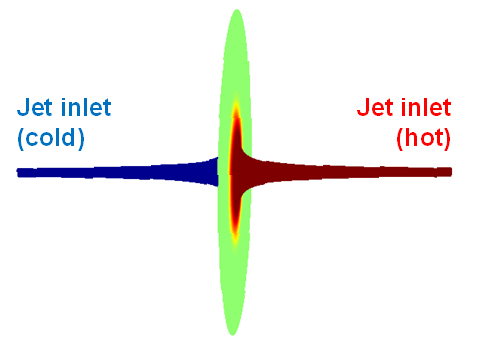
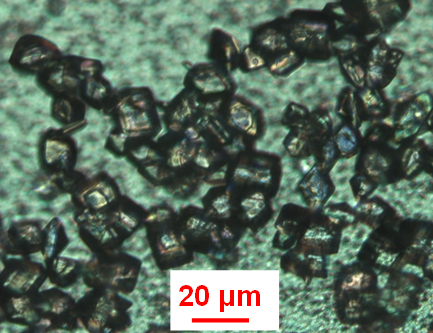
Figure 1 (left): A schematic of a cooling DIJ mixer, with hot (red) and cold (blue) streams impinging towards a cold/hot interface before diverting radially. (right): Small crystals of L-asparagine monohydrate with a narrow size distribution generated from a cooling DIJ mixer that combines hot (70°C) and cold (25°C) saturated solutions [5][6].
Theoretically, if the mixing was perfect (that is, concentration and temperature were completely mixed at the molecular scale in the mixer), the average supersaturation level would be too low to nucleate crystals in a cooling DIJ mixer. A surprising result of nucleating crystals by combining hot and cold saturated solutions in a DIJ mixer is that an additional enabling mechanism – differential rates of thermal and molecular diffusion – was in play in the cooling DIJ mixer. Theoretical analysis of the system showed that nucleation was enabled by the much faster energy transfer than mass transfer rates near the interface. This difference in rates enabled the temperature of the hot solution to drop to approximately the average temperature of the two solutions before its solution concentration had significantly changed, resulting in a supersaturation sufficiently high to nucleate crystals (Fig. 2) [6].
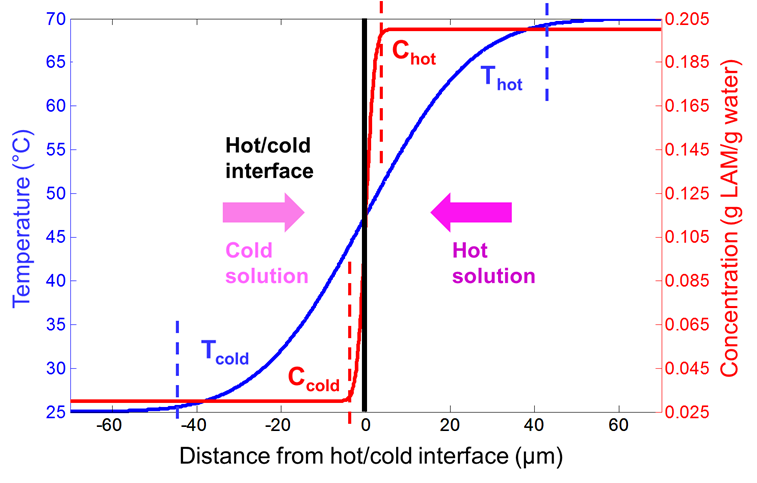
Figure 2. Temperature (blue) and concentration (red) profiles (solid lines) and edges of the boundary layers (dashed lines), based on the 1D approximation along the jet centerline. The black line is the impingement plane [6].
The theoretical analysis is supported with process simulations. The two-dimensional energy and solute mass balances are simplified using a one-dimensional approximation based on scaling analysis. 1D analytical solutions were derived from the simplified partial differential equations, to generate spatial distributions of temperature, concentration, and supersaturation near the hot-cold interface within a cooling DIJ mixer (Fig. 2). In the spatial region of importance for induction and control of nucleation, the analytical solutions are shown to be very close to the two-dimensional fields solved using COMSOL.
The 1D analytical solutions facilitated the derivation of design criteria to facilitate quick assessment of whether any particular pharmaceutical-solute combination will nucleate crystals in a cooling DIJ mixer, based on the physicochemical properties [6]:
(i) Calculate the Lewis number for the solute/solvent system. A large value of Le = α/D (thermal diffusivity/mass diffusivity) favors the generation of a region of high supersaturation.
(ii) Choose inlet temperatures and concentrations for the two jets so that the average supersaturation is as high as possible at the set jet velocity (or flow rate) ratio. Several approximate analytical expressions have been derived that can be used in place of this qualitative design criterion, which include
 (1)
where z is the distance away from impingement plane, T is solution temperature, c is solution concentration, ccold and chot are the concentrations of the cold and hot saturated inlet streams respectively, cmeta is the metastable concentration, and zrefm is the square root of the molecular diffusion coefficient of the solute multiplied by a constant specified by the inlet jet conditions. These criteria can save time and material by avoiding or reducing trial-and-error experiments, which is helpful at the early stage of pharmaceutical process development. The effects of key operational parameters (e.g., mixer geometry) on nucleation are quantified. The mathematical models and methodologies are validated for the aqueous crystallization of L-asparagine monohydrate (LAM) in various mixer designs [7] beyond DIJ.
This poster goes beyond the journal papers by describing accurate 2D analytical expressions for the temperature and concentration fields that are able to describe the change in the temperature and concentration fields away from the centerline of the two jets. Only one term in an infinite series solution for the 2D analytical expressions is able to very accurately describe the 2D spatial fields over the entire domain of interest. The 2D model includes an explicit term for the primary nucleation rate within the energy and species conservation equations, so the effects of nucleation on the temperature and concentration fields can be directly modeled instead of indirectly modeled through a metastable concentration. The effect of the nucleation term on the solute molecule depletion and the supersaturation field can be major, and the faster the nucleation kinetics, the more the 1D and 2D analytical expressions differ. As the theory used to derive the 2D analytical expression is more powerful than what is normally used to derive analytical expressions for partial differential equations and could be useful in other chemical engineering applications, a sketch of the theory is provided in the poster, with a separate detailed written proof available for anyone interested in the detailed derivation.
References
[1] M. Jiang, Y.-E. Li, H.-H. Tung, and R. D. Braatz., “Effect of jet velocity on crystal size distribution from antisolvent and cooling crystallizations in a dual impinging jet mixer,” Chem. Eng. Process., vol. 97, pp. 242–247, 2015.
[2] B. K. Johnson and R. K. Prud’homme, “Chemical Processing and Micromixing in Confined Impinging Jets,” AIChE J., vol. 49, no. 9, pp. 2264–2282, 2003.
[3] M. Midler, E. L. Paul, E. F. Whittington, M. Futran, P. D. Liu, J. Hsu, and S. H. Pan, Crystallization method to improve crystal structure and size. U.S. Patent 5314506A, 1994.
[4] X. Y. Woo, R. B. H. Tan, and R. D. Braatz, “Precise tailoring of the crystal size distribution by controlled growth and continuous seeding from impinging jet crystallizers,” CrystEngComm, vol. 13, no. 6, pp. 2006–2014, 2011.
[5] M. Jiang, M. H. Wong, Z. Zhu, J. Zhang, L. Zhou, K. Wang, A. N. Ford Versypt, T. Si, L. M. Hasenberg, Y. E. Li, and R. D. Braatz, “Towards achieving a flattop crystal size distribution by continuous seeding and controlled growth,” Chem. Eng. Sci., vol. 77, pp. 2–9, 2012.
[6] M. Jiang, C. Gu, and R. D. Braatz., “Understanding temperature-induced primary nucleation in dual impinging jet mixers,” Chem. Eng. Process., vol. 97, pp. 187–194, 2015.
[7] M. Jiang, Z. Zhu, E. Jimenez, C. D. Papageorgiou, J. Waetzig, A. Hardy, M. Langston, and R. D. Braatz, “Continuous-flow tubular crystallization in slugs spontaneously induced by hydrodynamics,” Cryst. Growth Des., vol. 14, no. 2, pp. 851–860, 2014.
See more of this Group/Topical: Computing and Systems Technology Division