
CO2 produced from the combustion of fossil fuels for power generation is the main greenhouse gas contributing to climate change. The mitigation of CO2 emissions in power generation can be achieved by increase in renewable industry penetration, improvement of power plant efficiency, and integration of carbon capture and sequestration (CCS) technologies. Specifically, chemical-looping combustion (CLC) is a promising CCS technology for power generation with low energy penalty and inherent CO2 separation.1 CLC involves the use of a metal oxide as an oxygen carrier which transports the oxygen from the air to the fuel, and avoids direct contact between fuel and air. Commonly, CLC is realized as two interconnected reactors, a Reducer and an Oxidizer. In the Reducer, fuel is oxidized by the metal oxide into combustion products (CO2, H2O), and pure CO2 can be captured after the stream of combustion products is condensed. In the Oxidizer, the reduced metal oxide is reacted with air. Other CLC reactor designs include fixed bed reactors2 and reverse flow fixed bed reactors,3 which provide process intensification and reactor modularization advantages compared to traditional fluidized beds.
The focus of this work is on combined cycle (CC) power plants integrated with fixed-bed CLC reactors, which consist of a fixed bed reactors island, an open cycle air gas turbine and a water/steam cycle. This plant configuration is of interest due to its high efficiency, low installation cost, and faster commercialization time.4,5 We explore the feasibility of fossil-fueled power plants with CLC on the basis of “virtual” power plant prototypes, as shown in Figure 1. Prototype plant models were first validated against static, full load data from an existing natural-gas-fueled supercrictical power plant with an efficiency of 57.9%, and then the conventional combustion chamber was replaced by a high-pressure fixed-bed CLC island. Dynamic optimization of high-pressure fixed-bed reactors was performed to improve the utilization and efficiency of the gas turbine of the power plant.5 The main factors impacting the integrated CLC-CC power plants efficiency were explored, including the CLC reactor operating strategy, pressure ratio, gas turbine inlet temperature and temperature of ambient air. This analysis showed an optimal efficiency of up to 49% being feasible for the integrated CLC-CC plant. This was accomplished by utilizing all the reactor exhaust streams to improve the Brayton and Rankine cycles efficiency. Dynamic simulation of the integrated CLC-CC plant showed that the integrated CLC-CC power plant generates a relatively flat power output and CC is only slightly affected by the discontinuous batch nature of the operation of the fixed-bed CLC reactors. Plant simulation under part-load and transient load operation was also studied and a plant level control architecture was devised for efficiency optimization. The developed simulation and optimization framework enabled in-depth studies of stability, feasibility and optimization of power cycles with CLC technologies embedded.
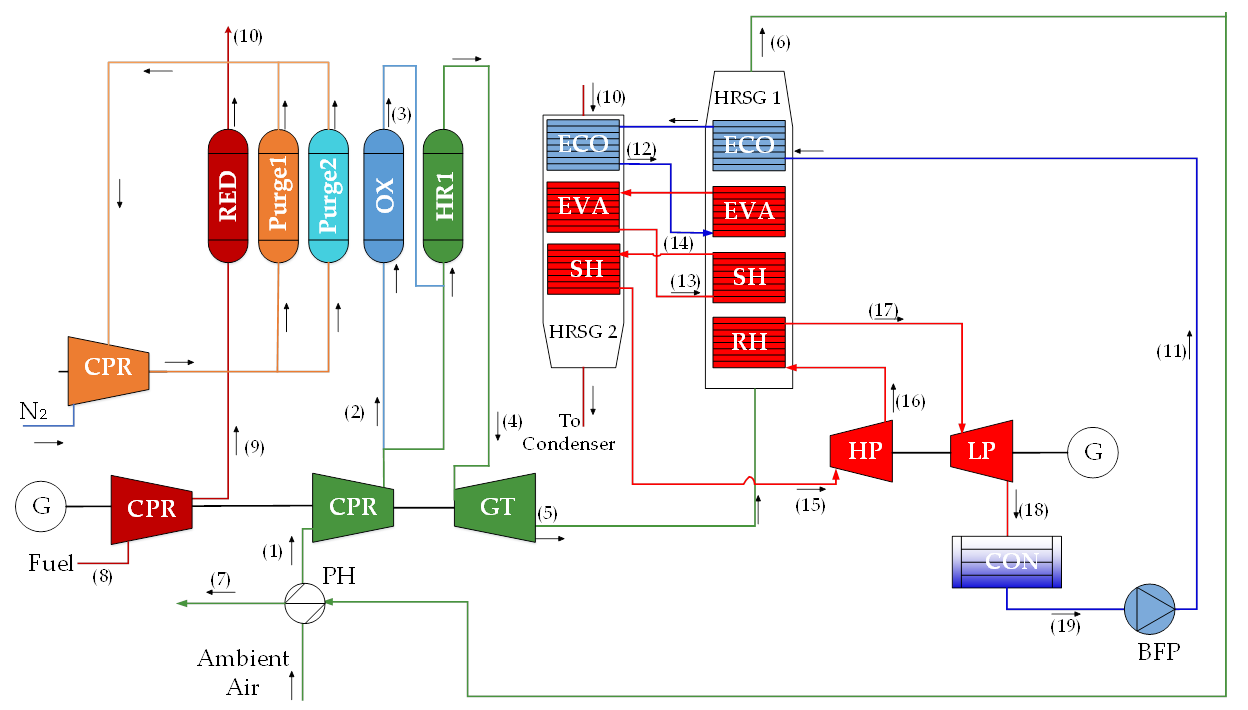
Figure 1: Simplified diagram of the CC integrated with CLC. (CPR: Compressor; G: Power generator; GT: Gas turbine; SH: Superheater; RH: Reheater; EVA: Evaporator; ECO: Economizer; HP: High-pressure turbine; LP: Low-pressure turbine; CON: Condenser; BFP: Boiler feed pump; PH: Preheater; OX: Oxidation; RED: Reduction; HR: Heat removal).
References
1. Herzog, H. J. New technologies could reduce carbon dioxide emissions to the atmosphere while still allowing the use of fossil fuels. Environ. Sci. Technol. (2001).
2. Han, L. & Bollas, G. M. Dynamic Optimization of Fixed Bed Chemical-Looping Processes. Energy 112C, 1107–1119 (2016).
3. Han, L. & Bollas, G. M. Chemical-looping combustion in a reverse-flow fixed bed reactor. Energy 102, 669-681 (2016).
4. Kehlhofer, R., Hannemann, F., Rukes, B. & Stirnimann, F. Combined-Cycle Gas & Steam Turbine Power Plants. (PennWell, 2009).
5. Chen, C., Han, L. & Bollas, G. M. Dynamic Simulation of Fixed-Bed Chemical-Looping Combustion Reactors Integrated in Combined Cycle Power Plants. Energy Technol. 4, 1209–1220 (2016).
6. Zhou, Z., Han, L. & Bollas, G. M. Overview of Chemical-Looping Reduction in Fixed Bed and Fluidized Bed Reactors Focused on Oxygen Carrier Utilization and Reactor Efficiency. Aerosol Air Qual. Res. 14, 559–571 (2014).
Acknowledgements
This material is based upon work supported by the National Science Foundation under Grant No. 1054718. CC gratefully acknowledges support by the GE Graduate Fellowship for Innovation. This work was partially sponsored by the United Technologies Corporation Institute for Advanced Systems Engineering (UTC-IASE) of the University of Connecticut. Any opinions expressed herein are those of the authors and do not represent those of the sponsor.
See more of this Group/Topical: Topical Conference: Innovations of Green Process Engineering for Sustainable Energy and Environment