
Pyrolysis of biomass and agricultural wastes is a readily achieved method for production of sustainable fuels and platform chemicals. While pyrolysis oil yields of up to 75 wt.% of the original biomass have been demonstrated,[1] raw pyrolysis oil is not suitable for combustion fuel applications due to poor stability and low heating value. Hydrodeoxygenation (HDO) of the oil fraction is a common method for removal of pyrolysis oil oxygen, which is eliminated in the form of water, thus preserving atomic carbon in the pyrolysis oil. Traditional HDO catalysts include NiMo, CoMo and precious metals, however the former require sulfidation and the latter are costly. Here, we propose Ultra-stable Y (USY) zeolite supported Ni catalysts for liquid-phase HDO of anisole, a common product formed from lignin pyrolysis.
Traditional zeolite catalysts are highly microporous, and as a result may limit diffusion of reactants and products to or from catalyst acid sites. Moreover, the low external surface area may result in increased micropore blockage after Ni impregnation. A variety of mesoporous USY zeolites were created using top-down alkaline desilication (DS), desilication with a pore-directing agent (DS-PDA)[2] and surfactant-mediated desilication (SA)[3]. As shown in Figure 1(A), DS formed a broad pore-size distribution with very little micropore volume, whereas DS-PDA preserved some microporosity and produced a narrower range of mesopores. The SA method preserved about 90% of the micropore volume and produced a narrow range of mesopore size at about 30 Ǻ. Material acidity and crystallinity decreased after all treatments, and a clear correlation between material crystallinity, acidity and micropore volume was observed. Figure 1(B) shows a visualization of the types of pores formed from each treatment. Alkaline treatment strength and PDA concentration were varied in order to determine the effect of each variable on zeolite properties.
Ni was impregnated by the incipient wetness method, and NiO crystal size was approximately 30 nm, determined by application of the Scherrer equation to X-ray diffraction (XRD) patterns. After reduction, the Ni crystal size decreased significantly on the more microporous materials, but remained high on the larger-pore materials. Larger crystal sizes and greater interaction with the DS and DS-PDA zeolites was observed from temperature programmed reduction (TPR).
Each material was evaluated as a catalyst for the liquid-phase HDO of anisole at 200 °C and 750 psi. Overall reaction rate increased in the order Ni-SA-USY<Ni-USY<Ni-DS-USY<Ni-DS-USY-PDA, shown in Figure 1(C). A simplified kinetic model of the anisole reaction pathways was proposed, and kinetic parameters were fit to the data and normalized to the number of Ni and acid sites. Analysis of the fitted kinetic parameters showed that the larger mesoporous zeolites enhanced access of reactant anisole to the Ni sites for more efficient hydrogenation of the aromatic ring, whereas acid-catalyzed deoxygenation of the hydrogenated intermediate was about an order of magnitude faster. The Ni-DS-USY-PDA was the most effective catalyst overall, as hydrogenation of the aromatic ring was shown to be the rate determining step in this reaction system.
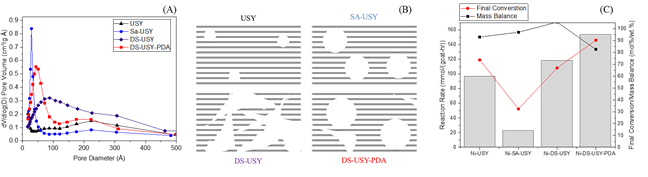
Figure
1. (A)
BJH pore size distribution of mesoporous USY materials. (B) Visualization of
each mesoporous USY material, white space indicates pore area. (C) Reaction
rates for anisole hydrodeoxygenation (bars correspond to left axis), in
addition to final anisole conversion and mass balance (corresponding to right
axis).
References
[1] O. Onay, Fuel 86 (2007) 1452–1460.
[2] D. Verboekend, G. Vile, J. Perez-Ramirez, Cryst. Growth Des. 12 (2012) 3123–3132.
[3] J. García-Martínez, M. Johnson, J. Valla, K. Li, J.Y. Ying, Catal. Sci. Technol. 2 (2012) 987.
See more of this Group/Topical: Catalysis and Reaction Engineering Division