
Combined molecular confinement and metal-support interface effects for control of hydrodeoxygenation selectivity on porous Pd@TiO2
Bingwen Wanga, Jing Zhangb, Will Medlinb and Eranda Nikollaa
aChemical Engineering Department, Wayne State University
5050 Anthony Wayne Drive, Detroit, MI, 48202
bChemical Engineering Department, University of Colorado
3415 Colorado Ave., UCB 596, Boulder, CO, 80303
Alcohols with aromatic substituents are key intermediates formed from deconstruction of biomass[1]. Selective deoxygenation of these alcohols is often desirable to produce fuels or fuel additives. Two probe molecules that have received attention are benzyl alcohol and furfuryl alcohol. Under hydrogenation conditions, various products can be formed from these reactants. The hydrodeoxygenation (HDO) products, toluene and 2-methyl furan, are the desired products for many fuels applications. Efforts to design catalysts capable of selective HDO of such oxygenated aromatic compounds have generally focused on two approaches: combination of two materials with complementary activity for hydrogenation and deoxygenation[2], and establishing control over aromatic-surface interactions[3].
In this study, we combine these approaches by successful encapsulating Pd nanoparticles (NPs) within a porous TiO2 film of controllable pore sizes to achieve high HDO selectivity, while maintaining high catalytic activity (Figure 1)[4]. Catalyst selectivity was found to be a strong function of both the presence of Pd-TiO2 interfacial sites and the pore size of the TiO2 shell. Moreover, experiments measuring hydrogenation rates for olefins of different molecular size strongly suggested that small pores hindered adsorption of aromatics in a “flat-lying” configuration that has been associated with non-selective C-C scission.
SHAPE \* MERGEFORMAT
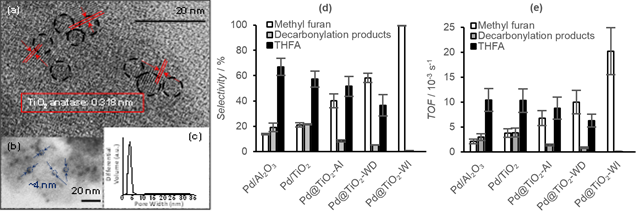
Figure 1. (a) Scanning transmission electron micrograph (b) bright field transmission electron micrograph and (c) pore size distribution of synthesized Pd@TiO2. (d) Selectivity and (e) turnover frequency for HDO of furfuryl alcohol over different Pd catalysts.
REFERENCES
[1] A. M. Robinson, J. E. Hensley, and J. W. Medlin, ACS Catal. 6 (2000) 5026.
[2] P. M. De Souza, R. C. Rabelo-Neto, L. E. P. Borges, G. Jacobs, B. H. Davis, T. Sooknoi, D. E. Resasco, and F. B. Noronha, ACS Catal. 5 (2015) 1318.
[3] C. H. Lien, and J. W. Medlin, J. Phys. Chem. C 118 (2014) 23783.
[4] J. Zhang, B. Wang, E. Nikolla, and J. W. Medlin, Angew. Chem. Int. Ed. (2017), in press.
See more of this Group/Topical: Liaison Functions