
Quorum-sensing (QS) therapeutics, which disable pathogen virulence without directly killing the target pathogen, offer a means of treating bacterial infection without creating the life/death selective pressure that in turn may lead to antibiotic resistance among bacteria. One infection of interest, pulmonary Pseudomonas aeruginosa, stands to benefit from these QS therapies; however, the bacteria exist in a biofilm state under a dense layer of pulmonary mucus, through which the QS therapeutic must be delivered at sufficiently high concentrations for effective treatment. We here demonstrate that the block copolymer-directed self-assembly technique Flash NanoPrecipitation (FNP) may be employed to create a series of nanoparticle (NP) formulations encapsulating V-06-18, a P. aeruginosa QS agent. Formulated nanoparticles reduce P. aeruginosa virulence factor production by as much as two orders magnitude more effectively than equivalently delivered but non-encapsulated drug. Pyocyanin toxin production and biofilm formation are nearly completely inhibited with micromolar concentrations of the nanoformulated compound. Formed nanoparticles offer controlled release with characteristic release rates as low as two weeks, which may be used for sustained release therapeutics. Particles also penetrate through human cystic fibrosis mucus, with >50% delivered particles being generally diffusive. This approach thus offers a promising means of combatting P. aeruginosa infections, even those beneath pulmonary mucus, using antivirulence therapies that do not directly elicit bacterial resistance.
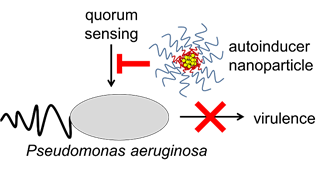
Concept schematic of a mucodiffusive nanoparticle encapsulating a QS drug that is effective against P. aeruginosa
See more of this Group/Topical: Nanoscale Science and Engineering Forum