
Analyzing the Effects of Time and Crosslinker Ratio on the Mechanical Properties of Biodegradable Zein Super Gels
Hazal Turasan, Jozef Kokini, Department of Food Science, Purdue University, West Lafayette, IN
Zein is the main storage protein found in corn and comprises almost 80% of all the corn proteins. Due to the lack of essential amino acids and insolubility in water, zein is not a good choice as a nutrition source for humans. However, its unique properties, such as film forming capability, make zein one of the most commonly chosen plant-based materials for many applications including textile production, adhesive industry, creating various analytical platforms or tissue engineering. Zein also has the ability to undergo gelation in different solutions. Many researchers have explored the solubility of zein in different solutions[1]–[4]. Based on the need for another solvent, the solvents for zein are classified in three. The solvents that does not need a secondary solvent to dissolve zein are classified as the primary solvents, and those that require the addition of either water or another solvent were defined as secondary solvents. Acetic acid is under the category of primary solvents. Ethanol, on the other hand, is classified in the secondary solvent for zein since it requires the addition of water to dissolve zein completely [4]. It has been reported that gelling properties of zein in solution depends on the type of the solution zein dissolved in, such that zein has less tendency to form a gel in its primary solvents [4]. It has also been reported that the addition of crosslinker to zein solutions increase the gelation process [5]. In this study, the gelation process of zein protein in a primary solvent, acetic acid solutions, have been explored to produce a stiff biomacromolecule gel from a plant-based polymer. The zein solutions have been crosslinked with glutaraldehyde solution and the results have been compared to control solutions with no glutaraldehyde. Rheological measurements were conducted on zein solutions to observe the changes in the chemistry and to determine the time of gelation. In addition, compression tests have been conducted on the fully gelled zein solutions to understand the highest compression the gels can endure without breaking.
The zein solutions were prepared with 70% aqueous acetic acid solution. The concentration of zein was kept constant at 1:5 (g/ml) ratio. Oleic acid and monoglyceride was added as plasticizer and the emulsifier at a ratio of 1:1 (g/g zein) and 1:0.15 (g/g zein), respectively. Different crosslinking ratios (0%, 4%, 8%, and 12% (w/w of zein)) have been tested to understand the minimum effective concentration of glutaraldehyde for stiff gel formation. The solutions were sonicated to remove the gas bubbles for 30 seconds for every 10 ml solution and left in room temperature without stirring for 30 days. Starting from Day 0 amplitude sweep tests and frequency sweep tests were conducted in replicates. The results showed that all the solutions showed liquid like behavior in Day 0, such that the loss modulus (G”) values were greater than the storage modulus (G’) values for all the crosslinker ratios. Uncrosslinked zein solutions did not show any sign of crosslinking throughout the experiment, such that neither the loss modulus values nor the storage modulus values showed an increasing trend in 30 Days. In addition, the loss modulus values were always greater than the storage moduli values for 0% solutions the entire experiment. This result suggests that zein in acetic acid solution does not gel without crosslinker. For 4% crosslinked solutions the loss moduli were greater than the storage moduli for 28 Days, indicating no gelation. However, at Day 30, the G’ values crossed the G” values, showing gelation onset for 4% crosslinked solution at Day 30. For 8% crosslinked zein solutions, the transition from sol to gel phase occurred at Day 12, shown by the crossover of G’ and G” values. For 12% crosslinked zein solutions, the gelation started the earliest, at Day 9. The highest G’ value reached in 12% crosslinked zein gels was 2000 Pa where it was 1100 Pa for 8% crosslinked zein gels. The mechanical compression tests showed that the gels formed from 4% were not stiff enough to resist compression; however, gels with 8% and 12% crosslinker ratio were stiff enough to take 70% compression to fully recover back to their original structure after the compression. At 80% strain, the gels collapsed irreversibly (Figure 1).
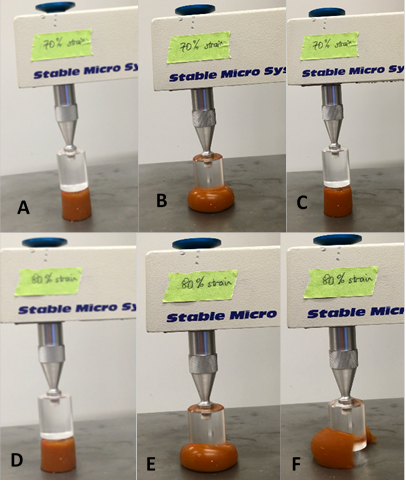 |
Figure 1. Compression test on zein gels. A) Before 70% strain, B) at 70% strain, C) Recovery after 70% strain, D) Before 80% strain, E) at 80% strain moment before failure and F) at 80% strain gel failure.
In summary, this study focuses on producing bio-based polymer super gels from zein-acetic acid solutions and understanding the rheological behavior of zein solutions during gelation. The results showed that with enough concentration of crosslinker, a super gel could be formed from corn protein. The uncrosslinked zein-acetic acid solutions did not show any gelation. 4% crosslinking was enough to start gelation, however, the formed gel was not stiff enough for compression test. Both 8% and 12% crosslinking caused gelation at day 12 and day 9 respectively resulting in stiff gels. The mechanical compression tests showed that both gels recovered from strains up to 70%. However, 80% compression caused gel failure.
[1] Y. Li, Q. Xia, K. Shi, and Q. Huang, “Scaling Behaviors of alpha-Zein in Acetic Acid Solutions,” J. Phys. Chem. B, vol. 115, no. 32, pp. 9695–9702, Aug. 2011.
[2] R. H. Manley and C. D. Evans, “Binary Solvents for Zein,” Ind. Eng. Chem., vol. 35, no. 6, pp. 661–665, Jun. 1943.
[3] D. Fu, “Zein properties and alternative recovery methods,” ETD Collect. Univ. Neb. - Linc., pp. 1–188, Jan. 2000.
[4] J. W. Lawton, “Zein: A History of Processing and Use,” Cereal Chem. J., vol. 79, no. 1, pp. 1–18, Jan. 2002.
[5] D. J. Sessa, A. Mohamed, and J. A. Byars, “Chemistry and Physical Properties of Melt-Processed and Solution-Cross-Linked Corn Zein,” J. Agric. Food Chem., vol. 56, no. 16, pp. 7067–7075, Aug. 2008.
See more of this Group/Topical: Materials Engineering and Sciences Division