
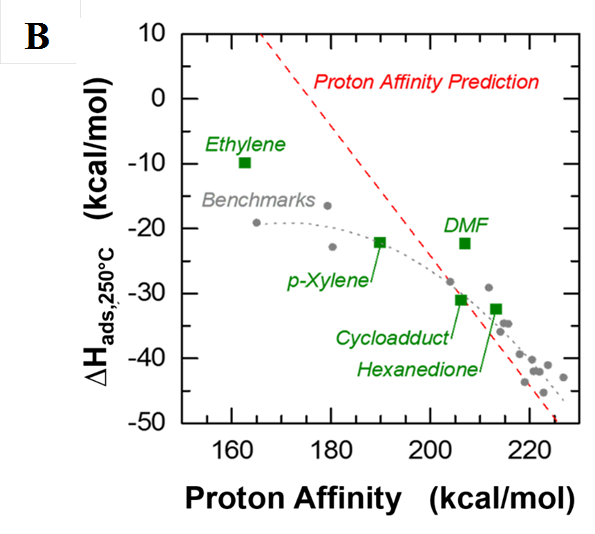
High selectivities (>90%) have been achieved with an H-BEA catalyst in the Diels-Alder cycloaddition, and subsequent dehydration, of 2,5-dimethylfuran (DMF) and ethylene to produce p-xylene.1-4 This success is unexpected due to the ability of xylene to isomerize in the presence of zeolite acid catalysts at similar conditions. In this work, three possible mechanisms describing the conversion of 2,5-dimethylfuran to p-xylene were evaluated, where the dominant mechanism was indicated as the homogeneous, uncatalyzed cycloaddition of DMF and ethylene, followed by an acid catalyzed dehydration (Figure 1a).5 The inhibition of xylene isomerization was attributed to large active site coverage of 2,5-hexanedione, the ring opened product of DMF. This is supported by the similar adsorption enthalpies of 2,5-hexanedione and the cycloadduct versus the less favorable adsorption enthalpy of p-xylene (Figure 1b). Though all reaction components were independently examined, only the presence of 2,5-dimethylfuran and 2,5-hexanedione, even at 1/50th the concentration of xylene, inhibited transalkylation and methyl shift reactions of p-xylene on H-Y (Si/Al 2.6) and H-BEA (Si/Al 12.5) zeolites. A combination of experimental techniques (thermogravimetric analysis, TGA, diffuse reflectance infrared Fourier transform spectroscopy, DRIFTS, and 27Al NMR) and ONIOM computational method allowed for the investigation of adsorption energetics of relevant species on zeolite acid active sites.
 | |||
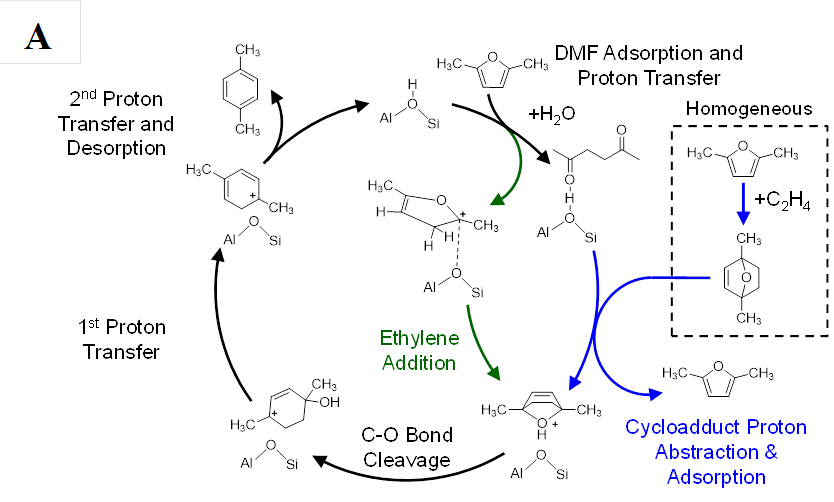 | |||
Figure 1. Proposed mechanisms of reaction of 2,5-dimethylfuran and ethylene to p-xylene and adsorption enthalpies of compounds in reaction mixture. A) Proposed catalytic cycles converting dimethylfuran to p-xylene. Brønsted acid sites within H-BEA and H-Y zeolite catalyze conversion of DMF and ethylene to p-xylene and water. B) Heat of adsorption versus proton affinity in H-Y zeolite. The heat of adsorption correlates linearly with proton affinity above 200 kcal mol−1. Deviation from the linear proton affinity prediction exists below 200 kcal mol−1.
[1] Williams, C. L.; Chang, C.-C.; Do, P.; Nikbin, N.; Caratzoulas, S.; Vlachos, D. G.; Lobo, R. F.; Fan, W.; Dauenhauer, P. J. ACS Catal., 2012, 2, 935-939.
[2] Chang, C.-C.; Green, S. K.; Williams, C. L.; Dauenhauer, P. J.; Fan, W. Green Chem. 2014, 16, 585-588.
[3] Patet, R. E.; Nikbin, N.; Williams, C. L.; Green, S. K.; Chang, C.-C.; Fan, W.; Caratzoulas, S.; Dauenhauer, P. J.; Vlachos, D. G. ACS Catal., 2015, 5, 2367-2375.
[4] Williams, C. L.; Vinter, K. P.; Chang, C.-C.; Xiong, R.; Green, S. K.; Sandler, S. I.; Vlachos, D. G.; Fan, W.; Dauenhauer, P. J. Catal. Sci. Tech., 6, 178-187.
[5] Williams, C. L.; Vinter, K. P.; Patet, R. E.; Chang, C.-C.; Nikbin, N.; Feng, S.; Wiatrowski, M. R.; Caratzoulas, S.; Fan, W.; Vlachos, D. G.; Dauenhauer, P. J. ACS Catal., 2016, 6, 2076-2088.
See more of this Group/Topical: Catalysis and Reaction Engineering Division