
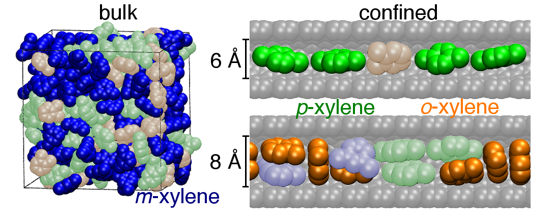
Xylene exists as three isomers: meta- (m-), ortho- (o-), and para- (p-). m-Xylene is the most abundant isomer in bulk fluids at equilibrium, but p-xylene is a valuable feedstock in the production of terephthalic acid. p-Xylene can be selectively produced using ZSM-5, a zeolite with narrow channels that prevent m- and o-xylene from escaping interior pores. Using reaction ensemble Monte Carlo (RxMC), we demonstrate that confining a xylene fluid to the interior of a carbon nanotube shifts the equilibrium composition as a function of nanotube diameter.
We adapt the original RxMC reaction move to align both the position and orientation of inserted product molecules and deleted reactant molecules. The accuracy and efficiency of this move is demonstrated for xylene isomerization in vapor, liquid, and supercritical phases. Classical RxMC requires the ideal gas free energy of reaction as an input. We compare three methods for computing this free energy: using tabulated enthalpies and entropies of formation, using the harmonic oscillator and rigid rotor approximation, and using QM/MM alchemical transformation combined with the multistate Bennett acceptance ratio (MBAR). We find that the tabulated free energies of reaction give the best agreement with experimental equilibrium compositions in bulk fluids. RxMC simulations in a carbon nanotube with an inner diameter of approximately 6 Å show that p-xylene becomes the dominant isomer under confinement, an effect consistent with the production of p-xylene in ZSM-5. We also show that o-xylene becomes the dominant isomer in nanotubes with an inner diameter of 7-8 Å. We find that both m- and p-xylene exhibit a loss of rotational entropy in nanotubes of this diameter, effectively allowing o-xylene to fit into cavities inaccessible to the other isomers.
See more of this Group/Topical: Computational Molecular Science and Engineering Forum