
Anti-Adhesive Glycosylated Proteins as a Technology for Improved Suspension Cell Culture in Bioreactors
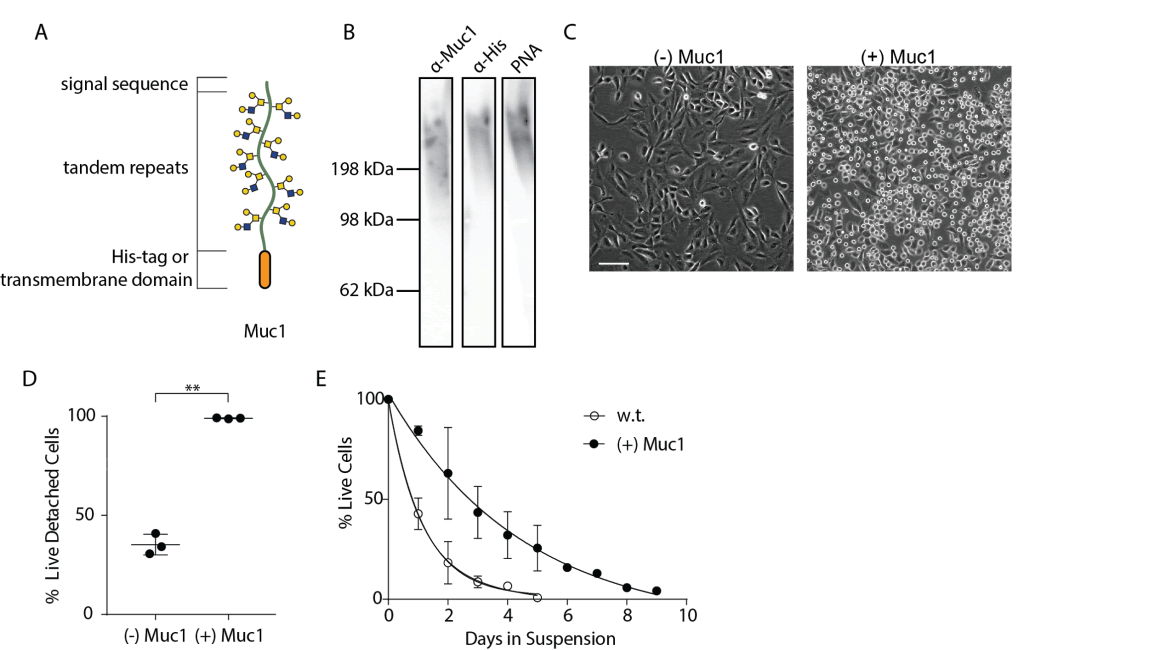
Mucins are brushlike biopolymers found in biointerfaces, including joints and on the surface of secretory glands (Figure 1A). Mucin biopolymers have anti-adhesive properties that mediate lubrication, resist cell adhesion, and protect cell surfaces, amongst other functions. Although mucin glycoproteins have broad potential in medicine and biomaterials applications, their use has been limited due to the challenge of biomanufacturing sufficiently large quantities. For example, prokaryotic host production, despite its efficiency, cannot properly reproduce the defining O-linked glycosylation of mucins. To address these issues, we have created a protocol to efficiently produce and purify structurally correct recombinant mucins from eukaryotic hosts, allowing us to better understand the molecular basis of mucin structure and investigate downstream applications, including their use as (1) biocompatible lubricants and (2) anti-clumping agents in eukaryotic-cell bioreactors. In another application, we engineered a membrane-anchored mucin, and observed that cells expressing the engineered mucins spontaneously transition from adherent to floating in the media, indicating decreased cell-cell and cell-matrix interactions (Figure 1C, D). Remarkably, these cells displayed an increased ability to survive in suspension compared to non-mucin expressing control cells (Figure 1E). These results suggest that cell surface engineering with genetically encoded mucins can improve the viability of eukaryotic cells, possibly streamlining suspension adaptation and bioreactor performance. Furthermore, the decreased cell-cell adhesivity of engineered cells should minimize aggregation, a common problem that has limited the use of human cell hosts in biomanufacturing. Overall, our engineered cells have potential to become a new production technology for biomanufacturing of complex biologics and recombinant proteins with human-specific glycosylation.
See more of this Group/Topical: Food, Pharmaceutical & Bioengineering Division