
Modern power plant designs are required to provide better operational flexibility and improved performance, and adapt to the rapidly evolving energy infrastructure.1–3 Dynamic simulation and optimization can be useful tools in analyzing the dynamic performance of power plants in response to seasonal and daily fluctuations in power demand and in the assessment of the value proposition and feasibility of new programs focused on renewable energy. Moreover, dynamic optimization offers the potential of reducing operating cost, improving exergy efficiency, meeting environmental requirements and reducing CO2 emissions.
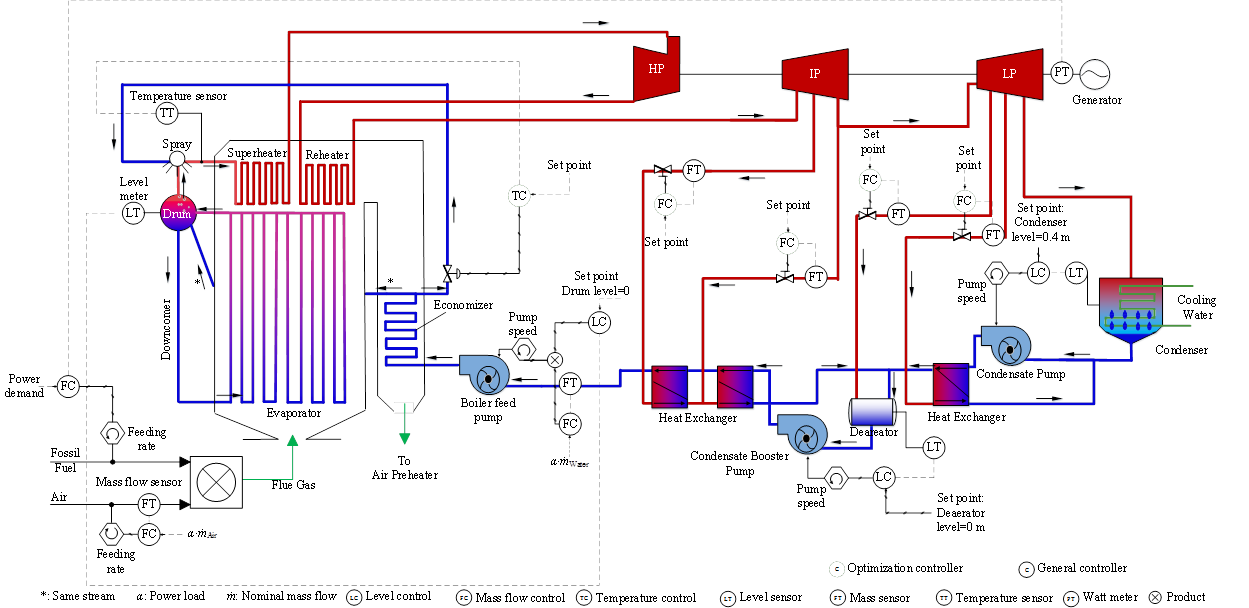
Figure 1: Simplified diagram of the steam side system of the 605 MW subcritical-pressure coal-fired power plant with control system.
In this work, a high-fidelity dynamic model was developed, for a 605 MW coal-fired, subcritical power plant with regenerative reheat cycle, as shown in Figure 1. Conventional regulatory controllers were incorporated in the plant model. The model was validated against static, full-load data from a fossil-fueled power plant reported in the literature.4 This validated plant model was used as a test-bed for dynamic simulations, in which the power plant operation was studied under transient power demand. The performance in closed-loop operation in response to step changes in coal load was assessed, showing that the plant model is stable and reliable for sudden changes, and the control system is able to maintain the controlled variables at their set points. Advanced power plant-level control architectures, including controllers for coal load, feed water load, and preheated air load, were used to adjust the power plant operations, in response to time-varying power demand. A supervisory control architecture was designed for the purpose of optimizing the net efficiency of the power plant operating under steady state and dynamically, in response to realistic load changes, employed using power demand from the New England ISO data. The value proposition of static and dynamic optimization of the plant operating at variable load was assessed. An improvement in time-averaged efficiency of up to 1.95% points was shown feasible with corresponding savings in coal consumption of 184.7 tons/day and carbon footprint decrease of 0.0352 kg/kWh. In summary, this presentation will show the complete work flow of data collection, model development and validation, control tuning, dynamic optimization formulation and solution, and supervisory control architecture for a coal-fired subcritical power plant, focusing on the potential efficiency, energy and carbon footprint benefits of model-based approaches.
References
1. Chen, C., Han, L. & Bollas, G. M. Dynamic Simulation of Fixed-Bed Chemical-Looping Combustion Reactors Integrated in Combined Cycle Power Plants. Energy Technol. 4, 1209–1220 (2016).
2. Chen, C., Zhou, Z. & Bollas, G. M. Dynamic Modeling, Simulation and Optimization of a Subcritical Steam Power Plant. Part I: Plant Model and Regulatory Control. Energy Convers. Manag. (unpublished) (2017).
3. Chen, C., Zhou, Z. & Bollas, G. M. Dynamic Modeling, Simulation and Optimization of a Subcritical Steam Power Plant. Part II: Dynamic Optimization under Time-Varying Power Load. Energy Convers. Manag. (unpublished) (2017).
4. Combustion Fossil Power: A Reference Book on Fuel Burning and Steam Generation. (Combustion Engineering, 1991).
Acknowledgements
This material is based upon work supported by the National Science Foundation under Grant No. 1054718. CC gratefully acknowledges support by the GE Graduate Fellowship for Innovation and helpful advice and guidance from Alstom Power.
See more of this Group/Topical: Computing and Systems Technology Division