
Models of complex systems, particularly thermofluid models of chemical processes, tend to be computationally and mathematically complex, consisting of many differential algebraic equations. Use of such models for applications beyond simple simulation, including optimization and controls development, can be infeasible due to their complexity. Model reduction methods are applied to develop reduced order models that adequately reflect the input-output behavior of higher-fidelity models, with significantly less computational cost. Currently practiced model reduction techniques are frequently based on projections [1], regressions, or surrogate modeling [2] [3]. The abstracted reduced models produced with these methods are effective for approximating outputs, but do not generally retain the physically meaningful parameters of the original model or system.
This work presents a novel method for the creation and evaluation of reduced order models, using a high-fidelity model as a basis. The proposed method consists of two key algorithmic processes. The first is a method for generating reduced models from an original model by heuristically directed term elimination. This process selectively removes or replaces parameters, variables, functions, and equations form the original model, creating a new candidate reduced model with each manipulation. The second key process is the selection of the most suitable reduced models from the candidate set by the evaluation of optimal experiments using a T-optimal design criterion. The candidate set of reduced models for the optimal experiments are those that are found to be suitable representations of the original for a nominal experiment. Similar formulations using different design criteria have been previously explored for use in the selection of kinetic models [4] [5] and fault detection and isolation [6].
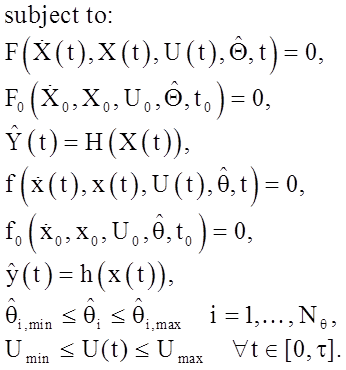
Eqs. (1) and (2) enumerate the optimal experiment design
problem, wherein 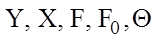 are
the outputs, state variables, equations, initial conditions, and parameters of
the original model while
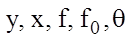 correspond
to the reduced model. The input trajectory
 is selected
to maximize the weighted error in the outputs of the reduced model as compared
to the original, integrated over the duration of the experiment
 . The
parameter values of the reduced model,
 , are
adjusted to minimize error and better approximate the original model. The
resulting optimal design vector
 characterizes
the experiment which will demonstrate the worst-case performance of the
parameterized candidate reduced model at representing the original model within
the state space of interest. If the observed maximum error from the optimal
experiment is within a specified threshold, the reduced model can be considered
as suitable.
| (1) |
| (2) |


The proposed method is demonstrated by application to some classic chemical process models, including homogenous and spatially discretized reactor models. It is observed that the method can autonomously recreate and select reduced models which match those identified in existing literature. It is also shown that the optimal experiment design approach can more reliably identify unsuitable reduced models as compared to experiments with nominal inputs or those with inputs at minimum or maximum values. Application to larger models of varying structure is performed in order to quantify the computational cost advantages achievable by the selected reduced models.
Acknowledgment
This work was sponsored by the UTC Institute for Advanced Systems Engineering (UTC-IASE) of the University of Connecticut and the United Technologies Corporation. Any opinions expressed herein are those of the authors and do not represent those of the sponsor.
References
[1] | B. Moore, "Principal component analysis in linear systems: Controllability, observability, and model reduction," IEEE Transactions on Automatic Control, vol. 26, no. 1, pp. 17-32, 1981. |
[2] | M. Schmidt and H. Lipson, "Distilling free-form natural laws from experimental data," Science, vol. 324, no. 5923, pp. 81-85, 2009. |
[3] | A. Cozad, N. V. Sahinidis and D. C. Miller, "Learning surrogate models for simulation-based optimization," AIChE Journal, vol. 60, no. 6, pp. 2211-2227, 2014. |
[4] | L. Han, Z. Zhou and G. M. Bollas, "Model-based analysis of chemical-looping combustion experiments. Part I: Structural identifiability of kinetic models for NiO reduction," AIChE Journal, vol. 62, no. 7, pp. 2419-2431, 2016. |
[5] | L. Han, Z. Zhou and G. M. Bollas, "Model-based analysis of chemical-looping combustion experiments. Part II: Optimal design of CH4-NiO reduction experiments," AIChE Journal, vol. 62, no. 7, pp. 2432-2446, 2016. |
[6] | K. A. Palmer, W. T. Hale, K. D. Such, B. R. Shea and G. M. Bollas, "Optimal design of tests for heat exchanger fouling identification," Applied Thermal Engineering, vol. 95, pp. 382-393, 2016. |
See more of this Group/Topical: Computing and Systems Technology Division