
Use of Sacrificial Agent to Enhance Gas Transport through the Washcoat
Pritpal Singh Dhillon, Michael P. Harold*
Di Wang2, Ashok Kumar2
1Dept. of Chemical & Biomolecular Engineering, University of Houston, Houston, Texas
2Cummins Inc., Columbus, Indiana
*
 corresponding
author e-mail: mpharold@central.uh.edu
Introduction
The Ammonia Slip Catalyst (ASC) is utilized to convert unreacted ammonia selectively into N2 while minimizing undesired products NO, NO2 and N2O. The dual-layer ASC comprises a base layer of an oxidation catalyst (Pt/Al2O3) and a top layer of a SCR catalyst such as Cu-exchanged zeolite. The dual-layer ASC is known for higher nitrogen selectivity, but it adversely affects ammonia conversion due to mass transfer limitations. Increasing the top (SCR) layer loading improves nitrogen selectivity, simultaneously it reduces ammonia conversion. To increase nitrogen selectivity without affecting conversion, we prepared modified dual-layer ASC materials with enhanced top washcoat macro-porosity. Sacrificial agents including yeast and poly-(tert-butyl acrylate) were used to create voidage inside the top SCR layer with the intent of reduced the mass transfer limitations for ammonia [1]. The impact of the modified washcoat on the ammonia conversion and N2 selectivity is the focus of the study. Reaction experiments were conducted using the modified dual-layer ASC showed significant increase in nitrogen selectivity and improvement in ammonia conversion simultaneously.
Materials and Methods
Bottom Layer: The base layer of a dual-layer ASC comprising Pt/Al2O3 was prepared through a sequence of steps. Catalyst powder was synthesized by incipient wetness impregnation using chloroplatinic acid hexahydrate as the Pt precursor. The Pt/Al2O3 slurry was prepared by adding deionized water and boehmite solution (AlOOH: 20wt %) to Pt/Al2O3 powder (mass ratio Pt/Al2O3: water: boehmite = 8:15:2) and ball milled for 20 h. The monolith was dipped into the Pt/Al2O3 slurry for 30 s and excess slurry was blown for 10 s. Subsequently, the monolith was dried in an oven at 120 oC for 2 h and the same dipping procedure was repeated to get the required loading. Finally, the monolith was dried overnight in an oven at 120 oC, followed by calcination at 550 oC for 5 h with a temperature ramp rate of 0.5oC/min. The freshly prepared monolith was then treated with 2% H2 and balance Ar for 1 h at 500 oC, followed by degreening with 5% O2 and balance Ar at same temperature for 2 h.
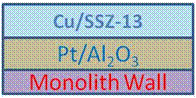
Conventional Dual-Layer: The dual-layer ASC comprising a Cu/SSZ-13 top layer and Pt/Al2O3 bottom layer was prepared as follows. Cu/SSZ-13 containing 3% Cu slurry was prepared by adding deionized water and boehmite solution (ALOOH: 20wt %) to Cu/SSZ-13 powder (mass ratio Cu/SSZ-13: water: boehmite = 4:8:5) and ball milled for 20 h. The monolith which was already coated with Pt base layer was dipped into the Cu/SSZ-13 slurry for 30 s and excess slurry was blown for 10 s. Subsequently, the monolith was dried in an oven at 120 oC for 2 h and the same dipping procedure was repeated to get the required loading. Finally, the monolith was dried overnight in an oven at 120 oC, followed by calcination at 550 oC for 5 h with a temperature ramp rate of 0.5oC/min. The type-I dual layer ASC was prepared (Fig 1).
Modified Dual-Layer: For the modified dual-layer ASC, the Cu/SSZ-13 (Cu/SSZ-13 containing 5% Cu) slurry was prepared by similar manner as above and ball milled for 20 h. Then, a calculated amount of sacrificial agent (yeast/polymer) was added to the slurry, intended to increase the porosity of top layer roughly by 20%. The monolith which was already coated with Pt base layer was dipped into the Cu/SSZ-13 slurry for 30 s and excess slurry was blown for 10 s. Subsequently, the monolith was dried at room temperature for 4 h and the same dipping procedure was repeated to get the required loading. Finally, the monolith was dried overnight at room temperature, followed by calcination in flow reactor (1000 sccm, 5% O2 & balance Argon) at 550 oC for 5 h with a temperature ramp rate of 1oC/min. The type-II dual layer ASC was prepared (Fig 2).
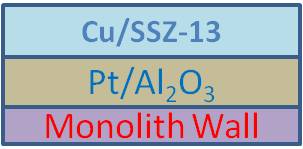
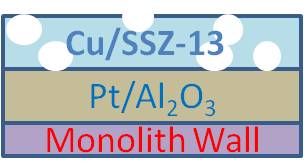
Figure 1: (Type-I: Dual Layer ASC) Figure 2: (Type-II: Modified dual layer ASC)
Results and Discussion
The dual layer samples (type I) with varied top layer loadings were tested for NH3 oxidation. The sample with the single Pt/Al2O3 layer achieved the highest NH3 conversion approaching 95% but had a poor N2 selectivity (Fig 3). The dual-layer sample with Cu/SSZ-13 loading of 3 g/in3 gave the highest N2 selectivity but had a lower NH3 conversion than the single layer sample (Fig 4). The results expectedly showed that the increase in top zeolite layer loading increases the mass transfer limitations by restricting the amount of NH3 reaching the base Pt layer [2]. To resolve the problem, modified dual-layer ASC is introduced.
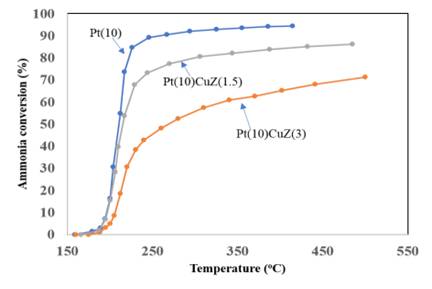
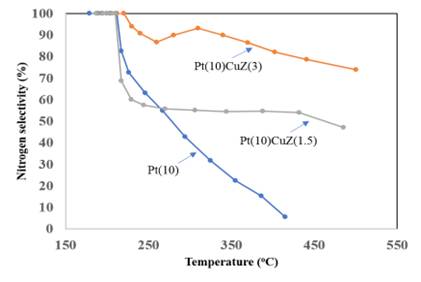
Figure 3: NH3 conversion vs temperature Figure 4: N2 selectivity vs temperature
Two samples of almost same loadings were prepared, a dual-layer ASC {Pt(10)CuZ(2.6)} and modified dual-layer ASC {Pt(10)CuZ(2.7)} using the above-mentioned steps. The modified dual-layer showed a notably higher N2 selectivity and somewhat improved NH3 conversion at high temperature (Fig 5 & 6).
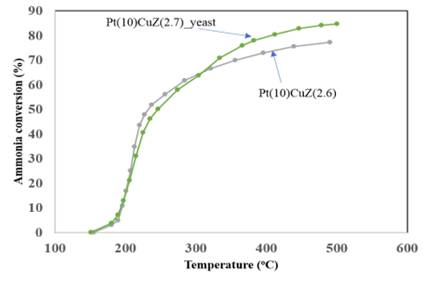
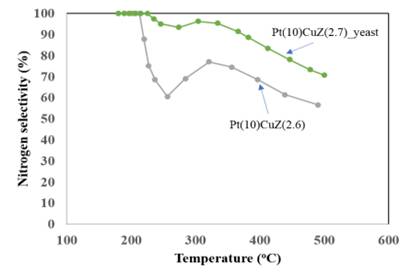
Figure 5: NH3 conversion vs temperature Figure 6: N2 selectivity vs temperature
This is an ongoing study. The results we get so far are quite encouraging and more experiments are being done to check the consistency of reaction results. Most of the yeast or poly-(tert-butyl acrylate) burn away at 550 oC (TGA data not shown here for brevity). The catalyst characterization will be done to find if there is any change in catalyst morphology due to yeast/polymer combustion.
References:
1. Václavík, M., Dudák, M., Novák, V., Medlín, R., Štěpánek, F., Marek, M., & Kočí, P. (2014). Yeast cells as macropore bio-templates enhancing transport properties and conversions in coated catalyst layers for exhaust gas oxidation. Chemical Engineering Science.
2. S. Shrestha, M. P. Harold, K. Kamasamudram, A. Kumar, L. Olsson and K. Leistner, "Selective oxidation of ammonia to nitrogen on bi-functional Cu-SSZ-13 and Pt/Al2O3 monolith catalyst," Catalysis Today, 2016.
See more of this Group/Topical: Catalysis and Reaction Engineering Division