
Investigation about SILICA PRECIPITATION IN A HYDROMETALLURGICAL PROCESS
Christian Manfoumbi 1,2, Martine Meireles 1, Kevin Roger 1, Denis Beltrami 2, Simon Blancher 2, Bruno Courtaud 2, Philippe Ribagnac2
1- LGC, Université de Toulouse, CNRS, INPT, UPS, Toulouse, France
2- ERAMET Research, Trappes, France
* Corresponding authors: christian.manfoumbi@erametgroup.com, meireles@chimie.ups-tlse.fr
Key words: Hydrometallurgy, silica, precipitation, solid-liquid separation, solubility
Silicon one of the most abundant constituent in the earth’s crust exist in amorphous forms, in crystalized phases (quartz) or in embedded inside crystallites such as silicates. Its dissolution and precipitation often lead to problems in hydrometallurgical processes such as cruds formation or decrease of the settling speed due to the formation of silica gels [1-2].Such phenomena are not well-known as they depend on many parameters such as silica concentration and the presence of impurities. As a consequence, it is a real challenge to understand the chemical and physical properties responsible for the dissolution and the precipitation of silica to avoid such difficulties in hydrometallurgical plants.
A comprehensive representative study was carried out to understand the behavior of silica during ore leaching process. The identification of the embedded silicon phases dissolved at pH 0 and 90°C was realized by XRD and MEB-QEMSCAN to identify the different phases present in the ore, in the residual concentrate and in the solid which precipitated during the leaching step. Their compositions and their evolution during the leaching step have been also investigated by using both methods. The results indicate that silicon is carried by quartz (SiO2), rhomboclase (HFe(SO4)2.4H2O) and mikasaïte (Fe2(SO4)3) minerals. During the leaching of the ore, iron phases are completely dissolved leading to the dissolution of silicon fraction which further precipitates.
Silica concentrations were determined by ICP_OES and UV-visible spectroscopy method at 800 nm. This last method was based on the complexation of silica with molybdic acid (equation 1) and allowed to study the influence of the composition of the aqueous solution on the kinetics of silica precipitation.
 (1)
The residence time and the initial leaching bath volume / ore mass ratio (L/M) are the two main parameters affecting the solubility of silica at a given pH and temperature. The kinetics results show that the dissolution of silica is fast and does not exceed 30 minutes whatever the ratio L/ M (Figure 1). However, the kinetics of precipitation is strongly dependent on this ratio as the solubility of silica is affected by the composition of the leached solution. The solubility of silica as a function of ratio L / M was investigated by using Pitzer’s model [3] with several interactions parameters [4] in PHREEQC thermodynamic software. The influence of sulfate ions concentrations on the solubility of silica was pointed out (Figure 2).
Small angle scattering techniques (SAXS) was used to characterize the morphology of the precipitates obtained for different residence times and L/M ratio. Filtration experiments were also carried out to investigate the solid-liquid separation performances of the precipitates obtained for the above mentioned conditions. SAXS results have shown that the ratio L/M changes the structure of the gel obtained and its filterability.
In conclusion, the difficulties on liquid-solid separation in the hydrometallurgical processes are frequently due to the precipitation and silica gels formation. In most cases, the knowledge of dissolution and precipitation mechanisms allows to find the solutions to improve liquid solid separation. For example by using resident time, mass fraction of ore for the leaching. However in our case the dissolution and precipitation is fast compared to the time required to recovery the value elements. Consequently these solutions are no viable. To improve liquid solid separation the composition effect has been used to guide the aggregation of silica particles towards gels having a good filterability.
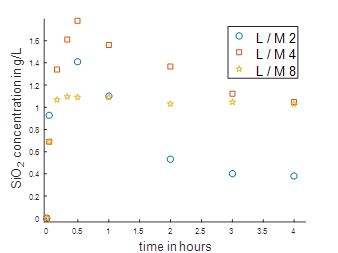
Figure 1: Effect of ratio L / M on kinetics of dissolution / precipitation of silica at pH 0 and 90°C measured by spectroscopic UV-visible at 800 nm.
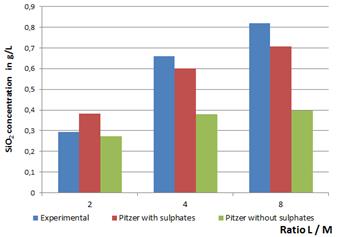
Figure 2: Influence of ratio L / M on the solubility of silica at pH 0 and 90°C. Experimental data are compared to the results of modeling under PHREEQC by using Pitzer’s model with and without interactions parameters of ions sulphates in liquid phase during the leaching.
References:
[1]. Margulis E.V.Behavior of silica when leaching oxidized material in zinc hydrometallurgy. Tsvetnye Metally Vol. 24 (1), 1983.
[2]. Queneau P.B, Berthold C.E. Silica in hydrometallurgy: an overview. Canadian Metallurgical Quarterly, Vol. 25 (3), 1986.
[3]. Weber C.F. Calculation of Pitzer parameters at higher ionic strength. Industrial & Engineering Chemistry Research, Vol. 39 (11), 2000.
[4]. Azaroual M., Fouillac C., Matray J.M. Solubility of silica polymorphs in electrolyte solution, activity coefficient of aqueous silica from 25 to 250 °C, Pitzer’s parametisation. Chemical Geology Vol. 140, 1997.997) 155-165
See more of this Group/Topical: Separations Division