
Model systems for mixed particulate fermentation broth
C Bliatsiou, L Böhm, M Kraume
Chair of Chemical and Process Engineering, Technische Universität Berlin, Germany
FH6-1, Fraunhoferstrasse 33-36, 10587 Berlin, Germany. Tel: +493031472791, email: lutz.boehm@tu-berlin.de
The project which is part of the Priority Programme “SPP1934 DiSPBiotech” is concerned with the experimental and numerical characterization of local mechanical stresses occurring in gassed stirred fermenters and their effect on biological agglomerates. The findings thus obtained are practically tested on the fermentation of Aspergillus niger. Furthermore, the results are used for the identification and development of low-shear stirrers.
To create controlled and repeatable conditions in experiments, suitable model systems which represent the biological broth are of high interest. The material properties such as density and rheology but also characteristics of the agglomerates depend on numerous parameters such as biological behavior, the mechanical and operational process settings as well as time. Even for such well known processes as the fermentation of A.niger, material property data can rarely be found. It is known that, depending on the conditions, the broth can have Newtonian (e.g., for pellet growth; Fig.1a) or non-Newtonian characteristics (incl. shear thinning, shear thickening, viscoelastic, e.g., for mycelia growth; Fig.1b) or even changing rheology over time due to increasing biomass concentration in the batch process. The same is valid for the characteristics of the agglomerates with rather large round particles in case of pellets down to smaller, in parts branched, filamentous shapes. This broad variety of conditions in real fermentation broth cannot all be covered by one model system. The requirements that the model solution should fulfill are challenging. It should be able to mimic all the material properties of the real system while covering the requirements of the applied measurement techniques as well. To name one example, e.g., for optical measurements, the continuous phase must be transparent.
Here, material and particle information is collected from literature and generated by own work and together with project partners within the frame of the Priority Programme. This information will be used to find proper model solutions. For a Newtonian rheology of the continuous phase, aqueous solutions with different additives can be used. Furthermore, for high viscous conditions, silicone oil or glycerol are valid options. To generate a non-Newtonian behavior carboxyl cellulose, xanthan gum or polyacrylamid solutions show a shear-thinning and, in parts, additionally viscoelastic behavior while still being transparent.
Covering the task of finding a model system for the dispersed phase as found in real systems with a comparable morphology and morphological behavior during the application of mechanical stress is an even the more complicated task. Suitable options are, e.g., a second immiscible liquid phase (Fig.1a) or blue-clay flocs (Fig.1b). The latter one, especially, is highly promising. Still it must be kept in mind that the dispersed phase can influence the rheology of the whole mixture, as well. To find a guideline for choosing the best model solution representing a particulate fermentation broth, these options must be investigated with according techniques for the determination of material properties, such as rheometers. Here, the accuracy of the measurements is of high importance especially for liquid-solid-mixtures as the solids can settle which changes the properties of the sample over time. As mentioned above, in the frame of this project, the morphology and morphological behavior during the application of mechanical stress, as found in stirred tanks, is of highest interest. This will be investigated in the stirred tank by using an endoscope measurement techniques together with an automated image analysis delivering the particle properties.
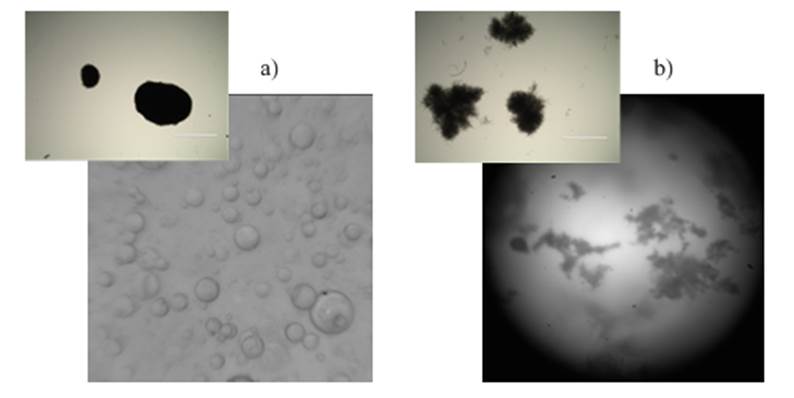
Figure 1. Images of a) pellet-like growth of A.niger (upper left) and an according potential model system (liquid-liquid dispersion) and b) of branched filamentous agglomerates of the fungi (upper left) with an according image of blue-clay flocs in a stirred tank
Acknowledgments
Financial support by the Deutsche Forschungsgesellschaft (DFG) in the frame of the Priority Programme SPP1934 DiSPBiotech is gratefully acknowledged. Special acknowledgements go to the working group of Prof. Krull from Technische Universität Braunschweig for the support in the fermentation and imaging of A.niger.
See more of this Group/Topical: North American Mixing Forum