
Electron energy loss spectroscopy for optoelectronics and thermal dynamics at nanocomposite interfaces.
D. Keith Ropera,b*, Jeremy R. Dunklind, Gregory T. Forcherioc, Keith R. Berryb, Carter Bodingerb, Tyler Howarde
a Microelectronics and Photonics Graduate Program, University of Arkansas, Fayetteville, AR 72701
b Department of Chemical Engineering, University of Arkansas, Fayetteville, AR 72701
cArmy Research Laboratory, Adelphi, MD 20783
dNational Renewable Energy Laboratory, Golden, CO 80401
 eDepartment of
Physics and Engineering Physics, Southeast Missouri State University, Cape
Girardeau, Missouri 63701
Optoelectronically active nanocomposite interfaces with programmable thermal dynamics could improve medical diagnostics, therapeutics and sustainable energy recovery. Nanoantenna at ceramic and polymer interfaces have been shown to enhance evaporative and pervaporative phase change. But challenges in simulating, fabricating and characterizing nanoantenna at solid-fluid interfaces has constrained their implementation in functional devices and systems.
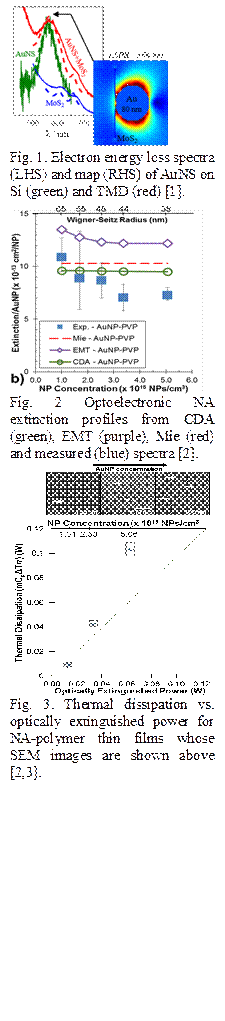
This work introduced electron energy loss spectroscopy (EELS) coordinated with coupled dipole approximation (CDA), finite element modeling (FEM), microthermometry and scanning electron microscopy (SEM) to develop structure-property relations for optoelectronic and optothermal effects of nanoantenna (NA) in nanocomposites and at interfaces. NA were integrated with transition metal dichalcogenides, polymer thin films and ceramic surfaces by three methods (i) drop-casting, (ii) solvent dispersion and (iii) electroless plating. Electron energy loss spectroscopy (EELS) was used to predict and characterize modes, damping and electromagnetic near fields of NA at nanocomposite interfaces (Fig. 1). Assembled NA were simulated using CDA to compare optoelectronic damping with Mie theory, Maxwell Garnett effective medium theory (EMT), and measured spectra (Fig. 2). Optothermal dissipation simulated by FEM using SEM was compared with microthermometry to distinguish contributions from excitation, radiation, conduction and convection (Fig. 3). Integrating results from these simulation tools and novel integrated characterization approach supported relating effects of geometry and composition for both NA and nanocomposite on equilibrium as well as dynamic optoelectronic and optothermal properties of nanocomposites [3].
The structure-property relations obtained were validated over ultraviolet, visible, and near-infrared wavelengths and over greater than 10-fold changes in relative values of internal and external thermal time constants. Polymer thin films and ceramics exhibited consistent interfacial thermal dynamics in both liquid and gas media. Enhanced optical extinction and enhanced interfacial energy transport observed in super-wavelength scale nanocomposites with concentrated NA inclusions was attributable to optical diffraction.
Overall, coordination of EELS, CDA, FEM, and SEM with transmission UV-vis spectroscopy and microthermometry supported a comprehensive approach to simulate, fabricate and characterize nanocomposites and interfaces decorated with optoelectronically active nanoantenna. Structure-function relations that appear valid across a broad spectrum of material properties and operating conditions could guide design of nanoantenna-containing nanocomposites for implementation in a variety of uses.
[1] G.T. Forcherio et al., Adv. Opt. Mat. (2016) 4(8) 1288 [2] T.V. Howard et al., submitted. [3] D.K. Roper et al., in preparation.
See more of this Group/Topical: Materials Engineering and Sciences Division