
The world continues to modernize its electrical grid with more renewable sources, among which wind and solar photovoltaics are fastest growing1. While these sectors are becoming more competitively priced2, their grid penetration is still limited by the variability of their supply. Secondary energy storage would then go far to enable renewable power, although such energy storage must likewise be cost-effective.
Redox flow batteries (RFBs) reversibly store energy in solubilized redox couples, which are stored external to the electrodes. This allows independent design of power and energy capacity and avails RFBs to a range of applications. The design space is further widened by an influx of chemical, geometric and operational innovations. Other advantages of RFBs include fast response, good efficiency and long cycle life.
While RFBs are getting closer to market, their grid-scale costs are confounded by the abundance of optimizable design conditions; moreover, experimental scale-up studies can exhaust a great deal of time and capital. A unified model, on the other hand, could quickly predict performance and cost characteristics of candidate RFBs, provided it be generalizable and contain an optimization framework to distill design variables into the lowest cost basis. We detail such a model3 and validate its robustness for several state-of-the-art RFBs (Figure 1). Our model could direct future efforts toward the most technically and economically promising designs (Figure 2), ushering in a new pace for RFB development.
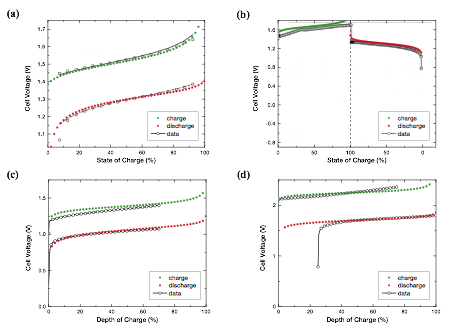
Figure
1. Model
validation with charge discharge data for the (a) all-vanadium4,
(b) polysulfide-bromide5, (c) polysulfide-iron6,
and (d) zinc-iron7 batteries.
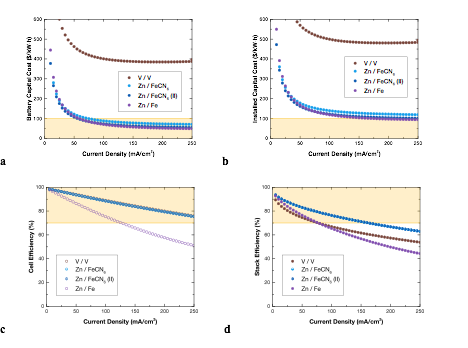
Figure 2. Modeled (a) battery capital costs, (b) installed capital costs,
(c) cell efficiencies, and (d) stack efficiencies for zinc-ferricyanide
and various state-of-the-art RFBs3-7.
References:
1. International Energy Agency. World Energy Outlook 2016. 2016; WEO-2016.
2. Yang Z, Zhang J, Kintner-Meyer MCW, Lu X, Choi D, Lemmon JP, Liu J. Chem. Rev. 2011; 111:3577.
3. Ma RX et al. In preparation.
4. You D, Zhang H, Chen J. Electrochim. Acta 2009; 54:6827.
5. Zhao P, Zhang HM, Zhou HT, Yi BL. Electrochimica Acta 2005; 51:1091.
6. Gu S, Gong K, Yan EZ, Yan YS. Energy Environ. Sci. 2014; 7:2986.
7. Gong K, Ma RX, Conforti KM, Kuttler KJ, Grunewald JB, Yeager KL, Bazant MZ, Gu S, Yan YS. Energy Environ. Sci. 2014; 7:2986.
See more of this Group/Topical: Transport and Energy Processes