
Computationally-Enhanced Spectroscopic Studies of Supported Vanadium Oxide
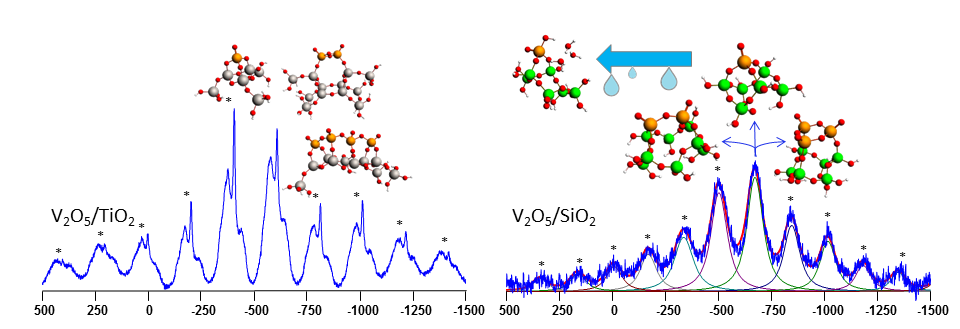
Supported vanadium oxide materials are utilized as catalysts for an expansive array of vital chemical transformations. Such reactions include the oxidation of paraffins, olefins, alcohols, and sulfur dioxide and the selective catalytic reduction (SCR) of NOx. The importance of these oxide catalysts has driven extensive efforts to understand the nature of these catalysts at the atomic level; promoting a greater understanding of the interactions between the catalyst and reactants. Despite these efforts, many questions remain regarding the structural nature of the vanadium centers, particularly with contrasting supporting materials and under different vanadium environments. Previous investigations have suggested the presence of VO4 monomers at low surface coverages and progressive oligomerization up to the monolayer limit on most oxide supports. Less decisive evidence is available for silica-supported catalysts due to their low surface reactivity and high surface area. Further ambiguity exists when considering the environmental effects on the catalyst’s structure. Hydration has been shown to alter the surface structure where contrasting claims of decavandate and vandia gel formation exist. In this study, solid-state nuclear magnetic resonance (NMR) spectroscopy and quantum chemistry simulations of the NMR spectra are used to aid in understanding the nature of V2O5/SiO2 and SCR V2O5(-WO3)/TiO2 catalysts exposed to different environments (dry, hydrated, and ammonia/NO).
To meet the challenge of collecting the 51V MAS NMR spectra, both a high-field (19.98 T) Varian-Inova spectrometer and a 14.09 T Bruker spectrometer were used. A sample spinning rate of 35 kHz was possible in pencil-type 2.5 mm rotors. Chemical-shift calculations were performed with the Amsterdam Density Functional software using the Gauge Independent Atomic Orbital approach. Chemical shift calculations were verified by comparison to known reference compounds. V2O5/SiO2 catalysts with coverages between 0.22θ and 0.63θ were probed with NMR to assess the potential for oligomerization upon increased loading. Vanadium oxide catalysts were also studied under both dehydrated and ambient environments to elucidate the structural changes that occur upon exposure to water. Dehydrated V2O5/SiO2 catalysts exhibited one broad feature at -675 ppm while the hydrated form offered peaks at -566 ppm and -610 ppm. Computational modeling of the 51V NMR chemical shifts indicated that anchoring of vanadium oxide does not occur on three-ringed silica and requires larger silica anchoring clusters such as 6-ringed support anchoring positions. The results also show that, unlike titania-supported vanadium oxide, the chemical shifts for monomeric and dimeric vanadium species are similar. Cyclic trimer species may also resonate near the observed chemical shift, but linear trimers, tetramers, and V2O5 crystallites are unlikely candidates. Hydrated structures were considered on the basis of water addition and previously-proposed olation mechanisms. Both di-grafted, isolated VO4 units and di-grafted dimer species demonstrated reasonable agreement between the calculated NMR parameters and the main peak at -566 ppm observed in the spectra.
The results suggest the possible presence of monomers, dimers, and cyclic trimers on the dehydrated V2O5/SiO2 samples. Upon exposure to ambient moisture, the V-O-Support bridge bonds partially hydrolyze to form di-grated species and a bulk-like species. No support for decavanadate or vanadia gel formation is available from this study. These results are compared with those obtained from SCR V2O5/TiO2 catalysts where different surface vanadium species are clearly observed by 51V MAS NMR. Understanding the structure of these materials and how they respond to changes in chemical environment is essential for proposing chemical reaction mechanisms and promoting the rational design of new materials.
See more of this Group/Topical: Catalysis and Reaction Engineering Division