
Manufacturing the thermodynamically stable polymorph of a given solute is typically desired to prevent changes of crystal form upon storage (which impacts the performance of the final product). While the stable polymorph is readily accessible in batch processes through seeding, efficient polymorph control strategies for continuous crystallization are still absent. However, continuous processes have considerable advantages over batch processes, such as higher productivity and steady state operation. In this contribution, we therefore present a strategy to achieve the production of the stable polymorph from such continuous processes.
| Figure 1. Process flowsheet.
|
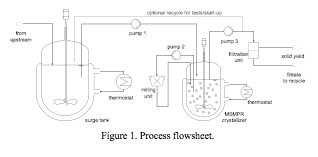 |
In this work, we investigate the polymorphs, yields and productivities obtained from a continuous process using models and experiments. The flowsheet is shown in Figure 1 where a crystallizer is fed from a surge tank with clear supersaturated solution and a milling unit is connected to the crystallizer in a loop. Using the mill in this way allows to increase the surface area of the crystals in the crystallizer which is expected to lead to an increased yield. We show that it also ensures the production of the stable polymorph in a much wider range of operating conditions than without the mill.
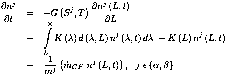
To study this process configuration, we use L-glutamic acid (LGA) as model compound. The two known polymorphs of LGA exist in a monotropic system (a metastable; b stable) and its thermodynamics and kinetics have been well characterized previously [2-6]. We introduce a model consisting of two population balance equations (PBEs) that represent the two polymorphs in the crystallizer (Eq. 1):
 (1)
| Figure 2. Solute concentration during the start-up of the processes (left) and the polymorph ratios of the b polymorph (right).
|
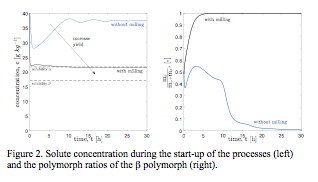 |
To conceptually show the effect of the mill on the process outcome, we report results with and without the mill under otherwise identical operating conditions (residence time: 1 h, feed concentration: 40 g/kg, temperature: 45ûC, equal starting masses of both polymorphs) in Figure 2. The model results show that the process including milling achieves a higher yield (Figure 2 left) and achieves production of the stable b polymorph (Figure 2 right). Conversely, the process without milling delivers a lower yield and produces the metastable a polymorph. The process concentration trajectory drawn in black shows that the steady state concentration drops below the a solubility when milling is used, hence all a crystals dissolve, are washed out, and no new crystals can be formed. Hence, the process only yields b crystals. In addition to that more solute is crystallized increasing both, the yield and the productivity of the process.
Concluding, the suspension mill effectively maintains a high surface area of the crystals in a continuous crystallization process, which allows achieving higher productivities, but can also be used to steer the polymorphic outcome towards the stable polymorph. For instance, using this setup, it becomes possible to obtain the stable polymorph at high productivities under processing conditions that would lead to the metastable polymorph without the mill.
In an attempt to confirm our modeling results experimentally, we performed experiments using a 500 mL crystallizer and an IKA MagicLab suspension mill. The experiments were conducted at 25ûC, 40 g/kg feed concentration and 2 h residence time. The feed is prepared in a 10 L reactor kept at 80ûC. The suspension/solution is transported between the vessels using peristaltic pumps. Qualitatively confirming our modelling results, we observed that operating the crystallizer with milling yields the b polymorph. Operation without the mill yields the metastable a polymorph.
We highlight here that the stable b polymorph was previously only obtained from continuous crystallizers that were either operated at higher temperature (i.e., lower potential yield) or with very long residence times exceeding 17.4 h at 25ûC [1]. In contrast, we show that using the combined milling-crystallization process, the same result can be achieved with a residence time of 2 h at 25ûC. Therefore, the present combination achieves both higher yield and higher productivity.
Through a combination of further experiments and modeling, we obtain a map of polymorphic outcomes in dependence of operating conditions (residence time, feed concentration, milling intensity), similar to what has been presented for systems without milling by Farmer et al. [6]. We show that our combined milling/crystallization process shows larger regions of operating conditions where the stable polymorph is reliably obtained in comparison to the crystallizer-only configuration.
References:
[1] T. Lai, S. Ferguson, L. Palmer, B.L. Trout, A.S. Myerson Org. Process Res. Dev. 18, 1382-1390 (2014).
[2] J. Cornel, C. Lindenberg, M. Mazzotti Cryst. Growth Des. 9, 243-252 (2008).
[3] M. Kitamura Cryst. Growth Des. 96, 541-546 (1989).
[4] J. Schšll, D. Bonulami, L. Vicum, M. Mazzotti Cryst. Growth Des. 6, 881-891 (2006).
[5] C. Lindenberg, J. Schšll, L. Vicum, M. Mazzotti Cryst. Growth Des. 8, 224-237 (2008).
[6] T.C. Farmer, C.L. Carpenter, M.F. Doherty, AIChE J. 62, 3505-3514 (2016).
See more of this Group/Topical: Separations Division