
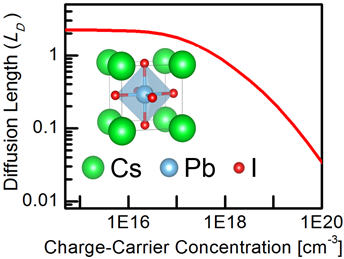
The exceptional photovoltaic performance of hybrid organic – inorganic perovskites, exhibiting power conversion efficiencies beyond 22%, has inspired a surge in research over the last few years into the broader family of lead-halide perovskites. More recently, all-inorganic CsPbX3 (where X is a halide) has emerged as a promising alternative to the hybrid perovskites due to its greater chemical stability. Herein, polycrystalline thin films of all-inorganic, perovskite-phase cesium lead iodide (CsPbI3) have been investigated by pump-probe transient absorption (TA) and time-resolved terahertz spectroscopies (TRTS). By modeling the carrier recombination kinetics as a function of the initial photo-induced carrier concentration, the rate constants are determined, revealing an unusually slow bi-molecular rate constant (k2) of 10-11 cm3s-1 and a mono-molecular recombination life time as long as 160 ns. From the TRTS measurement, the carrier mobility (m) has been estimated to be >10 cm2/Vs. The combination of these parameters leads to an estimated carrier diffusion length (LD), a critical parameter in solar absorber, well over one micrometer in CsPbI3. Remarkably, these excellent optoelectronic parameters are exhibited by a solution-deposited thin film, and are equivalent or even slightly superior to the examples of highly optimized hybrid perovskites in the literature, processed in the same manner. The surprising similarity between CsPbI3 and its hybrid equivalent strongly implies that the organic cation does not provide any explicit benefit in photovoltaic performance. In conjunction with recent successes in improving the structural stability of the perovskite phase of CsPbI3 these results argue for a greater role for CsPbI3 in future photovoltaic technologies.
See more of this Group/Topical: Materials Engineering and Sciences Division