
NO Uptake and Desorption on Fe-Modified Pd/ZSM-5:
Impact of Pd and Fe Loading
Kyle Karinshak*, Michael P. Harold*, and Kiran Premchand+
*Dept. of Chemical & Biomolecular Engineering, University of Houston, Houston, Texas
+FCA US LLC Auburn Hills, MI 48236
* corresponding author:
M.P. Harold (mpharold@central.uh.edu)
Reducing cold-start emissions, emissions under 200 °C, will play a significant role in meeting future EPA and EU emissions standards. By adsorbing NO and NO2 at low temperatures and releasing these gases in temperatures regimes where traditional emission control catalysts can operate, Passive NOx Adsorbers (PNAs) augment existing emission control systems and are a promising new field of catalysis. The scant published literature has focused on Pd supported on various materials, including ceria or alumina. In contrast, the patent literature suggests the efficacy of ZSM-5 as a support as well as the addition of Fe to PNA compositions [1-6]. Our preliminary investigations into Palladium-exchanged MFI zeolites show significant NOx uptake capabilities and complex desorption behavior.
Catalyst samples were prepared through a wet impregnation protocol before being deposited onto monolith cores. Palladium(II) nitrate was used as the precursor and dissolved into water equal to the pore volume of the ZSM-5 zeolite (SAR 30). Alumina solution was added to the washcoating solution to improve binding. Four catalysts – 0 wt% Pd, 1wt% Pd, 1 wt% Pd/1 wt% Fe, and 2 wt% Pd, were washcoated onto a 0.25in diameter, 2in length, 600 cspi monolith cores at a fixed loading of 1.5 g/in3. A bench-scale quartz reactor was utilized to simulate emissions and study uptake and desorption characteristics. DRIFTS (diffuse reflectance infrared Fourier transform spectroscopy) experiments of catalysts samples were performed to examine surface species formation and the mechanism through which NOx uptake occurs on Pd/ZSM catalysts.
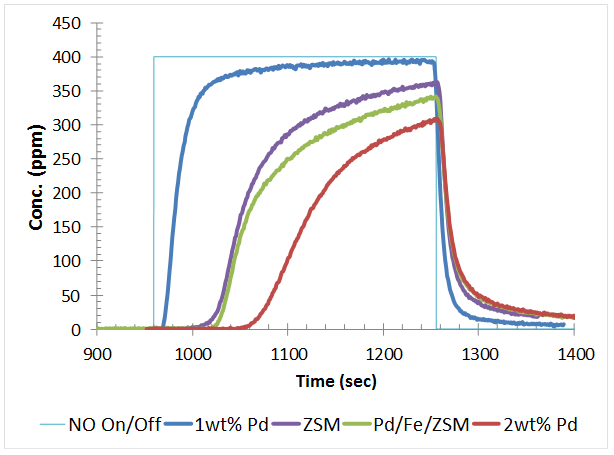
Figure 1 shows uptake characteristics of NOx uptake at 50 oC over a five minute duration for the four catalyst. 400 ppm of NO was flowed through the catalyst accompanied by 2% O2 and balance Ar. Similar trends were observed at uptake temperatures of 80 oC and 150 oC with decreasing uptake quantities and breakthrough periods. NO adsorption was accompanied by noticeable NO2 slip from the catalyst. The addition of Fe to the catalyst composition significantly improved the performance of NOx uptake.
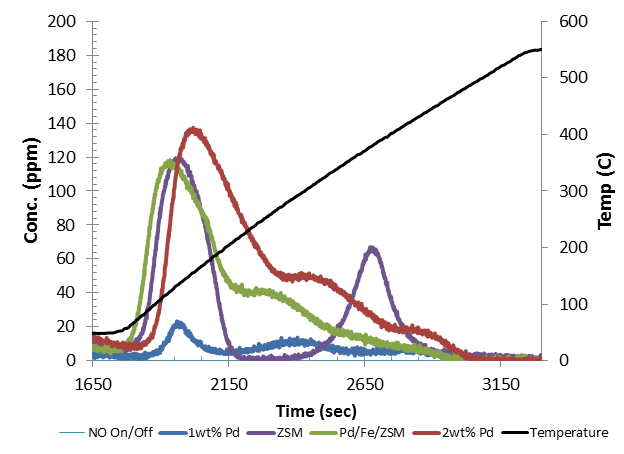
Figure 2 shows the NOx desorption peaks from the same experiments. Over half of desorbed NOx occurred in the form of NO2. As NO adsorbs as a mono nitrosyl palladium complex, this shows that NO is being converted into NO2 through a zeolite-surface reaction and likely storing on the Pd-less acid sites of the zeolite and binder. Unlike Murata et al, who reported a single NOx desorption peak during TPD experiments [7], our results reveal multiple desorption peaks. Three distinct peaks are identified in Pd-containing samples whereas only two exist in the Pd-less sample. A preliminary assignment of these peaks include acid sites of the binder, the acid sites of the zeolite, and the Pd nitrosyl complexes.
Figure 3 shows DRIFTS measurements of three samples: 0 wt% Pd, 1 wt% Pd/1 wt% Fe, and 2 wt% Pd. Experiments were conducted in the presence of oxygen. Peak analysis matches that reported by Descorme and Gelin, confirmed the NO adsorption mechanism [8]. The Pd/Fe sample did not show the peaks associated with NO adsorption onto Fe complexes, confirming that the role of Fe in the catalyst composition is ensure a high dispersion of Pd [9]. Experiments conducted without oxygen (not shown) display peaks associated with NO adsorption onto Pd but do not show peaks associated with NO2 formation and storage.
Additional TPD experiments (not shown) have shown that the presence of water significantly suppresses NOx uptake and desorption. The introduction of water inhibits the surface-reaction formation of NO2, likely through the suppression of zeolitic acid sites. Ongoing experiments include powdered catalyst TPD experiments as well as additional DRIFTS experiments to better understand and quantify the effects the addition of binder.
 Ongoing work will include modifications to the
catalyst compositions as well as the addition of a modelling component for both
uptake and desorption. Additionally, concurrent experiments are
being carried out to understand the effects of adding hydrocarbons
to the gas environment.
 |

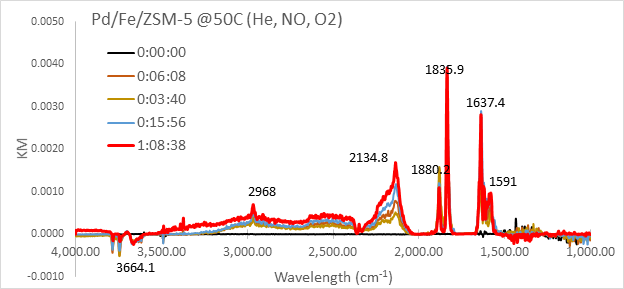
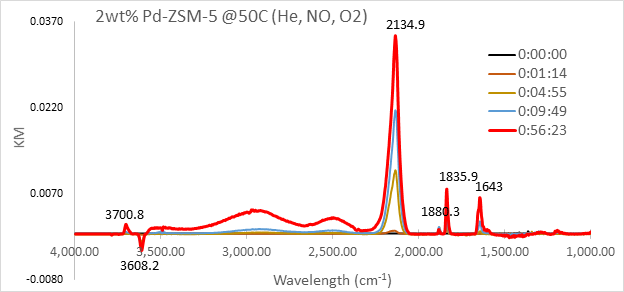
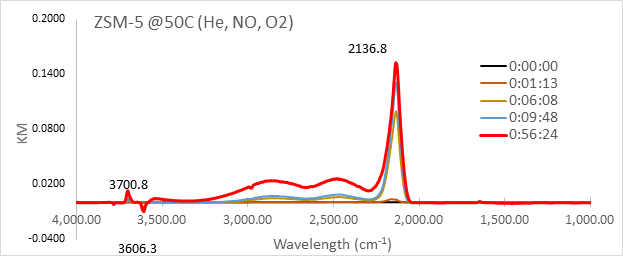 Figure
3: Evolution
of DRIFTS data over time from three samples.
See more of this Group/Topical: Catalysis and Reaction Engineering Division