
There is a great need to develop rapid, sensitive, and accurate infectious disease diagnostics. Current gold standard pathogen detection often involves fluorescence-based DNA amplification readings or antibody-based assays to confirm disease presence in either patient or environmental samples. Here we introduce an alternative method, particle diffusometry, where the presence of amplified DNA is detected by measuring change in solution viscosity. The presence of V. cholerae, S. aureus, and K. pneumoniae with specialized oligonucleotide primers allows for amplification using loop-mediated isothermal amplification (LAMP). This amplification increases the length of polynucleotides in the solution, which in turn makes the fluid sample more viscous. We suspend 200 nm particles in a fluid sample and image their Brownian motion with fluorescence microscopy. In the presence of amplified pathogen DNA, these particles exhibit slower Brownian motion, indicating a change in the particle diffusion coefficient, and in turn the solution viscosity. Particle diffusometry calculates the diffusion coefficient of the particles by correlating successive particle images (at time Dt) to one another (cross-correlation, sc) and the particle image with itself (autocorrelation, sa) at a magnification (M):
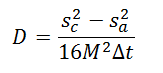
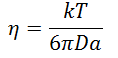
From the diffusion coefficient, the viscosity (η) of the solution is calculated by the Stokes-Einstein equation, where k is the Boltzmann’s constant, T is absolute temperature, and a is the hydrodynamic radius of the 200 nm particle.
Using particle diffusometry we successfully determine the presence of amplified V. cholerae DNA in blinded studies involving (A) V. cholerae DNA with oligos that underwent LAMP, and the following controls: (B) no V. cholerae DNA but with oligos that underwent LAMP, (C) V. cholerae DNA with oligos that did not undergo LAMP, and (D) no V. cholerae DNA but with oligos that did not undergo LAMP. Particle diffusometry measurements are also comparable to qPCR (fluorescence signal). We compare both techniques using a concentration range of pure DNA that is equivalent to what is found in samples containing 1-10,000 cells/mL. Further, we determine the change in viscosity of DNA amplification in the presence of whole cells for V. cholerae, K. pneumoniae, and S. aureus. Finally, we can measure the presence of DNA amplified V. cholerae cells in environmental pond water sources, indicating the feasibility of particle diffusometry for the point of care. From these studies, we find that particle diffusometry has a lower limit of detection of 100 cells/mL, a relevant concentration for the detection of V. cholerae in water sources. We will also discuss our current work on the implementation of particle diffusometry onto a smartphone-based platform as a quantitative point of care pathogen detection device.
See more of this Group/Topical: Food, Pharmaceutical & Bioengineering Division