
The alkaline Zn/MnO2 battery has dominated the primary battery market since its invention because of its low cost and safety characteristics, as well as its high theoretical energy density that arises from the high gravimetric capacity of MnO2. Currently, a long-term rechargeable Zn/MnO2 battery is achievable at a reduced depth of discharge (DOD) (~10%-20% of the first electron of MnO2) with a curtailment of energy density [1]. Its energy density higher than that of lead-acid batteries and the cost lower than $100/kWh make it a disruptive technology. Accessing higher DOD results in higher energy densities, but leads to detrimental characteristics like phase transformation of MnO2 and the zinc redistribution [2][3]. Recently, a class of Bi-birnessite (a layered MnO2 structure with bismuth oxide) material intercalated with Cu2+ has been reported as being able to stabilize the MnO2 structure and deliver near-full two-electron capacity for more than 6,000 cycles in the absence of zinc [4]. However, when a zinc anode is employed, the most detrimental effect arises from zincate ions ([Zn(OH)4]2-) formed during discharge that traverse to the cathode side and react to form a spinel phase ZnMn2O4, a highly resistive and electrochemically inactive compound, leading to rapid energy density loss and battery failure [5][6]. Therefore, inhibiting ZnMn2O4 formation remains a major challenge for the long-term cycling of an energy dense secondary Zn/MnO2 battery.
In this presentation, we report the use of an interlayer fabricated of calcium hydroxide for zincate sequestration, which successfully prevents ZnMn2O4 formation. Ca(OH)2 is known to reversibly react with zincate ions and form an insoluble complex, calcium zincate (Ca(OH)2•2Zn(OH)2•2H2O). Its role as an anode additive in Ni/Zn batteries is well known; however, its use has been limited due to its high resistivity and low density. We find that Ca(OH)2 as an interlayer successfully avoids these drawbacks. It shows good properties such as a porous structure, good electrolyte retention ability, and a high ionic conductivity (Fig. 1a). It stabilizes the zincate concentration at a lower number in the bulk electrolyte by forming calcium zincate with excess zincate ions during discharge, and working as a zincate source during charge through decomposition (Fig. 1b). It is effective in localizing and trapping the zincate ions, while not affecting the transport of hydroxyl ions. More importantly, it inhibits the formation of zinc manganese spinel phase at high DOD as observed through X-ray diffraction (Fig. 2a) and energy dispersive X-ray spectroscopy analyses, which results in improved capacity retention and energy density in a Zn/MnO2 cell (Fig. 2b).
References
[1] N. D. Ingale, J. W. Gallaway, M. Nyce, A. Couzis, and S. Banerjee, J. Power Sources, 276 (2015) 7-18
[2] D. E. Turney, J. W. Gallaway, G. G. Yadav, R. Ramirez, M. D'Ambrose, S. Kolhekar, M. Nyce, X. Wei, J. Huang, Y. Chen-Wiegart, J. Wang, S. Banerjee, Chemistry of Materials, under review.
[3] X. Wei, D. Desai, G.G. Yadav, D. E. Turney, A. Couzis, S. Banerjee, Electrochim. Acta, 212 (2016) 603-613
[4] G. G. Yadav, J. W. Gallaway, D. E. Turney, M. Nyce, J. Huang, X. Wei, S. Banerjee, Nat. Commun. 8, 14424 (2017)
[5] J. W. Gallaway, M. Menard, B. Hertzberg, Z. Zhong, M. Croft, L.A. Sviridov, D. E. Turney, S. Banerjee, D. A. Steingart, and C. K. Erdonmezg, J. Electrochem Soc., 162 (2015) A162-A168
[6] J. W. Gallaway, B. J. Hertzberg, Z. Zhong, M. Croft, D. E. Turney, G. G. Yadav, D. A. Steingart, C. K. Erdonmez, and S. Banerjee, J. Power Sources, 321 (2016) 135-142
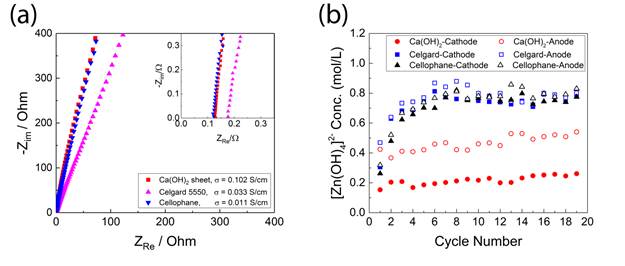
Fig. 1 (a) Nyquist plots showing ionic conductivities of different separators measured by a symmetric cell; (b) Zincate ion concentrations in the cathode and anode chambers of a cycling cell at the end of each discharge half-cycle, with different separators applied.
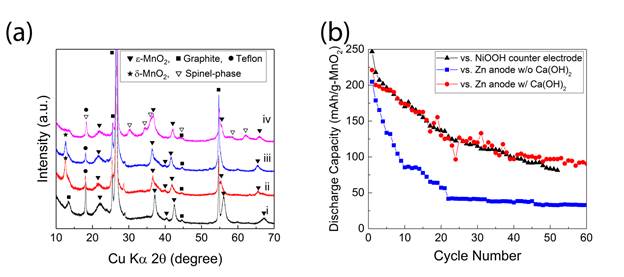
Fig. 2 (a) XRD patterns of different EMD electrodes i) uncycled, ii) cycled vs. a Hg/HgO reference electrode, iii) cycled in a cell with a Ca(OH)2 interlayer and iv) cycled in a Ca(OH)2-free cell; (b) Curves of specific discharge capacity with cycle number.
See more of this Group/Topical: Transport and Energy Processes