Dongyu S. Wang1, Sahil Bhandari1, Shahzad Gani2, Sarah Seraj2, Zainab Arub3, Gazala Habib3, Joshua Apte2 and Lea Hildebrandt Ruiz1, (1)Chemical Engineering, The University of Texas at Austin, Austin, TX, (2)Civil, Architectural, and Environmental Engineering, The University of Texas at Austin, Austin, TX, (3)Civil Engineering, The Indian Institute of Technology Delhi, Delhi, India
Chronic exposure
to fine particulate matter (PM) leads to premature death and increases the risk
of cardiopulmonary disease. Industrialization and urbanization in developing
countries like India and China present unique air quality challenges, where
dense populations are routinely exposed to high levels of atmospheric
pollutants. Pollutant composition and source profiles remain poorly
characterized and lack temporal resolution in such settings. A better
understanding is required to devise effective control and remediation policies
to combat air pollution challenges in megacities such as Delhi, India.
Ambient
measurements of submicron aerosol (PM1, dp
< 1 µm) were carried out at The Indian Institute of Technology Delhi during
the winter of 2017. Bulk chemical composition, number, size distribution, black
carbon content, and concentration of PM1 were measured by a suite of
instruments, including an Aerosol Chemical Speciation Monitor (ACSM). Results
show high PM concentrations dominated by organic species, exceeding 50 μg/m3 on
average during the campaign. Speciated diurnal
profiles highlight a unique morning (6:00–9:00) particulate chloride peak, as
shown in the figure below. A literature survey was conducted to identify
potential local and regional chloride sources. Complimentary laboratory studies
were performed to improve chloride quantification. Source apportionment was
carried out via Positive Matrix Factorization of ACSM mass spectra. Results
indicate significant contribution from hydrocarbon-like organic aerosol (HOA) sources.
This study provides time-resolved information on particulate matter concentrations,
sources, and characteristics in Delhi, India.
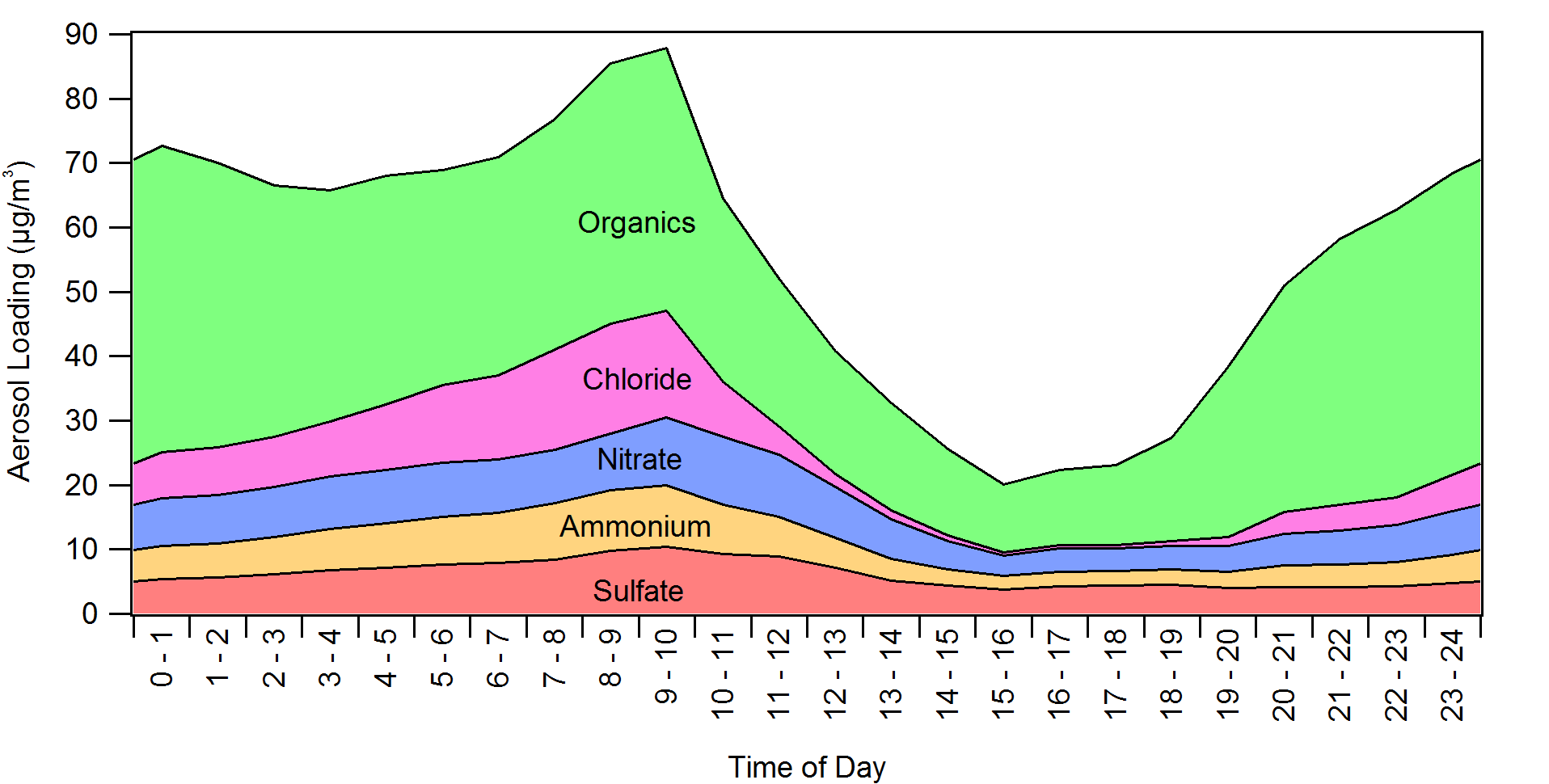
Figure 1: Preliminary diurnal PM1
profile in Delhi, India from February 2017, as measured by ACSM. Unity
collection efficiency was used.
Extended Abstract: File Not Uploaded
