
Identification of the equilibrium parameters for the modeling of the hydrogen solubility in heavy crude cuts using the Matlab-Aspen connection.
Camilo MONROY-PEÑA1, Johana ORJUELA1
1 Universidad Nacional de Colombia Universidad de Cundinamarca, Colombia
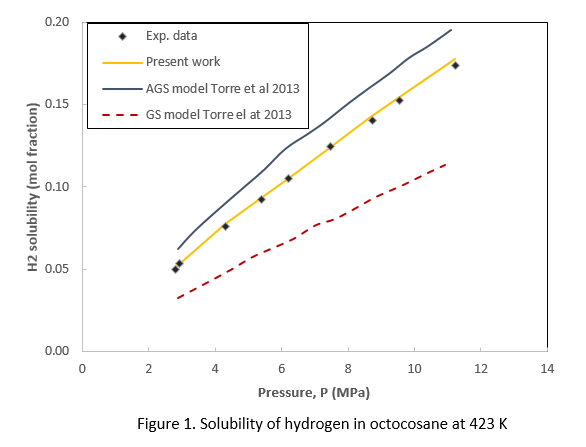
At present there is an increase in the use of heavy crude oil and bitumen, which must be converted into clean fuels. The conversion is carried out in processes such as hydrotreatment and hydrorupture. The design and operation of these equipment requires knowledge of the solubility of hydrogen in heavy crude blends. Various investigations have shown that thermodynamic methods such as Grayson Streed (GS)have an acceptable approximation to the experimental behavior for pure organic compounds, but does not adequately represent the solubility in heavy cuts. The present work implements the identification of the parameters of various thermodynamic models using Aspen Properties ® software as a tool for thermodynamic modeling and Matlab as a tool for optimization and programming of the NSPSO bioinspired algorithm in order to reduce the error between the experimental results and the model. Figure 1 compares the experimental data obtained by Torres et al. 2013 (black), with the GS (blue) and AGS (red) models developed by Torres et al. 2013 and the Peng Robinson (PR) model with the optimized parameters (yellow) in this work. We found that the thermodynamic models of Peng Robinson (PR), PengRobinson modified by Bostion Matias, Benedith Webb Rubin Straling reduced by more than 20% the approximation of the solubility in pure hydrocarbons as well as in the heavy cuts compared to the work developed by Torres et al. 2013.
Torres, Roger, JC.de Hemptinne, and I. Machin. "Improving the modeling of Hydrogen solubility in heavy oil cuts using an augmented Grayson Streed (AGS) Approach." Oil & Gas Science and Technology–Revue d’IFP Energies nouvelles 68.2 (2013): 217233.
See more of this Group/Topical: Engineering Sciences and Fundamentals