
Reversible Transformation from Pt Single Atoms to Sub-Nanometer Particles for Low Temperature CO Oxidation
Xavier Isidro Pereira Hernández1+, Andrew DeLaRiva2+, Haifeng Xiong2, Eric J. Peterson2, Deepak Kunwar2, Berlin Sudduth1, Yong Wang1,3,* and Abhaya K. Datye2,*
1 Voiland School of Chemical Engineering and Bioengineering, Washington State University, Pullman, WA 99164.
2 Department of Chemical and Biological Engineering and Center for Micro-Engineered Materials, University of New Mexico, Albuquerque, New Mexico 87131, USA.
3 Institute for Integrated Catalysis, Pacific Northwest National Laboratory, Richland, WA 99354.
*Corresponding authors: Prof. A. K. Datye (datye@unm.edu) and Prof. Y. Wang (yong.wang@pnnl.gov)
+ These authors contributed equally to this work
Abstract: While single atom catalysts can provide high catalytic activity and selectivity, application in industrial catalysts demands long term performance and the ability to regenerate the catalyst. We have investigated factors that lead to improved catalytic reactivity of Pt for low temperature CO oxidation. Single atom Pt/CeO2 becomes active for CO oxidation under lean condition only at elevated temperatures, because CO is strongly bound to ionic Pt sites. Activating the catalyst with a reduction treatment, even under mild conditions, leads to onset of CO oxidation activity even at room temperature. This high activity state involves the transformation of mononuclear Pt species to sub-nanometer sized Pt particles. Under oxidizing conditions, the Pt can be restored to its stable, single atom state. The key to facile regeneration is the ability to create mobile Pt species and suitable trapping sites on the support, making this a prototypical catalyst system for industrial application of single atom catalysis.
1. Introduction
One of the main objectives during the synthesis of heterogeneous catalysts is to have the active transition metal in an atomically dispersed form, in order to maximize atom efficiency. This can be achieved either through trapping the atomic species [1] or by limiting the transition metals weight loading [2], [3]. However, in most cases, increases in temperature under reaction conditions leads to sintering and loss of this dispersed form. Therefore, heterogeneous catalysts are based on catalyst supports that aid in the reaction and/or provide stability to the transition metal. Ceria is just one of the numerous supports that are used for Platinum Group Metals (PGM). Ceria is a commonly used component in automotive exhaust catalysts, often used as an additive for oxygen storage and in lean NOx traps. The unique ability of Ceria to change from Ce+4 to Ce+3 and the facile synthesis methods that can produce various morphologies make it ideal as a support for Pt. We show here a ceria-supported Pt single-atom catalyst with great stability even at temperatures as high as 800°C, as previously reported [4], and its activation (and structural changes) to achieve high activity for CO oxidation (low CO oxidation light-off temperatures) while maintaining its stability. Furthermore, we show that the catalyst can be restored to its initial state by high-temperature treatment under oxidative conditions, granting it flexibility to operate under the desired conditions. We propose that the Pt/Ceria catalyst be considered as a prototypical system that can toggle between an atomically dispersed form and self-assemble into a high activity state, providing the design elements for a thermally stable catalyst for industrial applications.
2. Experimental
The catalysts were synthesized via Dry Impregnation (DI) [5]. The activity measurements were performed using a stainless-steel reactor tube and monitored by a micro Gas Chromatograph (GC). The catalyst was characterized by means of High-Angle Annular Dark-Field Scanning Transmission Electron Microscopy (HAADF-STEM), Diffuse Reflectance Infrared Fourier Transform Spectroscopy (DRIFTS), X-Ray Photoelectron Spectroscopy (XPS), Raman Spectroscopy and X-Ray Powdered Diffraction (XRD).
3. Results and Discussion
The activity measurements for the As Synthesized catalyst (prior to activation) and the activated catalysts are observed on Figure 1. The activation of the catalyst is performed at 275°C under CO flow. It is seen that when the Pt/CeO2 catalyst is activated, the light-off temperature decreases drastically (approximately 200°C).
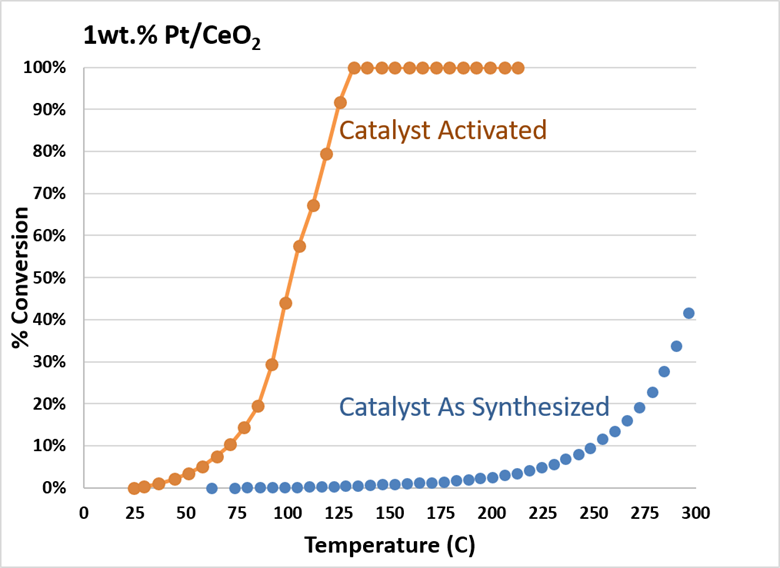
Figure 1. CO oxidation reaction on a 1wt.%Pt/CeO2 catalyst, As Synthesized and Activated.
DRIFTS measurements were performed on the catalyst As Synthesized, Activated and Regenerated and are observed on Figure 2. The catalyst as synthesized shows a very well defined peak at 2095 cm-1, assigned to CO adsorbed on ionic Pt. Other authors have reported the adsorption of CO on ionic Pt at similarly high wavenumbers [6], [7]. After being activated, the presence of two peaks at 2086 cm-1 and 2073 cm-1 is observed. These two peaks are assigned to CO adsorbed linearly on Pt nanoparticles (NPs). At the same time, the Activated catalyst shows a peak at 2110 cm-1, assigned to CO adsorbed on ionic Pt. The reason for the blueshift between the As Synthesized and Activated catalysts is associated to the presence of CO dipole-dipole interactions in the latter one, due to the existence of Pt NPs near the Pt single atoms. After performing a regeneration at 800°C under O2 flow, the catalyst shows the same behavior as the As Synthesized catalyst, suggesting it can be restored to the initial state.
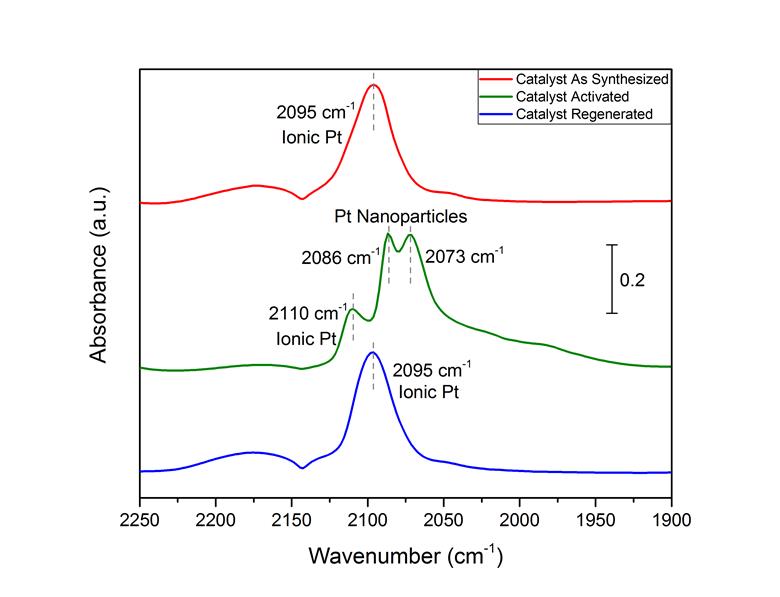
Figure 2. CO oxidation reaction on a 1wt.%Pt/CeO2 catalyst, As Synthesized, Activated and Regenerated.
To further study the state of the catalyst, XPS measurements were performed and can be observed on Figure 3. The Ce 3d region shows that changes on the support start occurring during activation at temperatures as low as 125°C, in which Ce4+ is reduced to Ce3+. Very little difference is observed between activation at 125°C and 275°C. Once regenerated, all the Ce3+ is converted to Ce4+, although, this behavior is expected since CeO2 can be oxidized relative easily. Analyzing the Pt 4f region, it can be observed that unlike on CeO2, activation at 125°C only reduces partially the Pt2+ species, which are present in the catalyst As Synthesized. Activating the catalyst at 275°C shows a more well defined peak at 71.2 eV, associated to Pt0. Once again, it is seen that the regeneration step restores the Pt species to their original state.
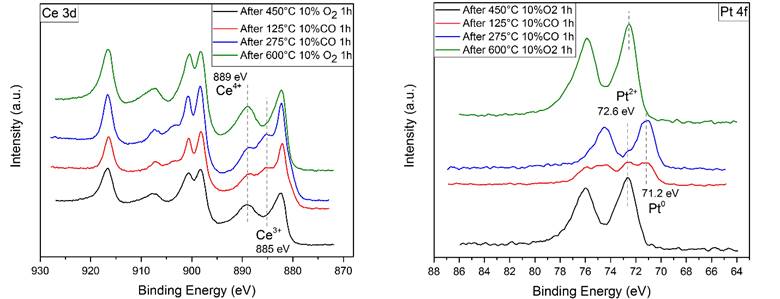
Figure 3. XPS spectra of the 1wt.% Pt/CeO2 catalyst. Left: Ce3d region. Right: Pt4f region. As Synthesized (Black), Activated at 125°C (Red), Activated at 275°C (Blue), Regenerated at 600°C (Green).
To confirm the results obtained by the previous characterization techniques, HAADF-STEM images on the Activated and Regenerated catalyst are presented on Figure 4. The Activated Catalyst (left) shows the presence of Pt species of 1 nm or smaller size (bright spots). These sub-nanometer particles are not observed anymore after regeneration (right) due to the redispersion of the Pt atoms.
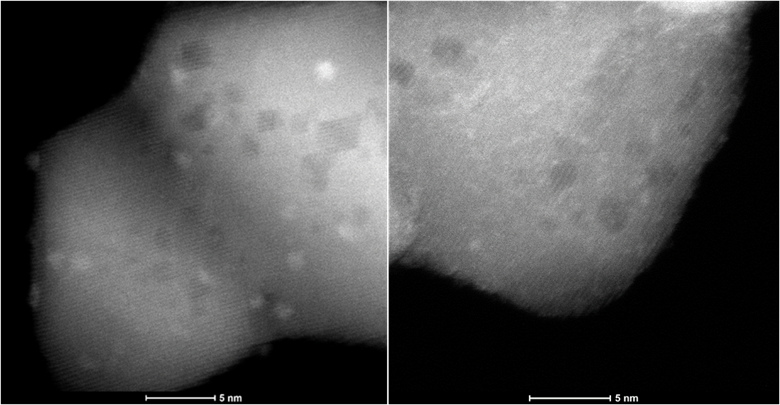
Figure 4. HAADF-STEM images of the 1wt.% Pt/CeO2 catalyst. Left: Activated catalyst. Right: Regenerated catalyst.
Conclusions
We presented a pathway to synthesize a Pt single-atom catalyst that is stable at temperatures as high as 800°C. This catalyst can be activated by a reduction treatment, leading to high activity for CO oxidation at low temperatures. Furthermore, the catalyst shows the capability to be restored to its initial state by regenerating it under an oxidation treatment at high temperatures, granting it flexibility to operate under the desired conditions in an industrial environment.
References
[1] X. Li et al., “Single-Atom Pt as Co-Catalyst for Enhanced Photocatalytic H2 Evolution,” Adv. Mater., vol. 28, no. 12, pp. 2427–2431, 2016.
[2] M. Moses-Debusk et al., “CO Oxidation on Supported Single Pt Atoms: Experimental and ab Initio Density Functional Studies of CO Interaction with Pt Atom on θ-Al2O3(010) surface,” J. Am. Chem. Soc., vol. 135, no. 34, pp. 12634–12645, 2013.
[3] B. Qiao et al., “Single-atom catalysis of CO oxidation using Pt1/FeOx,” Nat. Chem., vol. 3, no. 8, pp. 634–641, 2011.
[4] J. Jones et al., “Thermally stable single-atom platinum-on-ceria catalysts via atom trapping,” Science (80-. )., vol. 353, no. 6295, pp. 150–154, 2016.
[5] K. De Jong, Synthesis of Solid Catalysts. Wiley-VCH Verlag GmbH & Co. KGaA, 2009.
[6] K. Ding et al., “Identification of Active Sites in CO Oxidation and Water-Gas Shift over Supported Pt Catalysts,” Science (80-. )., vol. 350, no. 6257, pp. 189–192, 2015.
[7] S. C. Ammal and A. Heyden, “Water-Gas Shift Activity of Atomically Dispersed Cationic Platinum versus Metallic Platinum Clusters on Titania Supports,” ACS Catal., vol. 7, no. 1, pp. 301–309, 2017.
See more of this Group/Topical: Catalysis and Reaction Engineering Division