
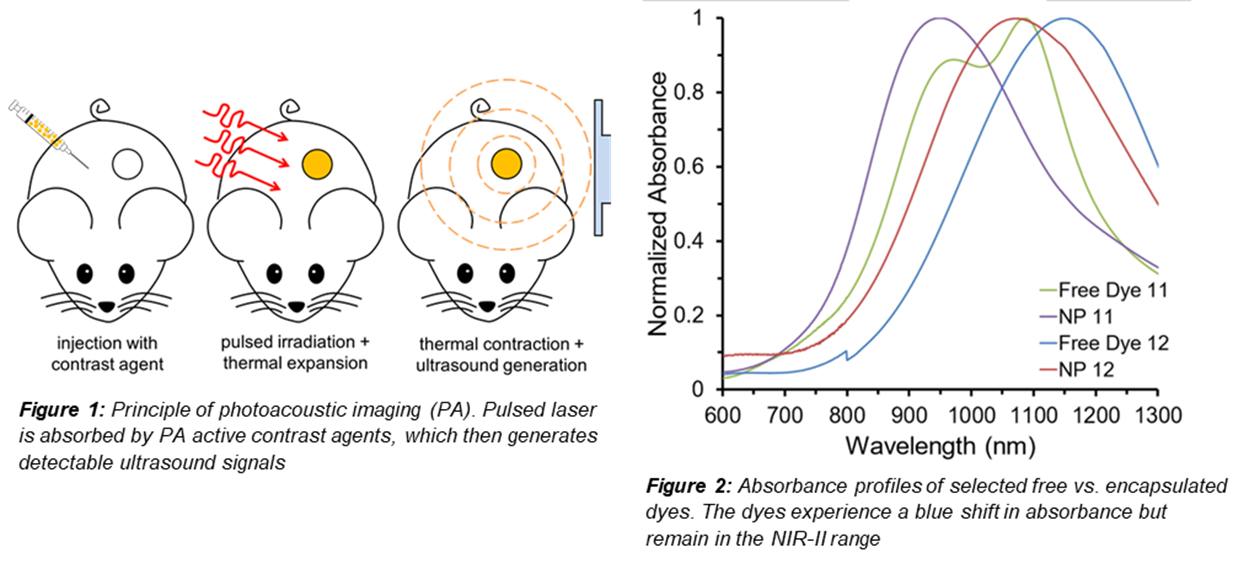
Developing technologies for cancer treatment and diagnosis is a vast yet very complex healthcare problem. New treatments are designed every day for each specific case of tumors, but cancer diagnosis technology has yet to keep up. This creates a situation where many treatments options are available but physicians are unable to select the best course of action due to limited information on tumor morphology. This lack of a fast, inexpensive, and safe method to image cancers remains the current bottleneck for effective therapies. The upcoming light-sound hybrid imaging modality, photoacoustic imaging (PA), is already recognized for being able to produce high resolution images without the need for expensive machinery and ionizing radiation. To maximize imaging depth and reduce signal attenuation, there is a drive to develop photoacoustic contrast agents that absorb in the Near Infrared II (900-2000nm) ranges. We here present the development of stable NIR-II active nanoparticles (NPs), utilizing the controlled self-assembly mechanism, Flash Nanoprecipitation (FNP). After screening potential NIR-II dyes, 10 distinct dye-encapsulated NPs were developed with sizes ranging from 20 to 180nm. These results shed light on the molecular requirements for nanoencapsulation into stable particles. NP sizes could be precisely tuned with co-core material, whereas the absorbance profiles remained constant. Thus, the addition of co-core material can be used to tune bulk properties and nanoparticle accumulation via EPR to tumors or clearance through the liver and spleen, while keeping the imaging properties constant. When kept frozen and in the dark, NIR-II dye NPs were determined to be stable for up to 7 days, and are thus suitable for long-term storage and use. While there was slight blue-shifts in the dyes’ absorbance due to H-stacking after encapsulation, these particles exhibited strong NIR-II photoacoustic activity in the 1200-1300 nm region, where water and background signals are negligible. These particles represent the first successful incorporation of NIR-II active organic dye into NPs as contrast agents for PA imaging.
See more of this Group/Topical: Food, Pharmaceutical & Bioengineering Division