
Fe catalysts are of great interest as they have been shown to be highly selective for the catalytic upgrading, via hydrodeoxygenation (HDO), of bio-oil compounds. Unfortunately, these catalysts alone are unacceptably prone to oxidative deactivation. One method of improving the oxidation resistance of Fe catalysts has been to dope the Fe with a second metal (e.g. Pd, Pt, etc.). However, the addition of the second metal increases the catalyst cost and complexity, thereby making it harder to experimentally optimize such systems to both increase activity and prevent oxidative deactivation. Previous work has shown that externally applied electric fields can dramatically improve the coke resistance of a Ni catalyst used in methane steam reforming (MSR).6-9 These results suggest that external electric fields are another adjustable parameter that can be used to increase activity, tune selectivity, or prevent catalyst deactivation. Due to the highly polar nature of oxygen-containing compounds, it is expected that electric fields will have a large effect on HDO and could potentially be used in conjunction with doping to create a highly stable and selective Fe-based HDO catalyst. To this end, we must develop multi-scale models that can guide the selection of dopants in a rational manner—with both surface coverage and electric fields explicitly accounted for.
Here, we develop density functional theory (DFT) parameterized lattice gas models of oxygen on both undoped and doped Fe(100) surfaces to show the direct effect of an applied electric field on oxygen adsorption. Typical DFT models consider a uniform coverage distribution of adsorbates on the surface, when in reality, this is not the case.2-4 Our cluster expansions of oxygen on Fe(100) surfaces both with and without an externally applied electric field accounts for the more realistic non-uniform adsorbate distributions and characterizes the lateral interactions between oxygen adatoms.5 The apparent sensitivity of the lateral interactions on an applied external electric field reveals their influence on the oxidative deactivation of Fe catalysts.
Our preliminary results for O/Fe(100) indicate that an applied electric field has a significant effect on the attractive/repulsive interactions between adsorbed oxygen atoms. As seen in Figure 1, the clusters that are most important to the predictiveness of the model also change after the application of an electric field. These changes suggests that electric fields will have major effects on the Fe oxidation process as the electric field has a significant effect on the dynamic surface behavior of oxygen. Using such a lattice gas model for oxygen on both undoped and doped Fe(100), we will characterize the synergy between surface dopants and external electric fields in order to minimize the oxidation potential of the Fe surface. Our preliminary results suggest that one can expect significant deviations in catalytic activity after the application of external electric fields, but also, they suggest that mean-field models will not be sufficiently predictive for the work needed moving forward. Overall, the work presented here provides the first ingredients necessary for the selection of potential dopants for optimizing Fe-based HDO catalysts in the presence of external electric fields.
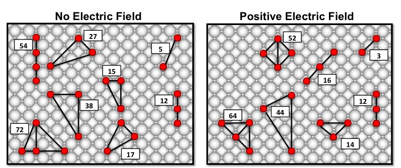
Figure 1: Effect of an electric field on oxygen cluster lateral interactions on the Fe(100) surface.
References:
1. Wang, H., Male, J. & Wang, Y. Recent Advances in Hydrotreating of Pyrolysis Bio-Oil and Its Oxygen-Containing Model Compounds. ACS Catal. 3, 1047–1070 (2013).
2. Govender, A., Curulla Ferré, D. & Niemantsverdriet, J. W. The Surface Chemistry of Water on Fe(100): A Density Functional Theory Study. ChemPhysChem 13, 1583–1590 (2012).
3. Błoński, P., Kiejna, A. & Hafner, J. Theoretical study of oxygen adsorption at the Fe (110) and (100) surfaces. Surface Science 590, 88–100 (2005).
4. Freitas, R. R. Q., Rivelino, R., de Brito Mota, F. & de Castilho, C. M. C. Dissociative Adsorption and Aggregation of Water on the Fe(100) Surface: A DFT Study. J. Phys. Chem. C 116, 20306–20314 (2012).
5. Frey, K., Schmidt, D. J. & Wolverton, C. Implications of coverage-dependent O adsorption for catalytic NO oxidation on the late transition metals. Catalysis Science & … (2014). doi:10.1039/C4CY00763H
6. Che, F., Gray, J. T., Ha, S. & McEwen, J.-S. Improving Ni Catalysts Using Electric Fields: A DFT and Experimental Study of the Methane Steam Reforming Reaction. ACS Catal. (2016). doi:10.1021/acscatal.6b02318
7. Che, F., Ha, S., McEwen, J. S., Hensley, A. J. & Zhang, R. Elucidating the Role of the Electric Field at the Ni/YSZ Electrode: A DFT Study. J. Phys. Chem. C (2016). doi:10.1021/acs.jpcc.6b01292
8. Che, F., Ha, S. & McEwen, J. S. Hydrogen Oxidation and Water Dissociation over an Oxygen-Enriched Ni/YSZ Electrode in the Presence of an Electric Field: A First Principles-Based Microkinetic …. Industrial & Engineering Chemistry … (2017). doi:10.1021/acs.iecr.6b04028
9. Che, F., Gray, J. T., Ha, S. & McEwen, J. S. Catalytic water dehydrogenation and formation on nickel: Dual path mechanism in high electric fields. Journal of Catalysis (2015). doi:10.1016/j.jcat.2015.09.010
See more of this Group/Topical: Catalysis and Reaction Engineering Division