
Experimental and Modeling Studies of Cycle Frequency, Reductant Type and Non-isothermal Effect on the Performance of a Lean NOx Trap
Allen Wei-Lun Ting, Michael P. Harold and Vemuri Balakotaiah
Department of Chemical & Biomolecular Engineering, University of Houston, Houston, TX 77204, USA
Abstract
The ¡§Di-Air¡¨ system proposed by Toyota researchers shows an overall increase in NOx conversion when using propene as the reductant under fast cycling [1]. In order to clarify this mechanism, a combined experimental and modeling study of fast cycling NOx storage and reduction for emissions control of lean burn gasoline and diesel vehicles is conducted to provide mechanistic insight. NOx generation pathways are analyzed by using H2 and C3H6 as reductants, under different cycle frequencies, and under near-isothermal and non-isothermal conditions. LNT (lean NOx trap) catalysts containing Pt/BaO/CeO2/Al2O3 are used in the monolithic reactor experiments. A 1-D two phase model that includes washcoat diffusional effects is used to simulate the cyclic experimental results to provide more details such as the spatio-temporal concentration, site saturation, and temperature profiles.
The mechanism of Di-Air system has been receiving great attention for its NOx conversion enhancement at both low and high feed temperature only by increasing the cycle frequency. The HC-intermediate pathway from which short-lived HC intermediates generated is thought to play important role in this novel system. The essence of this pathway is as follows: The intermediates form from reaction between NOx and propylene and are able to survive through the rich period even at high temperature and reduce NOx in the early lean period. Therefore, the goal of this work is to investigate how this HC-intermediate pathway enhances the NOx conversion.
By feeding H2 or C3H6 as the reductant agents by same reductivity in stoichiometry, the NOx regeneration pathway and the HC NOx regeneration pathway can be compared. Due to the different molecular characteristics of H2 and C3H6, the thermal effect under a non-isothermal environment (aerobic rich feed condition) is studied. The much larger molecular diffusivity of H2 compared to C3H6 shortens the reaction zone. This is observed by measuring the temperature in the front quarter and third quarter of the monolith reactor. Fig. 1a shows a sharper temperature rise and larger axial temperature gradient when using H2 than C3H6 under slow cycling. A 60 oC higher temperature rise (250~280 oC for H2) is measured in the first quarter of the monolith under slow cycling when using H2. This reduces the NOx storage capacity during the early lean period and results in a 10 to 15 % lower NOx conversion, as shown in Fig. 2.
Fast cycling when using H2 as the reductants has been thoroughly studied in our previous work, exhibiting a better usage of storage sites and a near-steady-state axial temperature profile comparing to slow cycling. However, under fast cycling these is no difference when using H2 and C3H6 in axial temperature profiles (Fig. 1b), so the previously mentioned thermal effect doesn¡¦t exist under fast cycling. Only a 5 ¡V 10 % NOx conversion enhancement can be found when using C3H6. This may be contributed from the HC-intermediate mechanism.
In addition to the thermal effect, steam reforming of propylene may also play an important role in NOx regeneration pathways because it converts C3H6 to CO and H2 through H2O, and oxidation reactions in such non-isothermal environment produces a lot of water.
Therefore, experiments under near-isothermal condition (anaerobic rich feed) with no H2O in feed were conducted. Fig. 3 shows that the NOx conversions are very similar under this near-isothermal condition at temperatures higher than the ignition temperature. Under fast cycling the enhancement of NOx conversion using C3H6 is less than 5 %.
This concludes that the NOx conversion enhancement of Di-air system mainly results from the thermal effect, and HC-intermediate mechanism is relatively minor.
Reference:
[1] Y. Bisaiji, K. Yoshida, M. Inoue, N. Takagi, T. Fukuma, Development of Di-Air - A New Diesel deNOx System by Adsorbed Intermediate Reductants, SAE Int. J. SAE Int. J. Fuels Lubr. 5 (2012) 380¡V388.
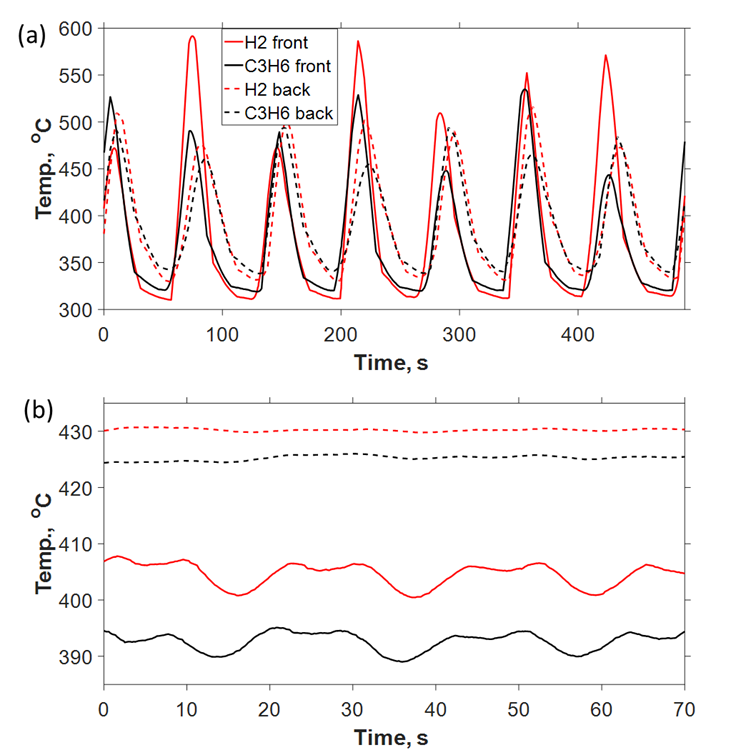
Fig. 1 The temperature measured at first quarter (solid line) and third quarter (dashed line) of the catalyst under 305 oC feed temperature for H2 (red) and C3H6 case (black) under slow cycling (a, 60/10 s) and fast cycling (b, 6/1 s). Feed condition: Lean: 5 % O2, Rich: 2.5% O2, 9 % H2/ 1 % C3H6, Both: 5% CO2.
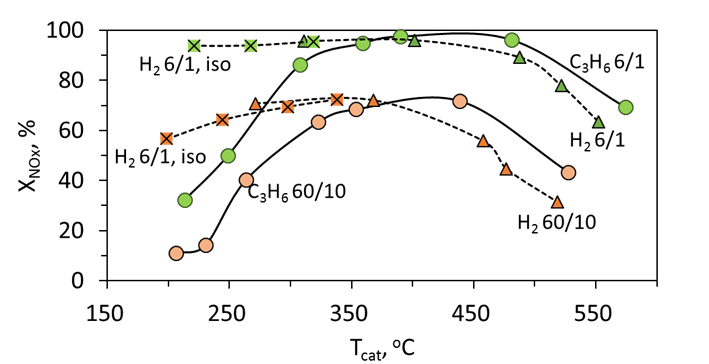
Fig. 2 Cycle-averaged NOx conversion with different cycle-averaged catalyst temperature, cycling frequency using H2 and C3H6 as the reductant under non-isothermal condition. Feed condition: Both: 5 % CO2, 500 ppm NO. Lean: 5 % O2, Rich: 9 % H2/ 1 % C3H6, 2.5 % O2.
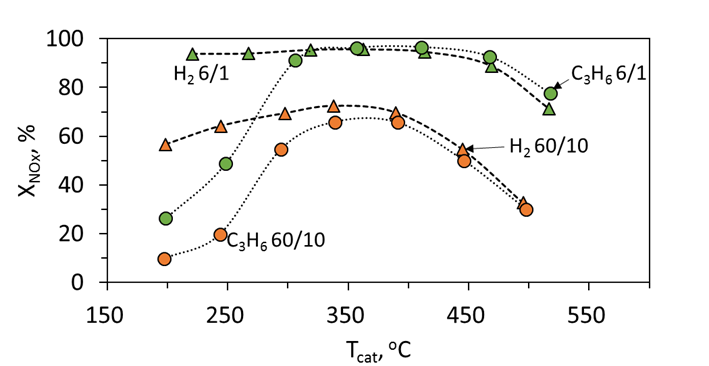
Fig. 3 Cycle-averaged NOx conversion with different cycle-averaged catalyst temperature, cycling frequency using H2 and C3H6 as the reductant under near-isothermal condition. Feed condition: Both: 5 % CO2, 500 ppm NO. Lean: 5 % O2, Rich: 4 % H2/ 4445 ppm C3H6.
See more of this Group/Topical: Catalysis and Reaction Engineering Division