
Nanoantenna enhanced wavelength mixing in monolayer transition metal dichalcogenide
D. Keith Ropera,b*, Greg Forcherioc, Mourad Benamarad, Luigi Bonacinae
a Microelectronics and Photonics Graduate Program, University of Arkansas, Fayetteville, AR 72701
b Department of Chemical Engineering, University of Arkansas, Fayetteville, AR 72701
cArmy Research Laboratory, Adelphi, MD 20783
dInstitute for Nanoscience and Engineering, University of Arkansas, Fayetteville, AR 72701
e GAP-Biophotonics, Université de Genève, Genève, CH 1211
Monolayer (1L) transition metal dichalcogenide (TMD) crystals offer compelling new functionalities, e.g., gate tunability of p-n junction, valleytronics and anti-ambipolarity as well as unique optical, electronic and transport properties attributable to distinct atom-scale heterointerfaces. These features could enable atomically-thin flexible integrated circuits, field effect transistors and closed-loop resonators. However, present utility of 2D semiconductors is limited by difficulty in tuning their optoelectronic properties.
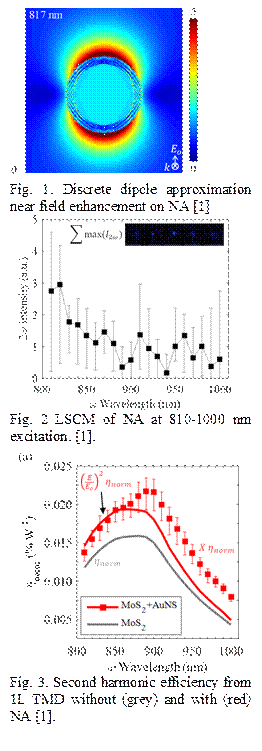
This work compared wavelength mixing at heterointerfaces of 1LTMD exhibiting broken inversion symmetry with and without an adjacent resonant nanoantenna (NA). Heterostructures of 1LTMD and NA were self-assembled via exfoliation and dropcasting. Nanometer- and femtosecond-resolved electron energy loss spectroscopy (EELS) was used to simulate and measure low-energy NA plasmon modes, damping and electric near fields at heterointerfaces. Discrete dipole approximation (DDA) was used to predict and induce bright, dark, and hybrid modes, damping, and electromagnetic near fields (Fig. 1). EELS allowed quantitative femtosecond-scale measurement of spectroscopic plasmon dephasing and nanometer-resolved mapping of electric fields on the NA and 2DNC-NA hybrids. A tunable laser scanning confocal microscope (LSCM) was used to measure wavelength mixing of NA, TMD and TMD-NA heterostructures (Fig. 2). Hyper Rayleigh Scattering (HRS) was used to measured second order nonlinear coefficient of NA-1LTMD. From HRS and LSCM data, values of second harmonic efficiency were compared for TMD and TMD-NA heterostructures. A computational scaffold supporting analysis spanning atom to nanometer scales was used to develop compact structure-function relations in order to rationalize measured values.
Coordination of DDA, EELS, LSCM and HRS supports comprehensive characterization of wavelength mixing in 1LTMD and 1LTMD-NA heterostructures at high spatiotemporal resolution.
[1] G.T. Forcherio and D.K. Roper et al., in preparation.
See more of this Group/Topical: Materials Engineering and Sciences Division